DAMASCUS: Syrian pro-government forces now hold more than a fifth of the country’s strategic desert, the army said Saturday, after reaching the eastern border with Iraq for the first time since 2015.
The desert, known as “Badiya,” extends over some 90,000 sq km from central Syria to the borders with Iraq and Jordan to the east and southeast.
Since 2015, much of the Badiya has been held by Daesh, but Syria’s army has been chipping away at it for months.
On Friday, they reached the country’s eastern frontier with Iraq for the first time in two years.
“In cooperation with our allies, our units have captured a large number of locations and strategic positions in the Badiya, amounting to an area of 20,000 square kilometers,” the general command of the army said on Saturday.
“This important achievement represents a strategic shift in the fight against terrorism and a launching pad to broaden military operations in the Badiya and along the borders with Iraq,” said the statement, distributed on state media.
The army had thus completed the “first phase” of its Badiya operations, the statement said.
State news agency SANA had reported on Friday that army units set up positions northeast of the Al-Tanaf garrison, currently used by the US-led coalition bombing Daesh, to train Syrian fighters to fight the militants.
The coalition has established a “de-confliction” zone extending 55 km from the garrison, in which pro-regime and allied Russian forces are not supposed to operate.
The US-led alliance has in recent weeks conducted three strikes against pro-regime forces it deemed to be threatening Al-Tanaf.
On Thursday, a US jet shot down a pro-regime combat drone that fired what turned out to be a dud bomb at US-led coalition forces close to Al-Tanaf.
Syria’s army on Saturday accused the coalition of carrying out the bombing raids in an attempt to slow the regime’s fight against Daesh.
“We once again warn of the dangers of repeated attacks by the so-called international coalition and its attempts to obstruct the advances of the Syrian army and its allies,” the command said.
Syria’s conflict erupted in March 2011 with protests against the rule of President Bashar Assad.
It has since evolved into a complex, multi-front war that has drawn in international powers and left more than 320,000 people dead.


![]()
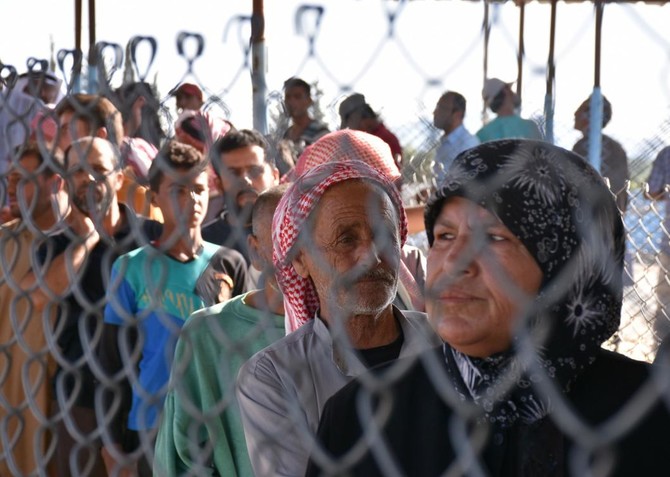

Syria army says it holds fifth of key desert territory
Syria army says it holds fifth of key desert territory
School materials enter Gaza after being blocked for two years, UN agency says
- Thousands of kits, including pencils, exercise books and wooden cubes to play with, have now entered the enclave, UNICEF said
GENEVA: The UN children’s agency said on Tuesday it had for the first time in two-and-a-half years been able to deliver school kits with learning materials into Gaza after they were previously blocked by Israeli authorities.
Thousands of kits, including pencils, exercise books and wooden cubes to play with, have now entered the enclave, UNICEF said.
“We have now, in the last days, got in thousands of recreational kits, hundreds of school-in-a-carton kits. We’re looking at getting 2,500 more school kits in, in the next week, because they’ve been approved,” UNICEF spokesperson James Elder said.
COGAT, the arm of the Israeli military that oversees aid flows into the Gaza Strip, did not immediately respond to a request for comment.
Children in Gaza have faced an unprecedented assault on the education system, as well as restrictions on the entry of some aid materials, including school books and pencils, meaning teachers had to make do with limited resources, while children tried to study at night in tents without lights, Elder said. During the conflict some children missed out on education altogether, facing basic challenges like finding water, as well as widespread malnutrition, amid a major humanitarian crisis.
“It’s been a long two years for children and for organizations like UNICEF to try and do that education without those materials. It looks like we’re finally seeing a real change,” Elder stated. UNICEF is scaling up its education to support half of children of school age — around 336,000 — with learning support. Teaching will mainly happen in tents, Elder said, due to widespread devastation of school buildings in the enclave during the war which was triggered by Hamas’ assault on Israel on October 2023.
At least 97 percent of schools sustained some level of damage, according to the most recent satellite assessment by the UN in July.
Israel has previously accused Hamas and other militant groups of systematically embedding in civilian areas and structures, including schools, and using civilians as human shields. The bulk of the learning spaces supported by UNICEF will be in central and southern areas of the enclave, as it remains difficult to operate in the north, parts of which were badly destroyed in the final months of the conflict, Elder said.
The Hamas-led attack in October 2023 killed 1,200 people, according to Israeli tallies. Israel’s assault has killed 71,000 Palestinians, Gaza’s health authorities say. More than 20,000 children were reported killed, including 110 since the October 10 ceasefire last year, UNICEF said, citing official data.
Thousands of kits, including pencils, exercise books and wooden cubes to play with, have now entered the enclave, UNICEF said.
“We have now, in the last days, got in thousands of recreational kits, hundreds of school-in-a-carton kits. We’re looking at getting 2,500 more school kits in, in the next week, because they’ve been approved,” UNICEF spokesperson James Elder said.
COGAT, the arm of the Israeli military that oversees aid flows into the Gaza Strip, did not immediately respond to a request for comment.
Children in Gaza have faced an unprecedented assault on the education system, as well as restrictions on the entry of some aid materials, including school books and pencils, meaning teachers had to make do with limited resources, while children tried to study at night in tents without lights, Elder said. During the conflict some children missed out on education altogether, facing basic challenges like finding water, as well as widespread malnutrition, amid a major humanitarian crisis.
“It’s been a long two years for children and for organizations like UNICEF to try and do that education without those materials. It looks like we’re finally seeing a real change,” Elder stated. UNICEF is scaling up its education to support half of children of school age — around 336,000 — with learning support. Teaching will mainly happen in tents, Elder said, due to widespread devastation of school buildings in the enclave during the war which was triggered by Hamas’ assault on Israel on October 2023.
At least 97 percent of schools sustained some level of damage, according to the most recent satellite assessment by the UN in July.
Israel has previously accused Hamas and other militant groups of systematically embedding in civilian areas and structures, including schools, and using civilians as human shields. The bulk of the learning spaces supported by UNICEF will be in central and southern areas of the enclave, as it remains difficult to operate in the north, parts of which were badly destroyed in the final months of the conflict, Elder said.
The Hamas-led attack in October 2023 killed 1,200 people, according to Israeli tallies. Israel’s assault has killed 71,000 Palestinians, Gaza’s health authorities say. More than 20,000 children were reported killed, including 110 since the October 10 ceasefire last year, UNICEF said, citing official data.
Latest updates


© 2026 SAUDI RESEARCH & PUBLISHING COMPANY, All Rights Reserved And subject to Terms of Use Agreement.