JEDDAH: The commander of the east Libyan forces has accused Qatar and other countries of supporting terrorist organizations linked to Al-Qaeda in Libya.
Field Marshal Khalifa Haftar, leader of the Libyan National Army (LNA), said some other countries were also aiding terror outfits, but he did not name them.
Haftar said on Sunday that the LNA is monitoring foreign communities in Libya who, he said, entered the country because of lack of border control.
These communities are “supported by regional countries and terrorism-sponsoring countries,” he said, specifically naming Qatar.
He said these countries fund militias fighting on Libyan soil, according to local media sources close to Haftar, including Iwan Libya.
He said some of these figures received “sums of money from Qatar and other countries, and from terrorist elements represented by some terrorist militias in Libya, linked to Al-Qaeda.”
Haftar added that Libya welcomes the presence of foreign communities that contribute to the country’s development.
He stressed that relations with them are based on neighborly ties, but “if they engage in terrorism and fighting on Libyan soil, Libyan forces will limit their activities and hold them accountable.”
He reiterated that “the armed forces are monitoring them, and that they will be firmly dealt with by security agencies.”
He added that foreigners in Libya are not allowed to own weapons, even if they claim to be helping the Libyan people. “Any foreigner who carries weapons in Libya will be arrested and fought — collectively or individually.”
Haftar also announced that his forces have started preparations for the battle to defend Tripoli.
“Militias representing militant political Islam lost control of the capital Tripoli; they deviated from the national path and started destroying institutions and citizens’ property. They began using heavy weaponry in the capital with no regard to the safety and security of citizens,” he said.
He called on regional countries, Arab League and the international community to support the Libyan people and their armed forces to protect and save Libya and the Libyan people, “who are being threatened, killed and raped by criminal gangs.”
Haftar also instructed units of the armed forces in the western region “to prepare for the defense of Tripoli, fight terrorism, expel and destroy terrorist bases and help the national forces defend the capital.”
He also called on the leaders of the armed forces “to declare a state of emergency in all sectors, government institutions and units in order to prepare for the confrontation and protect the defenseless citizen.”


![]()
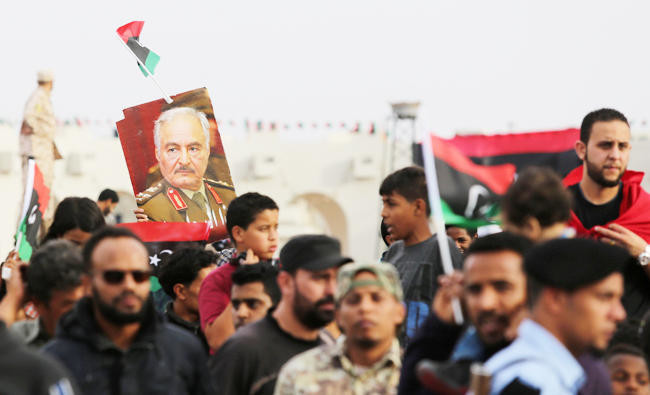

Haftar: Doha aiding terror outfits in Libya
Haftar: Doha aiding terror outfits in Libya


School materials enter Gaza after being blocked for two years, UN agency says
- Thousands of kits, including pencils, exercise books and wooden cubes to play with, have now entered the enclave, UNICEF said
GENEVA: The UN children’s agency said on Tuesday it had for the first time in two-and-a-half years been able to deliver school kits with learning materials into Gaza after they were previously blocked by Israeli authorities.
Thousands of kits, including pencils, exercise books and wooden cubes to play with, have now entered the enclave, UNICEF said.
“We have now, in the last days, got in thousands of recreational kits, hundreds of school-in-a-carton kits. We’re looking at getting 2,500 more school kits in, in the next week, because they’ve been approved,” UNICEF spokesperson James Elder said.
COGAT, the arm of the Israeli military that oversees aid flows into the Gaza Strip, did not immediately respond to a request for comment.
Children in Gaza have faced an unprecedented assault on the education system, as well as restrictions on the entry of some aid materials, including school books and pencils, meaning teachers had to make do with limited resources, while children tried to study at night in tents without lights, Elder said. During the conflict some children missed out on education altogether, facing basic challenges like finding water, as well as widespread malnutrition, amid a major humanitarian crisis.
“It’s been a long two years for children and for organizations like UNICEF to try and do that education without those materials. It looks like we’re finally seeing a real change,” Elder stated. UNICEF is scaling up its education to support half of children of school age — around 336,000 — with learning support. Teaching will mainly happen in tents, Elder said, due to widespread devastation of school buildings in the enclave during the war which was triggered by Hamas’ assault on Israel on October 2023.
At least 97 percent of schools sustained some level of damage, according to the most recent satellite assessment by the UN in July.
Israel has previously accused Hamas and other militant groups of systematically embedding in civilian areas and structures, including schools, and using civilians as human shields. The bulk of the learning spaces supported by UNICEF will be in central and southern areas of the enclave, as it remains difficult to operate in the north, parts of which were badly destroyed in the final months of the conflict, Elder said.
The Hamas-led attack in October 2023 killed 1,200 people, according to Israeli tallies. Israel’s assault has killed 71,000 Palestinians, Gaza’s health authorities say. More than 20,000 children were reported killed, including 110 since the October 10 ceasefire last year, UNICEF said, citing official data.
Thousands of kits, including pencils, exercise books and wooden cubes to play with, have now entered the enclave, UNICEF said.
“We have now, in the last days, got in thousands of recreational kits, hundreds of school-in-a-carton kits. We’re looking at getting 2,500 more school kits in, in the next week, because they’ve been approved,” UNICEF spokesperson James Elder said.
COGAT, the arm of the Israeli military that oversees aid flows into the Gaza Strip, did not immediately respond to a request for comment.
Children in Gaza have faced an unprecedented assault on the education system, as well as restrictions on the entry of some aid materials, including school books and pencils, meaning teachers had to make do with limited resources, while children tried to study at night in tents without lights, Elder said. During the conflict some children missed out on education altogether, facing basic challenges like finding water, as well as widespread malnutrition, amid a major humanitarian crisis.
“It’s been a long two years for children and for organizations like UNICEF to try and do that education without those materials. It looks like we’re finally seeing a real change,” Elder stated. UNICEF is scaling up its education to support half of children of school age — around 336,000 — with learning support. Teaching will mainly happen in tents, Elder said, due to widespread devastation of school buildings in the enclave during the war which was triggered by Hamas’ assault on Israel on October 2023.
At least 97 percent of schools sustained some level of damage, according to the most recent satellite assessment by the UN in July.
Israel has previously accused Hamas and other militant groups of systematically embedding in civilian areas and structures, including schools, and using civilians as human shields. The bulk of the learning spaces supported by UNICEF will be in central and southern areas of the enclave, as it remains difficult to operate in the north, parts of which were badly destroyed in the final months of the conflict, Elder said.
The Hamas-led attack in October 2023 killed 1,200 people, according to Israeli tallies. Israel’s assault has killed 71,000 Palestinians, Gaza’s health authorities say. More than 20,000 children were reported killed, including 110 since the October 10 ceasefire last year, UNICEF said, citing official data.
Latest updates


© 2026 SAUDI RESEARCH & PUBLISHING COMPANY, All Rights Reserved And subject to Terms of Use Agreement.