Egypt launches air raids on Libya after Christians killed

1 / 2
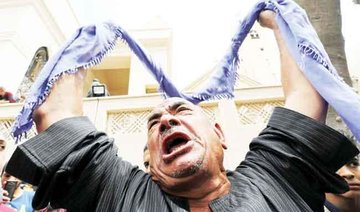
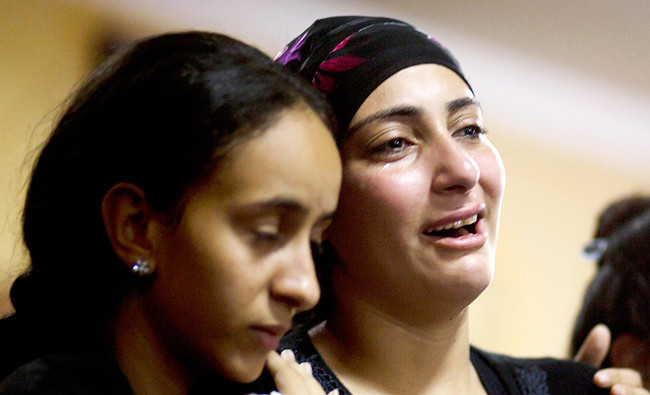
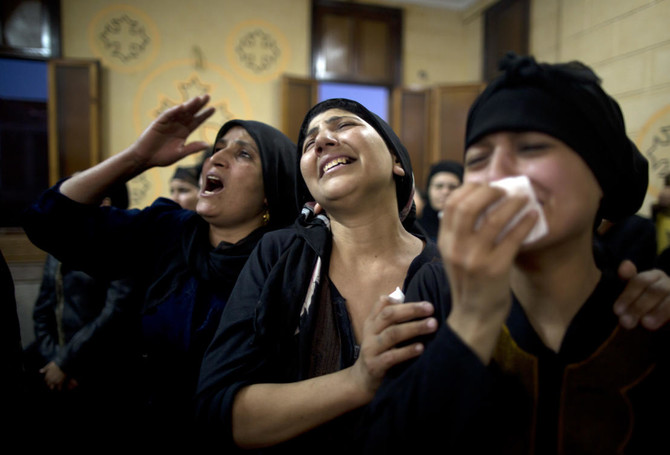
Relatives of Coptic Christians killed during a bus attack react during their funeral service, at Abu Garnous Cathedral in Minya, Egypt, on Friday. (AP)
2 / 2
Relatives of killed Coptic Christians grieve during their funeral at Abu Garnous Cathedral in Minya, Egypt. (AP)
Updated 27 May 2017
Follow

Egypt launches air raids on Libya after Christians killed

MINYA, Egypt: Egyptian fighter jets carried out strikes on Friday directed at camps in Libya which Cairo says have been training militants who killed dozens of Christians earlier in the day.
President Abdel Fattah El-Sisi said he had ordered strikes against what he called terrorist camps, declaring in a televised address that states that sponsored terrorism would be punished.
Egyptian military sources said six strikes took place near Derna in eastern Libya at around sundown, hours after masked gunmen attacked a group of Coptic Christians traveling to a monastery in southern Egypt, killing 29 and wounding 24.
The Egyptian military said the operation was ongoing and had been undertaken once it had been ascertained that the camps had produced the gunmen behind the attack on the Coptic Christians in Minya, southern Egypt, on Friday morning.
“The terrorist incident that took place today will not pass unnoticed,” Sissi said. “We are currently targeting the camps where the terrorists are trained.”
He said Egypt would not hesitate to carry out further strikes against camps that trained people to carry out operations against Egypt, whether those camps were inside or outside the country.
Egyptian military footage of pilots being briefed and war planes taking off was shown on state television.
East Libyan forces said they participated in the air strikes, which had targeted forces linked to Al-Qaeda at a number of sites, and would be followed by a ground operation.
A resident in Derna heard four powerful explosions, and told Reuters that the strikes had targeted camps used by fighters belonging to the Majlis Al-Shoura militant group.
Majlis Al-Shoura spokesman Mohamed Al-Mansouri said in a video posted online that the Egyptian air strikes did not hit any of the group’s camps, but instead hit civilian areas.
There was no immediate claim of responsibility for the attack on the Christians, which followed a series of church bombings claimed by Daesh in a campaign of violence against the Copts.
Daesh supporters reposted videos from earlier this year urging violence against the Copts in Egypt.
At a nearby village, thousands later attended a funeral service that turned into an angry protest against the authorities’ failure to protect Christians.
“We will avenge them or die like them,” mourners said, while marching with a giant wooden cross.

GUNFIRE AND BLOOD
Eyewitnesses said masked men opened fire after stopping the Christians, who were in a bus and other vehicles on a desert road. Local TV channels showed a bus apparently raked by gunfire and smeared with blood.
Clothes and shoes could be seen lying in and around the bus, while the bodies of some of the victims lay in the sand nearby, covered with black sheets.
Eyewitnesses said three vehicles were attacked. First to be hit was a vehicle taking children to the monastery as part of a church-organized trip, and another vehicle taking families there.
The gunmen boarded the vehicles and shot all the men and took all the women’s gold jewelry. They then shot women and children in the legs.
When one of the gunmen’s vehicles got a flat tire they stopped a truck carrying Christian workers, shot them, and took the truck.
One of the gunmen recorded the attack on the Copts with a video camera, eyewitnesses said.
The attack took place on a road leading to the monastery of Saint Samuel the Confessor in Minya province, which is home to a sizeable Christian minority.
Security forces launched a hunt for the attackers, setting up dozens of checkpoints and patrols on the desert road.
Police armed with assault rifles formed a security perimeter around the attack site while officials from the public prosecutor’s office gathered evidence. Heavily armed special forces arrived later wearing face masks and body armor.
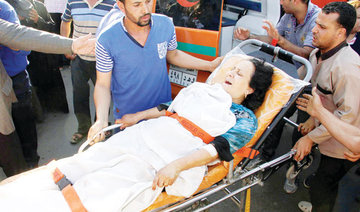
The injured were taken to local hospitals and some were being transported to Cairo. The Health Ministry said that among those injured were two children aged two.
US President Donald Trump, who has made a point of improving relations with Cairo, said his country stood with Sissi and the Egyptian people.
“This merciless slaughter of Christians in Egypt tears at our hearts and grieves our souls,” Trump said.
The Grand Imam of Al-Azhar, Egypt’s 1,000-year-old center of Islamic learning, said the attack was intended to destabilize the country.
“I call on Egyptians to unite in the face of this brutal terrorism,” Ahmed Al-Tayeb said. The Grand Mufti of Egypt, Shawki Allam, condemned the perpetrators as traitors.
The head of the Coptic Christian church, Pope Tawadros, who spoke with Sissi after the attack, said it was “not directed at the Copts, but at Egypt and the heart of the Egyptians.”
Pope Francis, who visited Cairo a month ago, described the attack as a “senseless act of hatred.”

ONGOING PERSECUTION
Coptic Christians, whose church dates back nearly 2,000 years, make up about 10 percent of Egypt’s population of 92 million.
They say they have long suffered from persecution, but in recent months the frequency of deadly attacks against them has increased. About 70 have been killed since December in bombings claimed by Daesh at churches in the cities of Cairo, Alexandria and Tanta.
A Daesh campaign of murders in North Sinai prompted hundreds of Christians to flee in February and March.
Copts fear they will face the same fate as brethren in Iraq and Syria, where Christian communities have been decimated by wars and Daesh persecution.
Egypt’s Copts are vocal supporters of Sissi, who has vowed to crush extremism and protect Christians. He declared a three-month state of emergency in the aftermath of the church bombings in April.
But many Christians feel the state either does not take their plight seriously enough or cannot protect them against determined fanatics.
The government is fighting insurgents affiliated with Daesh who have killed hundreds of police and soldiers in the Sinai Peninsula, while also carrying out attacks elsewhere in the country.


US Embassy resumes mechanism meetings ‘at full capacity’

US Embassy building in Awkar east of Beirut on June 23, 2025. (AFP)
Updated 11 sec ago
Follow

US Embassy resumes mechanism meetings ‘at full capacity’

  • Next meeting is scheduled for Feb. 25, settling debate in Lebanon over committee’s fate after postponement of January session
  • Beirut hopes resumption will allow US to press Israel for concessions in return for commitments to ceasefire security terms

BEIRUT: The US Embassy in Beirut said on Friday that the mechanism committee will meet on Feb. 25 to discuss next steps on Lebanon’s security.

The US-led five-member committee was established in the wake of the Israel-Hezbollah war in late 2024.

In a statement issued jointly with US Central Command, the embassy said that “the military coordination framework, as established in the cessation of hostilities agreement outlined on Nov. 27, 2024, remains fully in place and is operating at full capacity, with the same goals, participants and leadership.”

The embassy also listed upcoming meetings dates for March 25, April 22 and May 20, saying “these engagements will continue to serve as the primary forum for military coordination among the participating parties,” and adding that the mechanism will remain the key platform for such coordination.

A committee meeting had been tentatively scheduled for Feb. 18, but the participating parties did not receive official confirmation from the US.

A Lebanese official told Arab News that the Feb. 25 meeting would be limited to military personnel, with no civilian participation. “The US Embassy’s statement emphasized the participation of all parties, including the French side,” the source added.

The mechanism committee meetings constitute the only approved channel of communication for addressing military issues related to the cessation of hostilities between Lebanon and Israel.

The embassy’s announcement settled the debate in Lebanon over the committee’s fate after the postponement of a meeting scheduled for this month, amid Israeli pressure on Lebanon to convert civil negotiations into bilateral talks with US participation.

A Lebanese official closely following the work conducted by the mechanism committee previously told Arab News that there was “a structural crisis within the mechanism committee, specifically within the US delegation.”

The mechanism committee has held a series of meetings at the Ras Al-Naqoura border crossing. These meetings were described as technical and military in nature, and focused on establishing field communication mechanisms, addressing issues arising from violations, and ensuring continued coordination in line with the terms of the signed agreement. Civilian representatives from Lebanon and Israel were later added to the committee’s meetings.

At the beginning of December, Lebanon appointed former ambassador Simon Karam to head the Lebanese delegation to the Military Technical Committee for Lebanon. Karam attended meetings on two occasions, Dec. 3 and 19, during which he highlighted Lebanon’s demand that displaced residents be allowed to return to border villages as a prerequisite for discussing any economic buffer zone. A meeting scheduled for Jan. 14 was later postponed.

The Lebanese state hopes that the resumption of the mechanism’s meetings will enable the US to secure concessions from Israel in exchange for its commitment to the terms of the agreement to cease military operations, including the withdrawal from positions Israel still occupies inside Lebanese territory.

According to the official source, Lebanon is seeking through this request “to facilitate the next stages of the process of establishing the state monopoly on arms, particularly north of the Litani River.” The source said this followed the Lebanese army’s confiscation of illegal weapons south of the Litani, a step the US welcomed, while Hezbollah has refused to disarm north of the Litani line.

Another official source familiar with previous mechanism committee meetings said that “the Lebanese side stated that Israeli army violations on Lebanese territory provide Hezbollah with a justification to commit to its refusal to surrender its weapons.”

Lebanese army commander Gen. Rodolphe Haykal is scheduled to visit Washington next week, and will present to the Council of Ministers on Feb. 5 the next stages of the army’s plan to confine weapons between the Litani and Awali rivers.

According to the media office at the Presidential Palace, Lebanese President Joseph Aoun and Gen. Haykal reviewed on Friday the latest security developments in the south, amid repeated Israeli strikes and potential escalation risks along the border.

They also discussed Gen. Haykal’s meetings with US officials to “look into ways to support the army and coordinate on security issues at the border.”

Haykal also met Maj. Gen. Patrick Gauchat, head of mission and chief of staff of the UN Truce Supervision Organization at the command’s headquarters.

On Friday, an Israeli drone strike targeted a car in Seddiqin, Tyre, killing Mohammed Ahmad Youssef, the Lebanese Ministry of Health said.

Israeli army spokesman Avichay Adraee claimed that the strike was carried out in response to “Hezbollah violations,” accusing the party of “rebuilding itself.”

Israeli reconnaissance aircraft continued to fly over Beirut and its southern suburb throughout the day, in what Lebanon considered a violation of its airspace.

Meanwhile, the Lebanese army conducted armored patrols in the border town of Yaroun on Friday morning, after the Israeli army entered the town on Thursday night.