Israel guilty of more than 6,000 ceasefire violations in 3 months, Lebanon tells UN

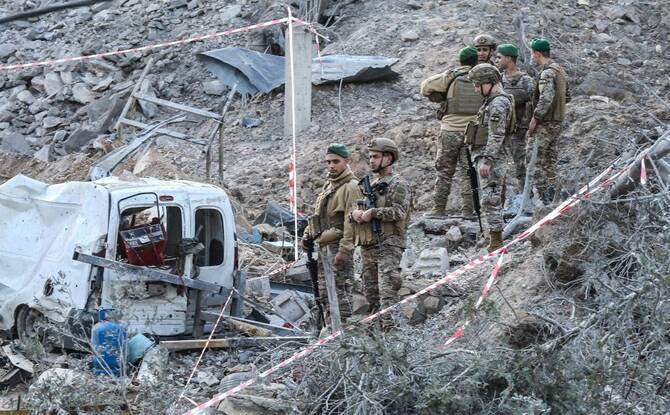
Lebanese soldiers inspect the scene following an Israeli airstrike that targeted a building in the southern Lebanese village of Kfar Dounine, Jan. 25, 2026. (AFP)
Short Url
Updated 27 January 2026
Follow

Israel guilty of more than 6,000 ceasefire violations in 3 months, Lebanon tells UN

  • Security Council informed of 1,542 land violations of Lebanese sovereignty, 3,911 air violations and 803 sea violations since November
  • Lebanon calls on council to compel Israel to halt hostile actions and fully withdraw from Lebanese territory it continues to occupy

NEW YORK CITY: Israel committed 6,256 violations of Lebanese sovereignty over a three-month period, Lebanon told the UN Security Council on Tuesday.

In a letter to council members seen by Arab News, Ahmed Arafa, the country’s permanent representative to the UN, said the breaches between November 2025 and January 2026 included 1,542 land violations, 3,911 air violations and 803 sea violations. Israel continues to commit such violations on a daily basis, he added.

The actions constitute a clear breach of Lebanon’s sovereignty, territorial integrity and political independence, and are a direct violation of Israel’s obligations under UN Security Council Resolution 1701, which ended the 2006 war between Israel and Hezbollah, Arafa said in his letter. They also represent a violation of the Nov. 26, 2024, cessation of hostilities declaration that ended the most recent war between Israel and Hezbollah, he added.

Lebanon called on the Security Council to compel Israel to fully implement Resolution 1701, cease its hostile actions, leave five areas of Lebanese territory it continues to occupy, and fully withdraw beyond Lebanon’s internationally recognized borders.

Arafa urged the council to halt Israel’s repeated violations of Lebanese sovereignty, secure the release of Lebanese prisoners, halt what he described as “threats to Lebanon’s territorial unity and political independence,” and put pressure on Israel to stop targeting the Lebanese Armed Forces, which he said continue to make “significant sacrifices to preserve security and stability in the region.”

He reaffirmed Beirut’s commitment to fulfilling its obligations under Resolution 1701, and to maintaining the cessation of hostilities with Israel.

In his letter, Arafa also noted that on Sept. 20, 2025, Lebanon’s Council of Ministers adopted a five-phase plan for the deployment of the Lebanese Armed Forces across the country to ensure that all weapons in the country are exclusively under state authority.

The plan aims to restore Lebanon’s sovereignty over its entire territory, ensure that “weapons remain solely in the hands of the Lebanese Armed Forces, and reinforce peace, security and stability in the region,” he added.

Lebanon further stressed the important need to end the Israeli occupation, implement the 1949 Armistice Agreement, adhere to the Arab Peace Initiative adopted at the 2002 Beirut Arab Summit, and respect Lebanon’s rights.


Fledgling radio station aims to be ‘voice of the people’ in Gaza

Updated 15 February 2026
Follow

Fledgling radio station aims to be ‘voice of the people’ in Gaza

  • The electricity crisis is one of the most serious and difficult problems in the Gaza Strip, says Shereen Khalifa Broadcaster

DEIR EL-BALAH: From a small studio in the central city of Deir El-Balah, Sylvia Hassan’s voice echoes across the Gaza Strip, broadcast on one of the Palestinian territory’s first radio stations to hit the airwaves after two years of war.

Hassan, a radio host on fledgling station “Here Gaza,” delivers her broadcast from a well-lit room, as members of the technical team check levels and mix backing tracks on a sound deck. “This radio station was a dream we worked to achieve for many long months and sometimes without sleep,” Hassan said.

“It was a challenge for us, and a story of resilience.”

Hassan said the station would focus on social issues and the humanitarian situation in Gaza, which remains grave in the territory despite a US-brokered ceasefire between Israel and Hamas since October.

“The radio station’s goal is to be the voice of the people in the Gaza Strip and to express their problems and suffering, especially after the war,” said Shereen Khalifa, part of the broadcasting team.

“There are many issues that people need to voice.” Most of Gaza’s population of more than 2 million people were displaced at least once during the gruelling war.

Many still live in tents with little or no sanitation.

The war also decimated Gaza’s telecommunications and electricity infrastructure, compounding the challenges in reviving the territory’s local media landscape. “The electricity problem is one of the most serious and difficult problems in the Gaza Strip,” said Khalifa.

“We have solar power, but sometimes it doesn’t work well, so we have to rely on an external generator,” she added.

The station’s launch is funded by the EU and overseen by Filastiniyat, an organization that supports Palestinian women journalists, and the media center at the An-Najah National University in Nablus, in the occupied West Bank.

The station plans to broadcast for two hours per day from Gaza and for longer from Nablus. It is available on FM and online.

Khalifa said that stable internet access had been one of the biggest obstacles in setting up the station, but that it was now broadcasting uninterrupted audio.

The Gaza Strip, a tiny territory surrounded by Israel, Egypt, and the Mediterranean Sea, has been under Israeli blockade even before the attack on Oct. 7, 2023, which sparked the war. Despite the ceasefire, Israel continues to strictly control the entry of all goods and people to the territory.

“Under the siege, it is natural that modern equipment necessary for radio broadcasting cannot enter, so we have made the most of what is available,” she said.