BERLIN: The scandal surrounding an attack plot hatched by two far-right soldiers has again forced Germany to confront its dark past — specifically, the role of the Wehrmacht in the Third Reich.
Defense Minister Ursula von der Leyen has ordered the Bundeswehr to cleanse itself of all links to the Nazi-era army that set the world aflame under Adolf Hitler over 70 years ago.
What seems like an obvious and belated step to many, given documented Wehrmacht atrocities in World War II especially on the eastern front, has also sparked criticism of a “witch hunt” and an unjust blanket condemnation of the conscript army.
Parliament was set to debate the sensitive historical question, brought to the fore by the arrests since last month of lieutenant Franco Albrecht, 28, and two alleged co-conspirators including another soldier.
In the bizarre case, far-right extremist Albrecht allegedly created the fake identity of a Syrian refugee who was granted asylum status, a bed in a shelter and welfare payments.
Prosecutors say Albrecht then planned to shoot a pro-refugee politician, possibly former President Joachim Gauck, and blame the murder on his fictious Syrian alter ego to stoke public fears about militant terror.
After Albrecht’s arrest, von der Leyen was incensed to learn that steel helmets and other memorabilia of the World War II army were openly on display at the Franco-German barracks where the army suspects were stationed.
Angry that earlier evidence of Albrecht’s far-right worldview had been ignored by superiors out of “a misunderstood esprit de corps,” she has ordered the Bundeswehr to sweep all barracks for Wehrmacht items and images.
“The Wehrmacht is not part of the tradition of the Bundeswehr,” said the minister who is often seen as a possible successor to Chancellor Angela Merkel.
She ordered a review of the army’s 1982 “decree on traditions” which allows displaying Wehrmacht items within their “historical context.”
She also said new names would have to be found for barracks still named after World War II figures, including field marshall Erwin Rommel, dubbed the “Desert Fox” for his North Africa campaign.
While there is mainstream condemnation for the Nazis, Gestapo and SS troops, the role of the millions-strong conscript army is more ambiguous in the minds of many Germans.
Hans-Peter Uhl of the conservative Christian Social Union (CSU) criticized von der Leyen’s “blanket condemnation” of all German soldiers of the era, urging some “respect for our fathers and grandfathers.”
The party’s parliamentary vice president, Johannes Singhammer, said they were “drafted under the reign of terror of the Nazis.”
Criticism also came from former defense minister Rudolf Scharping of the Social Democrats (SPD), who deplored the “witch hunt.”
He was angered by a decision of the Bundeswehr University in Hamburg to take a down a picture that showed former SPD chancellor Helmut Schmidt as a young Wehrmacht officer.
“That is cheap, it is outrageous,” Scharping wrote in a newspaper commentary, charging that “iconoclastic action does not make up a failure to deal with right-wing extremists in the ranks of the Bundeswehr.”
Theo Sommer, a former senior defense bureaucrat, labelled the sweep “an overreaction, which casts suspicion of Wehrmacht nostalgia over the entire armed forces.”
He added: “I won’t hide the photo of my father as a Wehrmacht soldier in a drawer.
“He served in Rommel’s Africa Corps and came back from the war with a belly shot — a brave, upright man who was abused by an ominous, criminal system. I see no reason to be ashamed of him.”
Von der Leyen has been undeterred, a position welcomed by many lawmakers and voters.
In the mid-1990s, traveling exhibitions extensively documented Wehrmacht war crimes against Jews, civilians and prisoners of war in eastern Europe and Russia.
More than one million people saw the exhibitions, which were frequently targeted by right-wing protests.
The minister has argued that the Bundeswehr should look at its own 60-year tradition in defense of a liberal democracy as a source of pride and meaning.
The Bundeswehr was founded as a purely defense military, but this has since the 1990s been interpreted to cover peacekeeping and conflict prevention abroad.
The now 180,000-strong armed forces have joined multinational missions from Kosovo to Afghanistan and Mali which must be mandated by parliament.
German troops — all volunteers since male conscription ended in 2011 — make their pledge at the Berlin Bendlerblock site that was the headquarters of the unsuccessful military resistance against Hitler.


German far-right plot rekindles debate on Nazi-era Wehrmacht
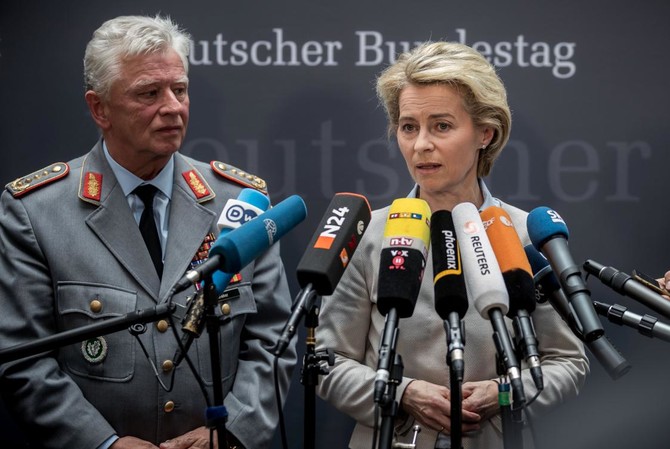
German far-right plot rekindles debate on Nazi-era Wehrmacht

Ethiopia accuses Eritrea of arming rebels in escalating war of words
- The charge by Ethiopia’s federal police escalates a feud between Ethiopia and Eritrea
- The two countries fought a three-year border war that broke out in 1998
ADDIS ABABA: Ethiopian police said they had seized thousands of rounds of ammunition sent by Eritrea to rebels in Ethiopia’s Amhara region, an allegation Eritrea dismissed as a falsehood intended to justify starting a war.
The charge by Ethiopia’s federal police escalates a feud between Ethiopia and Eritrea, longstanding foes who reached a peace deal in 2018 that has since given way to renewed threats and acrimony.
The police said in a statement late on Wednesday they had seized 56,000 rounds of ammunition and arrested two suspects this week in the Amhara region, where Fano rebels have waged an insurgency since 2023.
“The preliminary investigation conducted on the two suspects who were caught red-handed has confirmed that the ammunition was sent by the Shabiya government,” the statement said, using a term for Eritrea’s ruling party.
Eritrea’s Information Minister Yemane Gebremeskel told Reuters that Ethiopian Prime Minister Abiy Ahmed’s Prosperity Party (PP) was looking for a pretext to attack.
“The PP regime is floating false flags to justify the war that it has been itching to unleash for two long years,” he said.
In an interview earlier this week with state-run media, Eritrean President Isaias Afwerki said the Prosperity Party had declared war on his country. He said Eritrea did not want war, but added: “We know how to defend our nation.”
The two countries fought a three-year border war that broke out in 1998, five years after Eritrea won its independence from Ethiopia. They signed a historic agreement to normalize relations in 2018 that won Ethiopia’s Abiy the Nobel Peace Prize the following year. Eritrean troops then fought in support of Ethiopia’s army during a 2020-22 civil war in Ethiopia’s northern Tigray region.
But relations soured after Asmara was frozen out of the peace deal that ended that conflict. Since then, Eritrea has bristled at repeated public declarations by Abiy that landlocked Ethiopia has a right to sea access — comments many in Eritrea, which lies on the Red Sea, view as an implicit threat of military action.
Abiy has said Ethiopia does not seek conflict with Eritrea and wants to address the issue of sea access through dialogue.


