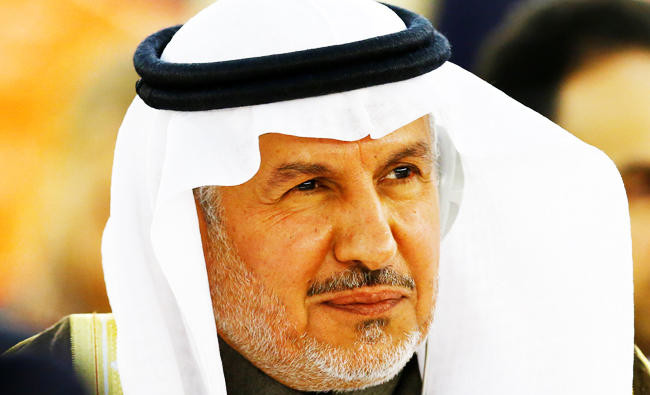
OTTAWA: Royal Court Adviser and General Supervisor of the King Salman Center for Relief and Humanitarian Aid (KSRelief) Abdullah Al-Rabeeah, underscored the Kingdom’s leading role in humanitarian work and its commitment to the international humanitarian law, which corresponds to the teachings of Islam that call for the preservation of human dignity and sparing mankind suffering.
Al-Rabeeah who is visiting the province of Ottawa made his remarks in the presence of Saudi Ambassador to Canada Naif bin Bandar Al-Sudairi and a group of Canadian journalists whom he briefed on KSRelief’s vision and message, stressing its commitment to international law and collaboration with the UN and other global humanitarian organizations.
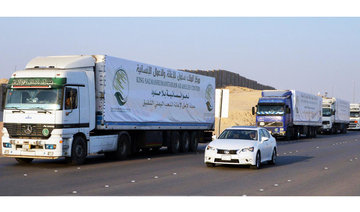
He said the Kingdom has been showing utmost concern for the humanitarian situation in Yemen, sending aid to all Yemeni provinces, including areas controlled by the Houthi militia, through KSRelief programs.
KSRelief carried out 127 projects in Yemen providing relief and humanitarian aid, as well as shelter, in addition to agricultural and water programs, Al-Rabeeah said.
KSRelief was able to reach everywhere in Yemen through 81 international and local partners; its programs place special emphasis on children and women projects, he said.
Al-Rabeeah said Saudi Arabia received 603,833 Yemeni refugees with their families who are allowed to move freely and work.
Beyond its borders, the Kingdom offered support to Yemeni refugees in Djibouti and Somalia, he added.
At the same time, the Kingdom, he said, was among the first countries to give support to the Syrian people, of whom it welcomed 291,342 as refugees, allowing them to live in the Kingdom as guests.
Thousands of them work and 114,000 Syrian students are enrolled in government schools. At the same time, similar support is given by the Kingdom to millions of refugees in neighboring countries, he added.
Al-Rabeeah also stressed the Kingdom’s concern over the humanitarian situations in Iraq, Somalia and other disaster-hit countries.
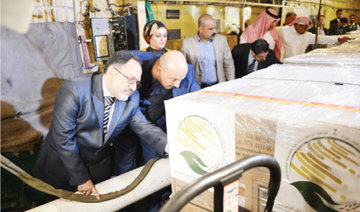
Through KSRelief, the Kingdom has so far provided $700 million worth of aid to 37 countries, he said.
He also spoke about the difficulty of delivering aid through Al-Hudeidah port in Yemen, in view of the fact that the fell under the control of Houthis who seize aid, depriving the Yemeni people of their simplest rights for political ends.
Al-Rabeeah also talked about the Kingdom’s Vision 2030 and the National Transformation Program (NTP) 2020 that aim at building a strong economy and creating job opportunities, and encourage humanitarian and voluntary work.
He stressed that the Arab Coalition forces facing terrorism is performing its role in response to the call of the Yemeni people and in line with the outcome of the national dialogue, UN resolutions and GCC initiative.

Saudi Arabia hosts 895,175 Yemeni, Syrian refugees as guests: KSRelief chief
Art therapy workshop sparks hope for cancer patients
- First monthly session was presented by local artist Hanan Al-Ateeq in cooperation with Kalimat House and Sawn Project
- Gathering brought together women ranging from cancer survivors to those who attended directly from chemotherapy
DHAHRAN: King Fahd University Hospital in the Eastern Province boosted the healing process on Wednesday with the launch of a year-long cultural program supporting cancer patients and survivors through art therapy.
The first monthly session was presented by local artist Hanan Al-Ateeq in cooperation with Kalimat House and Sawn Project. Taking place until December, the program aims to offer fun, playful sessions.
Wednesday’s gathering brought together women ranging from cancer survivors to those who attended directly from chemotherapy. Some picked up a drawing pencil for the first time since childhood, but all were there to get their hands dirty while cleansing their spirits.
Somewhat sullen and quiet at first, the space became a giant canvas of color as the women began to relax, giggle and ask questions, such as which colors to mix to make a particular shade.
Some accidentally dipped their abaya sleeves into the acrylic paint — but luckily it washes out with soap and water. Aside from prayer time, soothing music delicately swirled through the air as the moon peered through the window.
Lina Al-Muhanna, founder and director of the Sawn Project, told Arab News how a deeply personal family experience led her to create the program, which is centered on human connection and emotional support.
The idea grew from her own journey supporting her father during his long cancer battle, a time shaped by hospital visits and moments of isolation. The experience inspired her to help cancer patients to benefit from socializing with the chance to unleash their creative energy away from medical treatments, and she launched the initiative three years ago.
“Today, I honestly feel happy from the very beginning, because Sawn is a dream initiative that I founded,” Al-Muhanna said.
“The main goal of the initiative is to support cancer patients by providing other support to help them accept their condition, which contributes to better healing, alongside their medical treatment, of course.”
The project includes both group-based sessions and cultural and art-related workshops, each carrying a clear message of care, solidarity and encouragement. The program was developed in coordination with the hospital after Al-Muhanna identified a gap in patient support.
“Today was the first session, and it was very exciting. Seeing the patients’ enthusiasm was moving,” she said after Wednesday’s event, with tears filling her eyes.
At its core, Sawn focuses on helping patients navigate the emotional realities of illness — coping with pain, the side effects of treatment, and the sense of disconnection that often accompanies long hospital journeys.
Al-Muhanna told Arab News about a specific patient who attended the art therapy session despite feeling unwell after undergoing chemo just hours earlier.
Concerned for her, Al-Muhanna phoned the patient’s doctor and was told the session would be beneficial. Joining the group, the patient used vibrant pink colors to paint her white canvas.
“That’s why we focused on creating group psychological support, cultural workshops and meaningful activities,” she said, adding that Sawn was aiming to expand remote services and continue evolving in response to patients’ needs.
Kalimat House served as the cultural partner for the initiative, with the workshop led by the organization as part of its year-long cultural programming. Founded in 2014 by cultural visionaries Anfal Al-Hammad and Haifa Al-Owain, it was established with a mission to nurture literature, the arts, and socially driven cultural engagement.
Speaking to Arab News, Al-Hammad told Arab News that Kalimat House’s role as the cultural arm meant it supported arts and culture programming that spans “art workshops, creative writing, workshops, book club sessions and poetry nights.”
She said the decision to take part was rooted in the belief that “arts and culture are tools to self- expression,” particularly for individuals navigating difficult physical and mental healing journeys.
Being part of the program, she added, offered an opportunity to give something back to society, while also engaging participants’ potential and skills by giving them “those tools in order to express themselves also to create artworks from their pain, from their emotions, to support them and their journey.”
Al-Hammad highlighted that Kalimat House’s role focuses on “giving that outlet to those patients, or target audience, and be supportive to them on their journey,” as the initiative launches a full-year program with additional art therapy sessions planned in the months ahead.
Facilitating artist Al-Ateeq, whose practice bridges art, psychology and community-based healing, told Arab News that while she had been drawing since childhood, her relationship with art changed profoundly after the death of her mother in 2017.
That loss, she said, marked a turning point. She stopped doing art while mourning until one day, four years later, she was ready to start again. Since then, she has transformed art from a disciplined practice into a personal tool for healing.
“I always say that perfectionism is what creates blocks,” Al-Ateeq explained, describing how the pressure to achieve “flawlessness” eventually led her to put down the paintbrush.
“Drawing is instinctive,” she said. “Why do we think we need to suffer or struggle to return to art? We are all born artists. It’s our natural state.”
That realization reshaped her approach and now forms the foundation of her art therapy workshops.
“Every human being has the ability to express themselves on a canvas,” she said. “If someone cannot express their thoughts or emotions through words, they can express them through painting.”
Al-Ateeq’s sessions focus on observation as much as instruction. She watched participants’ movements, color choices and hesitations as they paint — details which she says often reveal internal states more honestly than conversation.
“When they draw, they release emotions because no one is judging them,” she said. She added that many patients draw night skies, dark spaces and layer the paint thickly, while others who are in recovery might draw sunshine and vibrant trees.
The hospital setting, she said, was intentional as the workshop was designed specifically for Saudi women undergoing cancer treatment or recovery.
“They are the people who need it most,” Al-Ateeq said. “In Saudi Arabia, I feel that many people come because they don’t have a voice. They carry a lot inside them.”
Many women arrived insisting they did not know how to draw — only to leave changed, with some vowing to continue at home.
“Therapy doesn’t have to be heavy,” explained Al-Ateeq. “It can be joyful. It can be creative. It can be gentle. It can be deep in a beautiful way.”
For her, the goal is not diagnosis or technical mastery, but creating a safe, human space — one where participants leave feeling, as one woman once told her: “Like we left the room and came back different.”
One participant, Samarh “um Turki” Al-Zahrani, said she left the session energized and inspired: “At the beginning, I didn’t know anyone here, but the atmosphere created a sense of excitement. I felt that we all became friends very quickly. The group energy was lovely. I would love to keep doing this and to return to other sessions.
“I surprised myself. I discovered talents within myself that had been buried. I felt a spirit of passion — a spirit that came from the place we were in, from the group, from the sense of closeness and togetherness between us. It was a truly beautiful experience,” she added.
Additional support for the program was provided by SMT Family Counseling Center, Estenarh, the Saudi Cancer Foundation, Al-Rashed Social Responsibility and Vibent.