MIAMI: Increasing the number of young children, who exercise for just under a half hour a few times a week could save tens of billions in medical costs over their lifetimes, researchers said.
Currently, just 32 percent of US children aged eight to 11 get enough exercise, said the report in the journal Health Affairs.
The minimum guideline of 25 minutes a day, three days a week, was established by the Sports and Fitness Industry Association.
But if even just half of children exercised that much, the nation could avoid $21.9 billion in medical costs and lost wages over the course of their lifetimes, said the report by researchers at Johns Hopkins University’s (JHU) Bloomberg School of Public Health.
And if 100 percent of all children in that age range did, $62.3 billion could be averted and 1.2 million fewer youths would be overweight or obese.
About one in six US youths aged two to 19 are overweight or obese, according to the US Centers for Disease Control and Prevention.
“Physical activity not only makes children feel better and helps them develop healthy habits, it’s also good for the nation’s bottom line,” said lead author Bruce Lee, executive director of JHU’s Global Obesity Prevention Center.
“Our findings show that encouraging exercise and investing in physical activity such as school recess and youth sports leagues when children are young pays big dividends as they grow up.”
The CDC defines being “overweight” as having a body mass index — a ratio calculated using measures of height to weight — that is between 25 and 30.
Being “obese” means having a BMI higher than 30. The normal BMI range is 18.5-24.9.
More than one in three US adults are obese (36.5 percent), raising their risk of heart disease, stroke, diabetes and other life threatening conditions such as certain cancers.
Research has shown that youths who are overweight by age 18 are far more likely than normal-weight peers to be overweight as adults.
The study also looked at the possibility of no change, with just under a third of children aged 8-11 continuing to meet the three-times-a-week exercise guideline.
“Maintaining the current level of physical activity would result in 8.1 million of these youths being overweight or obese by 2020,” said the study, anticipating “$2.8 trillion in additional medical costs and lost wages over their lifetimes.”
The lifetime medical costs for a person who is overweight average $62,331, while lost wages average $93,075, according to the study.
For people who are obese, the costs are even higher.
“As the prevalence of childhood obesity grows, so will the value of increasing physical activity,” said Lee.
“We need to encourage kids to be active, to reduce screen time and get them running around again.”


More exercise for children could save billions on health: US study
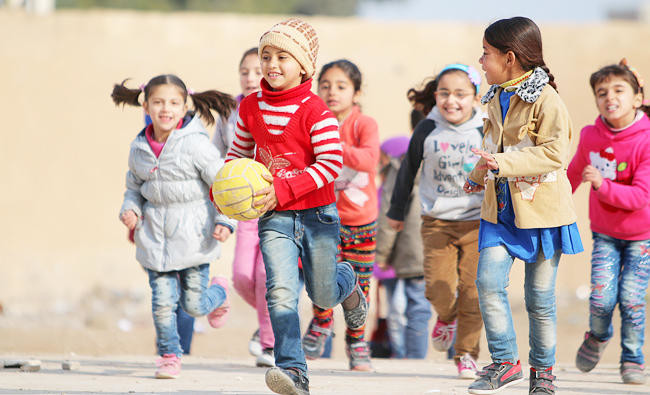
More exercise for children could save billions on health: US study

India rolls out free HPV vaccines to combat cervical cancer
- Nationwide HPV vaccination campaign targets 11.5 million 14-year-old girls annually
- India records about 80,000 cervical cancer deaths, 120,000 new cases every year
NEW DELHI: Indian Prime Minister Narendra Modi launched a free HPV vaccination drive on Saturday for young girls across India, which has the world’s highest rate of cervical cancer deaths.
India records around 120,000 new cases of cervical cancer annually and around 80,000 deaths. It is the second-most-common cancer among women in the country.
India has the highest number of cervical cancer deaths, followed by China and Indonesia. The number of cases in India is the second highest globally, after China.
With cervical cancer largely preventable through HPV vaccination and regular screening, the new campaign aims to vaccinate around 11.5 million 14-year-old Indian girls annually.
“The prime minister launched the nationwide HPV vaccination campaign … describing it as a pivotal step toward empowering India’s ‘Nari Shakti’ (women power) and ensuring the health of mothers and daughters,” Modi’s office said in a statement.
Under the campaign, a dose of HPV vaccine will be provided free of cost at all government health centers across the country for all 14-year-old girls, said Anupriya Satel, minister of state for health and family welfare.
“This initiative is a historic step towards protecting our adolescent girls from serious diseases like cervical cancer,” she wrote on X.
The launch event, which took place in the northern city of Ajmer, also saw a few young girls receiving the HPV vaccine on stage.
The vaccination is a “powerful preventive step that can save lives,” according to a statement from India’s Ministry of Health and Family Welfare, which also said that HPV vaccinations can help families “secure a healthier, cancer-free future for India’s daughters.”


