TEHRAN: Iran has become self-sufficient in producing the amount of gasoline the country requires on a daily basis, the official IRNA news agency reported on Sunday.
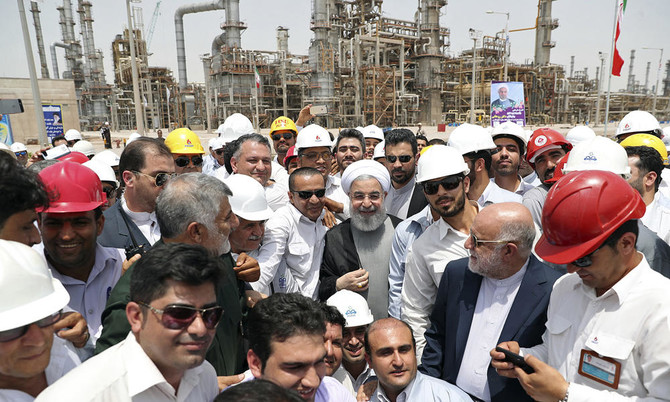
President Hassan Rouhani inaugurated a new refinery that produces some 12 million liters (3.17 million gallons) of gasoline in its first phase, according to the report.
Iranians consume about 60 million liters (15.85 million gallons) of the fuel daily on average. The country already produces about 50 million liters (13.2 million gallons) and some 11 million liters (3 million gallons) had to be imported.
The report said the refinery in the port city of Bandar Abbas, some 750 miles (1,205 kilometers) south of Tehran, is capable of producing 36 million liters (9.5 million gallons) of gasoline per day after it is completed in 2018.
Rouhani said a 2015 landmark nuclear deal with world powers contributed to reaching the operation stage of the project. The deal capped Iran’s nuclear activities in return for lifting sanctions.
If the agreement hadn’t been reached, Rouhani said, “this giant refining unit would never go online.”
Rouhani answered the criticism by hard-liners who say Iran gave too much in return for too little under the deal. He is running for re-election in the May 19 presidential election in which hard-line rivals blame longstanding problems such as unemployment and recession on Rouhani’s 4-year-old administration.
“Those who say we have not seen results from the deal, come to the refinery and see all the related equipment that has been imported into the country without any hassle,” he said.
The refinery also daily produces 4.5 million liters (1.2 million gallons) of diesel fuel, 1.3 million liters (340 thousand gallons) of liquid petroleum gas and one million liters (264 thousand gallons) of kerosene.

Report: Iran becomes self-sufficient in gasoline production
Saudi POS spending jumps 28% in final week of Jan: SAMA
RIYADH: Saudi Arabia’s point-of-sale spending climbed sharply in the final week of January, rising nearly 28 percent from the previous week as consumer outlays increased across almost all sectors.
POS transactions reached SR16 billion ($4.27 billion) in the week ending Jan. 31, up 27.8 percent week on week, according to the Saudi Central Bank. Transaction volumes rose 16.5 percent to 248.8 million, reflecting stronger retail and service activity.
Spending on jewelry saw the biggest uptick at 55.5 percent to SR613.69 million, followed by laundry services which saw a 44.4 percent increase to SR62.83 million.
Expenditure on personal care rose 29.1 percent, while outlays on books and stationery increased 5.1 percent. Hotel spending climbed 7.4 percent to SR377.1 million.
Further gains were recorded across other categories. Spending in pharmacies and medical supplies rose 33.4 percent to SR259.19 million, while medical services increased 13.7 percent to SR515.44 million.

Food and beverage spending surged 38.6 percent to SR2.6 billion, accounting for the largest share of total POS value. Restaurants and cafes followed with a 20.4 percent increase to SR1.81 billion. Apparel and clothing spending rose 35.4 percent to SR1.33 billion, representing the third-largest share during the week.
The Kingdom’s key urban centers mirrored the national surge. Riyadh, which accounted for the largest share of total POS spending, saw a 22 percent rise to SR5.44 billion from SR4.46 billion the previous week. The number of transactions in the capital reached 78.6 million, up 13.8 percent week on week.
In Jeddah, transaction values increased 23.7 percent to SR2.16 billion, while Dammam reported a 22.2 percent rise to SR783.06 million.

POS data, tracked weekly by SAMA, provides an indicator of consumer spending trends and the ongoing growth of digital payments in Saudi Arabia.
The data also highlights the expanding reach of POS infrastructure, extending beyond major retail hubs to smaller cities and service sectors, supporting broader digital inclusion initiatives.
The growth of digital payment technologies aligns with Saudi Arabia’s Vision 2030 objectives, promoting electronic transactions and contributing to the Kingdom’s broader digital economy.