LONDON: India’s gasoline consumption is surging and has become one of the fastest-growing components of global oil demand.
With other parts of the global economy struggling, continued growth in gasoline consumption in India, together with the US and China, has become one of the most important indicators for global oil prices.
Saudi Arabia and other members of the Organization of the Petroleum Exporting Countries are relying on India’s continued consumption growth to help absorb excess crude supply and rebalance the oil market in 2016/17.
India’s drivers used 500,000 barrels per day of motor spirit in the 12 months ending in February 2016, according to the Petroleum Planning and Analysis Cell of the Ministry of Petroleum.
Gasoline consumption rose by more than 60,000 bpd in 2015 compared with an increase of 240,000 bpd in the (much larger) US market.
Gasoline still accounts for a relatively small share, about 12 percent, of refined petroleum products consumed in India. The corresponding figure for the United States is 47 percent.
But gasoline consumption has been growing much faster than petroleum demand as a whole as the country becomes more affluent and the expanding urban middle class become car owners.
Gasoline consumption has grown at a compound annual rate of 11 percent over the last five years compared with 5 percent for other products.
Gasoline consumption growth surged to around 14 percent over the last year compared with 9 percent for other products.
Gasoline consumption has doubled since the start of 2009 and quadrupled since 1999, according to India’s Central Statistics Office.
India’s growing number of drivers provided the third-largest increase in gasoline consumption anywhere in the world last year after the US and China.
The Ministry of Petroleum predicts gasoline consumption will increase further to almost 800,000 bpd by 2021/2022.
Since actual consumption is already running ahead of the five-year plan the eventual outturn could be higher.
Sales of passenger cars and utility vehicles are expected to grow by as much as 12 percent in 2016/17 up from 6 percent in 2015/16, which translates to around 230,000 new vehicles hitting the roads every month.
The government plans to spend around $14 billion in the next fiscal year upgrading the country’s road network.
Consumption of other fuels and lubricants is also growing, although not as fast as the super-charged gasoline market.
India’s total petroleum consumption has increased by around 340,000 bpd over the last year, with gasoline accounting for more than 18 percent of the increase.
India’s fuel markets have become one of the most important sources of global oil demand growth.
India accounted for more than one barrel in every six of extra oil demand reported in 2015, according to estimates prepared by the International Energy Agency.
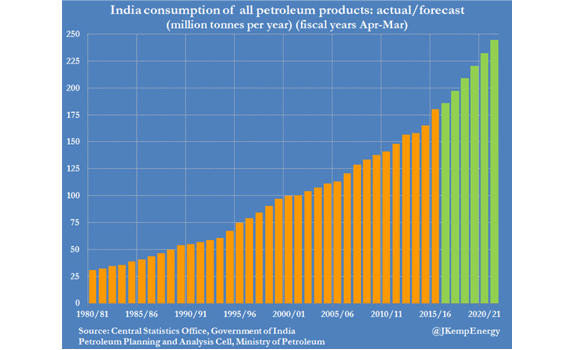
Total consumption of petroleum products has doubled from 2 million bpd in 1998/99 to almost 4 million bpd in 2015/16.
India’s oil ministry predicts consumption will hit 5.4 million bpd by 2021/22.
— John Kemp is a Reuters market analyst. The views expressed are his own.


![]()
India’s thirst for gasoline helps spur global oil demand
India’s thirst for gasoline helps spur global oil demand
Latest updates





© 2026 SAUDI RESEARCH & PUBLISHING COMPANY, All Rights Reserved And subject to Terms of Use Agreement.