Iraq begins expansion of oil field aiming to double output

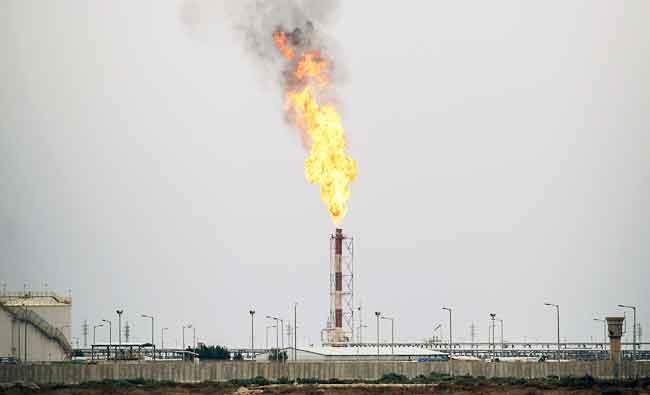
A photo taken on April 17, 2017 shows flames rising from the burning of excess oil at the West Qurna-2 oilfield, west of Basra in southern Iraq. (AFP)
Updated 26 April 2017
Follow

Iraq begins expansion of oil field aiming to double output

BASRA: Iraq has launched the third and final phase of work to expand its southern Halfaya oil field, aiming to double its output capacity in 2018 to 400,000 barrels per day (bpd), a state-run oil company said.
Additional facilities to separate crude oil from associated natural gas will be set up as part of Halfaya’s expansion, Adnan Noshi, head of Maysan Oil Co., which oversees oil fields in Maysan province, told Reuters on Tuesday.
Halfaya, operated by PetroChina, is Maysan Oil’s largest field, producing 200,000 of the company’s total output of 380,000 bpd, Noshi said.
Expansion at Halfaya should raise Maysan’s overall output to nearly 600,000 bpd in 2018, he said. Iraq plans to increase its oil output capacity to 5 million bpd before the end of the year.
Output stood at more than 4.7 million bpd, Oil Minister Jabar Al-Luaibi said on April 2.
The Organization of the Petroleum Exporting Countries’ (OPEC) second-largest producer after Saudi Arabia, Iraq produced at a rate of 4.464 million bpd in March, down by more than 300,000 bpd from late last year. Iraq has reduced its output alongside other oil exporters this year as part of an agreement aimed at boosting crude prices.


Gold slips over 1 percent on strong dollar, easing rate-cut bets

Updated 12 March 2026
Follow

Gold slips over 1 percent on strong dollar, easing rate-cut bets

  • Chile central bank issues first gold purchase in decades
  • BMI expects silver to average $93/oz in 2026

Gold prices fell more than 1 percent on Thursday, pressured by a stronger dollar and diminishing hopes for a reduction in borrowing costs as the ongoing Iran war stoked inflation concerns.
Spot gold dipped 1.1 percent at $5,118.16 per ounce by 1:31 p.m. ET (1731 GMT). US gold futures for April delivery settled 1 percent lower at $5,125.80.
The dollar gained for a third consecutive session. The greenback is a competitive ‌safe-haven asset, and ‌a stronger US currency makes gold more ​expensive ‌for ⁠holders ​of other currencies.
“The ⁠higher dollar index, rising treasury yields and lack of interest-rate cuts are the negative factors, but the conflict in the Middle East has been generating some safe-haven flows,” said Phillip Streible, chief market strategist at Blue Line Futures.
Two tankers were ablaze in Iraqi waters in an apparent escalation in Iranian attacks that have cut off ⁠Middle East energy supplies. In reaction, oil prices ‌rose sharply for the day.
Iran will avenge ‌the blood of its martyrs, keep ​the Strait of Hormuz closed and ‌attack US bases, new Supreme Leader Ayatollah Mojtaba Khamenei said.
Higher crude ‌prices feed into inflation by raising transportation and production costs. Gold is considered an inflation hedge, but high interest rates weigh on it by making yield-bearing assets more attractive.
“If they can prevent oil prices from climbing ‌further, gold should be in a good place... On the bullish side for gold, the main argument is ⁠that central ⁠bank buying and steady exchange-traded fund inflows, which have remained positive all year,” Streible added.
Chile’s central bank issued its first major gold purchase since at least 2000. In February, the bank boosted its gold reserves to $1.108 billion, up from $42 million in January, equivalent to 2.2 percent of total reserves.
Elsewhere, spot silver eased 1 percent to $84.90. Prices gained more than 146 percent last year.
Analysts at BMI wrote in a note they expect silver to average $93 per ounce in 2026, with strong investment demand consolidating the gains witnessed in 2025, and offsetting price-induced ​demand destruction in solar ​panels and jewelry.
Spot platinum lost 1.1 percent to $2,145.75, and palladium fell 1 percent to $1,620.86.