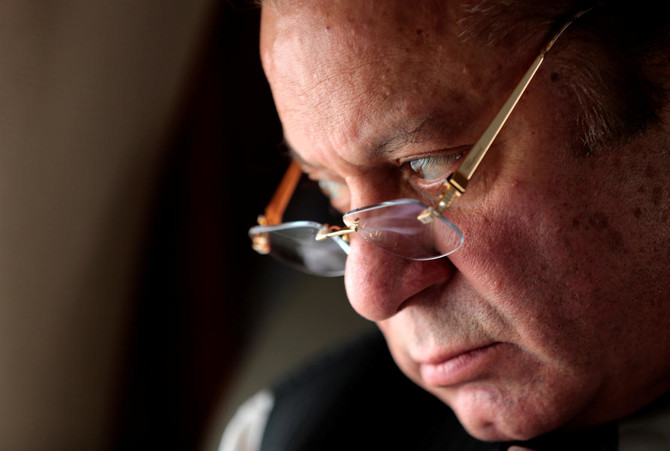
ISLAMABAD: Pakistan’s Prime Minister Nawaz Sharif on Saturday sacked one of his special advisers and sanctioned another bureaucrat after an inquiry into a newspaper leak, but the country’s powerful army rejected Sharif’s directive as “incomplete.”
The report’s findings and recommendations threaten to reopen a rift between the army and the civilian government at a time when relations between the two have been relatively stable.
An article published in the English-language Dawn newspaper in October, detailing high-level security talks, had angered the army and led to the firing of then-Information Minister Pervaiz Rashid, who was a Sharif ally.
The military’s tough response, which included asking intelligence agencies to identify the journalist’s sources, drew widespread criticism from rights groups who accused it of curtailing Pakistan’s press freedoms.
The prime minister’s office said Sharif had “approved the recommendations” from the report into the leak, which included the removal of Syed Tariq Fatemi, Sharif’s special assistant on foreign affairs, from his post.
Sharif’s office, in a statement, added Rao Tehsin Ali, principal information officer at the information ministry, will also be sanctioned on the basis of the report, which has not yet been published.
The Dawn newspaper, its editor Zafar Abbas and article author, Cyril Almeida, have been referred to the All Pakistan Newspaper Society for “necessary disciplinary action.”
But the army swiftly rejected Sharif’s directive.
“Notification on Dawn Leak is incomplete and not in line with recommendations by the Inquiry Board. Notification is rejected.,” the military’s spokesman, Major General Asif Ghafoor, said on Twitter.
He did not elaborate on what other actions the government should take.
In October, the prime minister’s office said the story was “planted” and termed it a “breach of national security.”
The Dawn newspaper has stood by the author. Dawn journalists could not be reached for comment.
Quoting anonymous sources, the Dawn article said civilian government officials called for the military not to interfere if civilian authorities tried to arrest members of anti-India militant groups such as Jaish-e-Mohammad and Lashkar-e-Taiba.
Westerns powers and India have criticized Pakistan over its links with home-grown Islamist militant groups which carry out attacks in neighboring India, though Islamabad denies supporting them.
Relations between the civilian government and military have often been strained in a country where several prime ministers, including Sharif himself, have been ousted in coups.
The appointment of Gen. Qamar Javed Bajwa as the country’s new military chief in November led to easing of tensions between Sharif’s government and the military.


![]()
Pakistan PM fires adviser over newspaper leak, army rejects actions
Pakistan PM fires adviser over newspaper leak, army rejects actions


Latest updates


© 2026 SAUDI RESEARCH & PUBLISHING COMPANY, All Rights Reserved And subject to Terms of Use Agreement.