

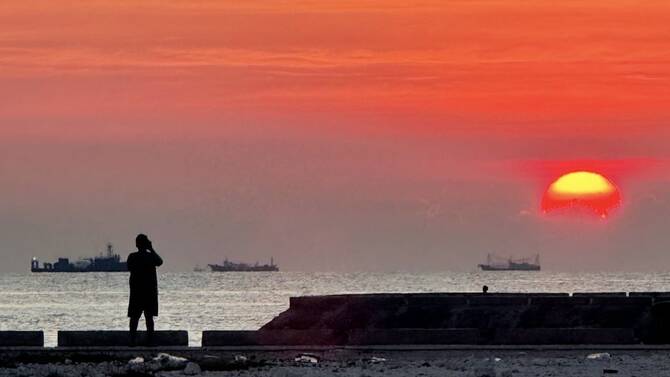

THITU ISLAND: When Mary Joy Suelo set off for Thitu Island in 2024, it took five days at sea on a Philippine navy ship to get there — a journey that made her realize how very far she was from her family and the life she knew.
She arrived with a group of other teachers to work at the island’s only school. As soon as they disembarked, they saw it was surrounded by Chinese military vessels.
“At night, their lights would flicker. It almost looked like you were in a park. We even counted them. Before, they could reach up to around 50 ships. Now, there are fewer,” she said.
“We really felt sadness because we were far from our families and had to adjust to a completely new environment … We really felt fear. But we embraced it — not just for our work, but for the children here.”
Thitu Island is the largest Philippine-occupied feature in the disputed Spratly Islands in the South China Sea, and the only one with a civilian population. It is located some 480 km northwest of mainland Palawan province and surrounded by shallow coral ranges.
The Philippine military took over the island in the early 1970s and renamed it as Pagasa, which means “hope” in Filipino.
While it is also claimed by China, Taiwan and Vietnam, the Philippines has controlled it for the past half-century and incorporated it into the Palawan province.
Covering just 37 hectares — roughly a tenth of Central Park in Manhattan — the island has a civilian population of a few hundred people and hosts military personnel who maintain the Philippines’ claim and provide security.
“The community is united. There are no conflicts or disputes among residents. There are about 418 of us living here,” Danilo Belono, a municipal worker, told Arab News.
Belono decided to move to the island in 2010, as working there guaranteed a steady income and various subsidies on staple goods, allowing him to save enough to properly educate his four children, who now attend college on the mainland.
Goods are transported to the island by boat, while residents — most of whom work as fishermen — often supplement the local market with seafood.
“There are times when they get a good catch, especially when the weather is good. There are times when they get blocked (by the Chinese) when they try to go to the fishing grounds,” Belono said.
China Coast Guard and military ships are visible from every corner of the tiny island, which can be circled in just half an hour on foot.
Despite the Chinese presence, however, the island’s infrastructure has been steadily expanding. Since Belono’s arrival, it has gained a sheltered port and an airstrip.
“Sometimes, those bringing construction materials are afraid to come here because they are also being blocked by the Chinese,” he said.
“Lately, there hasn’t really been any harassment. Things are relatively OK here.”
But tensions remain and the island’s inhabitants, including the youngest ones, are well aware of it.
Chinalyn U. Belidan, a 14-year-old who was born on the island, has no doubts that it “truly belongs to us, the Philippines.”
At the same time, she knows that the area is rich in resources and that several countries are contesting it, with one never letting its presence be forgotten.
“When you’re out at sea, Chinese vessels follow you and they’ll send messages on the radio … We always see Chinese vessels in the waters nearby. I wish they would just leave completely,” she said.
“Much of the marine life here is gradually disappearing because of destructive practices by foreign vessels.”
Her schoolmate, Jason Dolar, is worried about marine life too and is planning to become a marine biologist to protect the coral reefs and help restore the fish population for the ecosystem and local livelihoods.
He moved to the island three years ago, when his mother found a job there. For him, the sense of belonging to Pagasa is not so clear-cut, and he is already preparing to leave the island for further studies, as schooling only goes up to secondary level.
“I know that someday we will have to leave to study at college on the mainland,” he said.
“If I become successful as a marine biologist, I will come back and live here again. I believe that even after many years Pagasa will still belong to us.”


