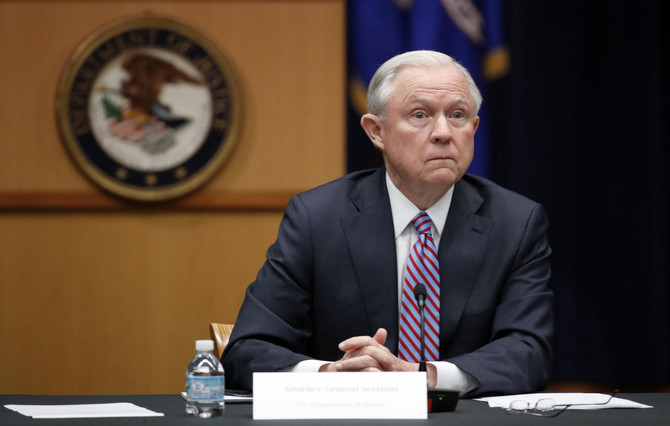
WASHINGTON: The arrest of WikiLeaks founder Julian Assange is a US “priority,” Attorney General Jeff Sessions said Thursday, as media reports indicated his office was preparing charges against the fugitive anti-hero.
“We are going to step up our effort and already are stepping up our efforts on all leaks,” Sessions, America’s top cop, said at a news conference in response to a reporter’s question about a US priority to arrest Assange.
The Justice Department chief said a rash of leaks of sensitive secrets appeared unprecedented.
“This is a matter that’s gone beyond anything I’m aware of. We have professionals that have been in the security business of the United States for many years that are shocked by the number of leaks and some of them are quite serious,” he said.
“Whenever a case can be made, we will seek to put some people in jail.”
Prosecutors in recent weeks have been drafting a memo that looks at charges against Assange and members of WikiLeaks that possibly include conspiracy, theft of government property and violations of the Espionage Act, the Washington Post reported, citing unnamed US officials familiar with the matter.
Several other media outlets also cited unnamed officials as saying US authorities were preparing charges against Assange. The Justice Department declined to comment on the reports.
Assange, 45, has been holed up at the Ecuadoran embassy in London since 2012 trying to avoid extradition to Sweden where he faces a rape allegation that he denies.
He fears Sweden would extradite him to the United States to face trial for leaking hundreds of thousands of secret US military and diplomatic documents that first gained attention in 2010.
Assange’s case returned to the spotlight after WikiLeaks was accused of meddling in the US election last year by releasing a damaging trove of hacked e-mails from presidential candidate Hillary Clinton’s campaign and the Democratic party.
US officials say the e-mails were hacked with the aid of the Russian government in its bid to influence the US election.
Critics say their release late in the race helped to tip the November 8 election to Republican Donald Trump.
Trump and his administration have put heat on WikiLeaks after it embarrassed the Central Intelligence Agency last month by releasing a large number of files and computer code from the spy agency’s top-secret hacking operations.
The documents showed how the CIA exploits vulnerabilities in popular computer and networking hardware and software to gather intelligence.
Supporters of WikiLeaks say it’s practicing the constitutional right of freedom of speech and the press.
CIA Director Mike Pompeo last week branded WikiLeaks a “hostile intelligence service,” saying it threatens democratic nations and joins hands with dictators.
Pompeo focused on the anti-secrecy group and other leakers of classified information like Edward Snowden as one of the key threats facing the United States.
“WikiLeaks walks like a hostile intelligence service and talks like a hostile intelligence service. It has encouraged its followers to find jobs at CIA in order to obtain intelligence... And it overwhelmingly focuses on the United States, while seeking support from anti-democratic countries and organizations,” said Pompeo.
“It is time to call out WikiLeaks for what it really is — a non-state hostile intelligence service often abetted by state actors like Russia.”
The day before Pompeo spoke, Assange published an opinion piece in The Washington Post in which he said his group’s mission was the same as America’s most respected newspapers: “to publish newsworthy content.”
“WikiLeaks’s sole interest is expressing constitutionally protected truths,” he said, professing “overwhelming admiration for both America and the idea of America.”


![]()
Arrest of WikiLeaks’s Assange a ‘priority’: US top cop
Arrest of WikiLeaks’s Assange a ‘priority’: US top cop


Latest updates





© 2026 SAUDI RESEARCH & PUBLISHING COMPANY, All Rights Reserved And subject to Terms of Use Agreement.