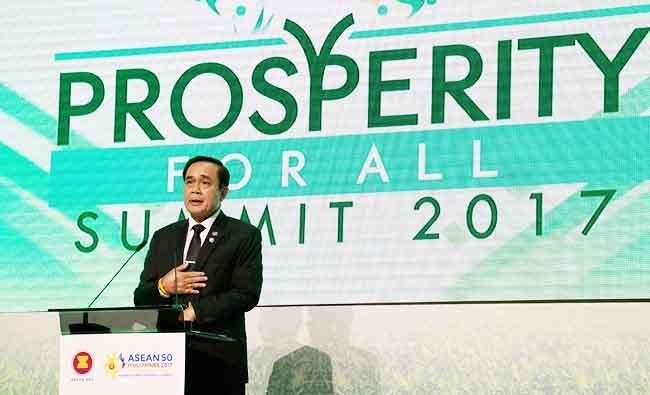
MANILA: The 10 countries of the Association of Southeast Asian Nations (ASEAN) could form the world’s fourth largest economy by 2030 though work is needed to help small companies and reduce trade barriers, Malaysia’s Prime Minister Najib Razak said Friday.
Najib told a business forum on the sidelines of a summit of ASEAN leaders meeting in Manila that the combined size of the group’s economies will grow to $9.2 trillion by 2050.
He said more optimistic forecasts see that happening as early as 2030, turning the region into the world’s fourth-biggest economy after the US, EU and China.
As of November 2015, the region’s combined economy was nearly $2.7 trillion, ranking 7th largest in the world, he said.
Growth is crucial to ensure prosperity can be shared, Najib said. Some ASEAN members, like Singapore, are already affluent, but others, such as Myanmar and Laos, lag far behind.
The Malaysian leader urged that ASEAN members bring average tariffs to zero or near zero from the 4 percent average seen in 2015. He also decried an increase in “non-tariff barriers,” such as quotas and excessively onerous import regulations, saying the number of such measures had risen to nearly 6,000 in 2015 from about 1,600 in 2000.
Expanding e-commerce would be especially helpful to small companies. Retail e-commerce transactions in ASEAN countries currently average just over 1 percent of total retail spending, compared to more than 10 percent in developed economies, suggesting the huge potential for growth, Najib added.

‘ASEAN likely to become world’s 4th-largest economy’
Saudi Arabia set to attract $500bn in private investment, Al-Falih tells conference
RIYADH: Sustainability, technology, and financial models were among the core topics discussed by financial leaders during the first day of the Momentum 2025 Development Finance Conference in Riyadh.
The three-day event features more than 100 speakers and over 20 exhibitors, with the central theme revolving around how development financial institutions can propel economic growth.
Speaking during a panel titled “The Sustainable Investment Opportunity,” Saudi Investment Minister Khalid Al-Falih elaborated on the significant investment progress made in the Kingdom.
“We estimate in the midterm of 2030 or maybe a couple of years more or so, about $1 trillion of infrastructure investment,” he said, adding: “We estimate, as a minimum, 40 percent of this infrastructure is going to be financed by the private sector, so we’re talking in the next few years $400 (billion) to $500 billion.”
The minister drew a correlation between the scale of investment needs and rising global energy demand, especially as artificial intelligence continues to evolve within data processing and digital infrastructure in global spheres.
“The world demand of energy is continuing to grow and is going to grow faster with the advent of the AI processing requirements (…) so our target of the electricity sector is 50 percent from renewables, and 50 percent from gas,” he added.
Al-Falih underscored the importance of AI as a key sector within Saudi Arabia’s development and investment strategy. He made note of the scale of capital expected to go into the sector in coming years, saying: “We have set a very aggressive, but we believe an achievable target, for AI, and we estimate in the short term about $30 billion immediately of investments.”
This emphasis on long-term investment and sustainability targets was echoed across panels at Momentum 2025, during which discussions on essential partnerships between public and private sectors were highlighted.
The shared ambition of translating the Kingdom’s goals into tangible outcomes was particularly essential within the banking sector, as it plays a central role in facilitating both projects and partnerships.
During the “Champions of Sectoral Transformation: Development Funds and Their Ecosystems” panel, Saudi National Bank CEO Tareq Al-Sadhan shed light on the importance of partnerships facilitated via financial institutions.
He explained how they help manage risk while supporting the Kingdom’s ambitions.
“We have different models that we are working on with development funds. We co-financed in certain projects where we see the risk is higher in terms of going alone as a bank to support a certain project,” the CEO said.
Al-Sadhan referred to the role of development funds as an enabler for banks to expand their participation and support for projects without assuming major risk.
“The role of the development fund definitely is to give more comfort to the banking sector to also extend the support … we don’t compete with each other; we always complement each other” he added.