Iran election campaign kicks off without Ahmadinejad

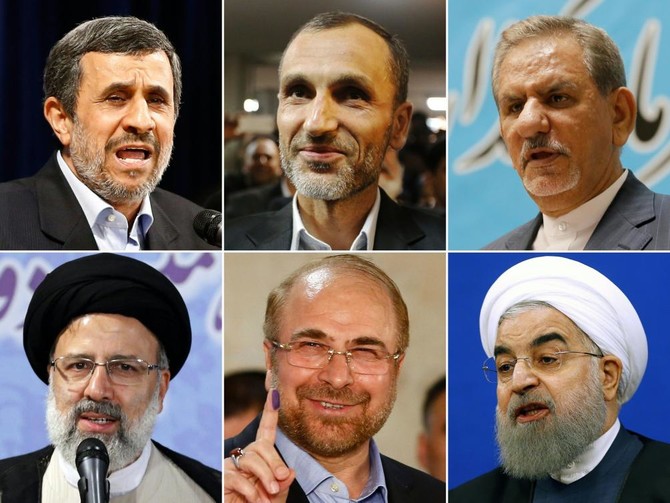
(COMBO) This combination of pictures created on April 15, 2017 shows the main contenders for Iran’s upcoming presidential elections: (top L-R) former Iranian president Mahmoud Ahmadinejad speaking after registering at the Interior Ministry’s election headquarters for the presidential elections in Tehran on April 12, 2017, Iranian Hamid Baghaie, former vice president under Ahmadinejad, giving a press conference in Tehran on April 5, 2017, Iran’s first Vice-President, Eshaq Jahangiri speaking during a conference on investment in Iran’s tourism sector at the International Conference Center in Tehran on October 2, 2016, (bottom L-R) Iranian cleric and head of the Imam Reza charitable foundation, Ebrahim Raisi, delivering a speech after registering his candidacy for the presidential elections in Tehran on April 14, 2017, Mohammad Bagher Ghalibaf, Mayor of Tehran, showing his ink-stained finger after registering his candidacy for the presidential elections at the ministry of interior in Teh
Updated 22 April 2017
Follow

Iran election campaign kicks off without Ahmadinejad

TEHRAN: Campaigning began on Friday for Iran’s presidential election with incumbent Hassan Rouhani facing a tough battle against hard-liners, though not from former President Mahmoud Ahmadinejad who was barred from standing.
Ahmadinejad’s disqualification by the conservative-run Guardian Council was no surprise — he had been advised not to run by Supreme Leader Ayatollah Ali Khamenei who said it would “polarize” the nation.
His populist economics and defiant attitude to the establishment had alienated even Ahmadinejad’s hard-line backers during his 2005-2013 tenure.
“Once the supreme leader had told him not to stand, it became impossible for him to be cleared by the Guardian Council,” said Clement Therme, research fellow for Iran at the International Institute for Strategic Studies.
“By his second term, (Ahmadinejad) was even challenging the clerics. He was not useful anymore for the system.”
The mood in Tehran has been subdued — many are disillusioned with Rouhani’s failure to kick-start the economy despite broad support for his efforts to rebuild ties with the West, notably through a nuclear deal with world powers that eased sanctions.
There has been uproar over a decision by the election commission to ban live TV debates, seen by some as an attempt to prevent embarrassment to some of the candidates or the regime as a whole.
Campaigning, which the Guardian Council announced could begin immediately, had not been supposed to start for another week, so there was little activity on Friday.
But experts say the authorities are keen to excite interest in the vote.
“They need that for legitimacy — the turnout is even more important than the result,” said Therme.
Iran’s elections are tightly controlled, with the Guardian Council allowing just six people — and no women — to stand for the May 19 vote out of 1,636 hopefuls that registered last week.
If no candidate wins more than 50 percent, a run-off between the top two is held a week later.
Rouhani, a politically moderate cleric, squeaked to victory last time with 51 percent in the first round, helped by a divided conservative camp.
The Guardian Council has resisted efforts by Iran’s Parliament, the Majles, to clarify the criteria by which they choose candidates.
The constitution adopted after the 1979 revolution offers only vague guidelines that candidates should possess “administrative capacity and resourcefulness... trustworthiness and piety.”
The build-up to the vote has injected more interest than many predicted just a couple of months ago, when Rouhani was seen as a shoo-in for a second term if only because the conservative opposition seemed unable to offer a strong candidate.
Since then, the 56-year-old former judge and cleric Ebrahim Raisi has emerged as a front-runner for the conservatives.
Little-known on the political scene, Raisi runs a powerful religious foundation and business empire in Mashhad and is seen as a close ally of — and possible successor to — supreme leader Ayatollah Ali Khamenei.
But despite emphasizing his care for the poor, many say Raisi’s hard-line judicial background and entourage will turn off voters.
“He seems like a good and calm person himself, but the people around him are scary,” said a tour operator in Yazd, echoing a widely heard sentiment.
Some think he may drop out at the last minute in favor of Tehran mayor Mohammad Bagher Ghalibaf, who came second to Rouhani in 2013.
Ghalibaf — a war veteran, former Revolutionary Guards commander and police chief — has support from powerful backroom hard-liners and presents himself as a pragmatic problem-solver.


Palestinians look to salvage Gaza’s history from the ruins of Israel’s military offensive

Updated 5 sec ago
Follow

Palestinians look to salvage Gaza’s history from the ruins of Israel’s military offensive

  • Great Omari Mosque in Gaza being hit by Israeli strikes in the two-year war muffled by an uncertain ceasefire
  • With major military operations halted, Palestinians are gaining a clearer picture of the destruction
GAZA CITY: Muneer Elbaz remembers the joy of visiting the Great Omari Mosque in Gaza with his family, praying at a site where people have worshipped over centuries as empires came and went.
“These were the best days,” Elbaz said, as he recalled promenading through the lively markets around the mosque before the Israel-Hamas war. “This place transports us from one era to another.”
Today, much of the mosque stands in ruins – like most of Gaza – after being hit by Israeli strikes in the two-year war muffled by an uncertain ceasefire. The sight of the rubble brings to mind “a tree that had been uprooted from the land,” said Elbaz, a Palestinian heritage consultant involved with recovery work at the site.
Israel’s military offensive killed over 72,000 Palestinians, according to Gaza’s Health Ministry, and erased entire extended families.
Gone too is some of the heritage of a land with a rich history going back to ancient times. The mosque was built on a site where a Byzantine church had stood, and changed hands and even religions as one invader followed another.
With major military operations halted, Palestinians are gaining a clearer picture of the destruction. Some organizations are trying to save what they can at historical sites, even as full-scale restoration – and the broader reconstruction of the territory – face major obstacles.
Dozens of sites were damaged
Israel launched its offensive after Hamas-led militants killed some 1,200 people, mostly civilians, and took another 251 hostage in the Oct. 7, 2023, attack. The military accuses Hamas of concealing military assets beneath or near heritage sites, as well as other civilian structures.
The UN cultural agency, in an ongoing assessment based on satellite images, says it has verified damage to at least 150 sites since the start of the war. They include 14 religious sites, 115 buildings of historical or artistic interest, nine monuments and eight archaeological sites.
They are fragments of Gaza’s soul, connecting Palestinians to a place and a history that many fear is at risk of being erased.
“These sites were an important element that solidifies the presence of the Palestinian people on this land and that represents the continuity of their cultural identity,” said Issam Juha, co-director of the Center for Cultural Heritage Preservation, based in the Israeli-occupied West Bank.
“They want to erase the Palestinian identity and Palestinian heritage and ... to remove any connection that keeps the Palestinian society clinging to this land,” he said.
The center is doing urgent rescue work at the badly damaged Pasha Palace, which housed centuries-old artifacts, many of which appear to have been looted, Juha said. Among the missing items are an Ottoman-era Qur’anic manuscript, jewelry from the medieval Mamluk era and a Roman-era sarcophagus from which only some fragments have been recovered, according to Hamouda Al-Dohdar, an expert working at the site.
The Israeli military said it struck “a Hamas military compound and an anti-tank missile array” at the site. It said its forces struck a “terror tunnel” at the Omari mosque. It did not provide evidence in either case.
Amir Abu Al-Omrain, an official with Gaza’s endowments ministry, part of the Hamas-run government, denied the allegation about the mosque.
UNESCO does not have a mandate to assign responsibility for the damage it assesses.
An independent commission established by the UN’s Human Rights Council said it was not aware of any evidence of a tunnel shaft in the mosque. Noting the Israeli allegations about the mosque, it said that even the presence of a “legitimate military objective … would not have justified the resulting damage.” Israel has previously accused the commission of bias.
The centuries-old Saint Porphyrius Orthodox church complex, which had been sheltering displaced Palestinians, was also hit in an Israeli attack early in the war, causing deaths and injuries. The military said it had targeted a nearby Hamas command center. UNESCO said the church complex was moderately damaged.
Some of Gaza’s heritage sites appear to have been spared. UNESCO said it has found no evidence of damage at the Saint Hilarion Monastery, dating to the 4th century.
Under international law, cultural property should not be targeted or used for military purposes.
The Israeli military says it takes the sensitivity of cultural and religious sites into account, aims to minimize damage to civilian infrastructure and adheres to international law.
A rich history
Artifacts and accounts stretching back thousands of years testify to Gaza’s long history of commerce and conflict. Egypt’s pharaohs sent chariots through the low-lying coastal strip in their wars with the Hittites in modern-day Turkiye. Traders in Gaza did brisk business with the ancient Greeks.
The Omari mosque, named for Islam’s second caliph, was initially built in the seventh century. Centuries later, the Crusaders converted it into a cathedral, and it went back to being a mosque after they were expelled, said Stephennie Mulder, associate professor of Islamic art at the University of Texas at Austin.
The mosque was damaged during World War I, when the British shelled Gaza in their campaign against the Ottoman Turks, and was later rebuilt.
“The building itself told the story of Gaza’s past as a crossroads of trade, armies, empires, and religious traditions,” said Mulder. “For many Gazans, the Omari mosque stood as a beloved symbol of multiplicity, resilience and persistence.”
More than stones
Mohammad Shareef, 62, remembers attending prayers at the mosque with his father when he was a child, and studying for exams in its quiet confines. Years later, he would bring his own children there. He wept when it was hit.
“We were raised in it and around it, and there’s no stone here that we haven’t stepped on,” he said. “For the people of Gaza, this is their history.”
The loss will feel particularly acute during the Muslim holy month of Ramadan, which begins later this month. Before the war, thousands converged on the mosque for Ramadan prayers amid a festive atmosphere. This year, a large tented structure has been erected.
In recent days, workers have been filling wheelbarrows in the shadow of a damaged minaret.
Hosni Almazloum, an engineer working at the site, said the mosque’s prayer hall ceiling had collapsed and columns had crumbled. He said it could be rebuilt, if construction supplies are allowed in. For now, teams have been focused on recovery and preventing further damage, sifting through and storing stones.
The US-brokered ceasefire agreement, which halted most of the fighting in October, gives no timeline for Gaza’s reconstruction, which may prove impossible if Israel maintains the blockade it imposed on the territory when Hamas seized power in 2007, after the militant group won Palestinian elections in 2006.
Many historic sites suffered from neglect before the war. The blockade and previous Israel-Hamas wars, along with a lack of resources and urban sprawl, posed challenges. Hamas-run authorities have leveled parts of what archaeologists believe was a Bronze Age settlement to make way for construction projects.
Elbaz says that before the ceasefire, grief was a luxury he couldn’t afford – his family was just trying to survive.
“What would you begin to cry over?” he asked. “The historic mosques or your home or your history or your children’s schools or the streets?”
Now, as he processes the war’s toll, he sometimes weeps, away from the eyes of his children.
“Gaza is our mother,” he said. “We have memories everywhere – in this tree, this flower, this garden and this mosque. Yes, we cry over every part of Gaza.”