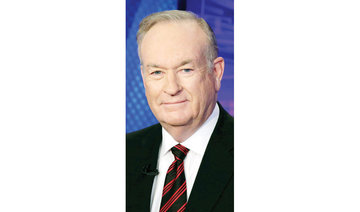
NEW YORK: Fox News Channel’s parent company fired Bill O’Reilly on Wednesday following an investigation into harassment allegations, bringing a stunning end to cable news’ most popular program and one that came to define the bravado of his network over 20 years.
O’Reilly lost his job on the same day he was photographed in Rome shaking the hand of Pope Francis. By the evening, “The O’Reilly Factor” no longer bore his name, simply titled “The Factor.”
The downfall of Fox’s most popular — and most lucrative — personality began with an April 1 report in The New York Times that five women had been paid a total of $13 million to keep quiet about disturbing encounters with O’Reilly, who continued to deny any wrongdoing in a statement hours after he was fired. Dozens of his show’s advertisers fled within days, even though O’Reilly’s viewership increased.
O’Reilly’s exit came nine months after his former boss, Fox News CEO Roger Ailes, was ousted following allegations of sexual harassment.
Following the Times story, 21st Century Fox said it had asked the same law firm that investigated Ailes to look into O’Reilly’s behavior. 21st Century Fox leaders Rupert Murdoch and his sons Lachlan and James said in a memo to Fox staff that their decision to ax O’Reilly came following an “extensive review” into the charges.
“I understand how difficult this has been for many of you,” Rupert Murdoch said in a memo to Fox staff.
O’Reilly, denied a chance to say goodbye to his Fox viewers, did so via a statement.
“It is tremendously disheartening that we part ways due to completely unfounded claims,” he said. “But that is the unfortunate reality that many of us in the public eye must live with today. I will always look back on my time at Fox with great pride in the unprecedented success we achieved and with my deepest gratitude to all my dedicated viewers.”
O’Reilly’s dismissal doesn’t signal any change of direction for the network: Fox said conservative pundit Tucker Carlson would move into O’Reilly’s time slot — the second time in three months he’s replaced an exiting prime-time personality. Carlson, a veteran who has hosted shows on CNN, MSNBC and PBS, had taken over for Megyn Kelly in January when she announced she was moving to NBC News. “The Five,” a talk show with five rotating hosts that regularly airs at 5 p.m. ET, will move into the 9 p.m. time slot. Eric Bolling will host a new show that airs at 5 p.m. starting next month, the company said.
Dana Perino, who had been subbing for O’Reilly who had been on vacation for the past few days, acknowledged his departure at the top of “The Factor.” At the end of the show, she paid him a warm tribute.
Noting the “dramatic changes,” Perino said: “It is the end of the era . Bill has been the undisputed king of cable news, and for good reason.”
She also noted his devoted fans and their loyalty to the show.
O’Reilly, 67, had ruled the “no spin zone” on television with a quick smile and an even quicker temper. He pushed a populist, conservative-leaning point of view born from growing up on Long Island, and was quick to shout down those who disagreed with him. Fans loved his willingness to talk back to power or point out hypocrisy among liberal politicians or media members.
O’Reilly and President Donald Trump are both “crowd-pleasing showmen who know how to signal to loyalists in their audience that they are not taking themselves quite as seriously as their detractors are,” said news consultant Andrew Tyndall. “Half of the fun that they have with their audiences comes from watching the outrage that they manage to provoke.”
“What Rush Limbaugh was to talk radio, Bill O’Reilly has been to conservative television,” said Mark Feldstein, communication professor at the University of Maryland. “You can’t underestimate the influence and the profits that he brought into Fox News for all these years and that’s why they hesitated so long in doing the right thing.”
His show generated $178 million in advertising revenue in 2015, according to Kantar Media. Before the advertising boycott, there was the prospect of even more: his audience was larger in the first three months of 2017 than it has ever been. With a profit center gone, 21st Century Fox stock fell almost 1 percent Wednesday in heavy trading.
O’Reilly’s pugnacious personality wasn’t just an onscreen affectation, with one of the settlements going to a woman who complained about being shouted at in the newsroom. O’Reilly was alleged to have slowed the careers of women who spurned his advances. One former Fox personality, Juliet Huddy, said she pulled away and fell to the ground when he tried to kiss her, and he didn’t help her up, the Times reported.
One harassment case, from a former producer who said O’Reilly called her and described sexual fantasies and appeared to be masturbating, dated back more than a decade and was widely reported then. While O’Reilly survived then, the accumulation of cases outlined in the Times damaged him much more extensively. For Fox executives, it wasn’t clear when it would end: a campaign to target advertisers was continuing, a group of women demonstrated in front of Fox’s headquarters Tuesday and another woman, a former clerical worker at Fox, called a harassment hotline and accusing the host of boorish behavior.
Some of O’Reilly’s critics were happy with the news.
Author Stephen King tweeted: “New book by Fox News: Killing Bill O’Reilly.” It referred to O’Reilly’s series of best-selling books on the deaths of major historical figures.
“Mission accomplished,” said Keith Olbermann, who frequently tweaked O’Reilly on an MSNBC show that competed in the same time slot for several years. Olbermann said that when he was working at Fox Sports in 1999, he helped a friend get a job at Fox News. She quit the job — and the business — due to her treatment by O’Reilly, he said.
“This has been going on for decades and I hope his having to go out in shame and disgrace makes things just a little bit better for her and all his victims right now,” he said. “Certainly they make things better for America.”
But many of O’Reilly’s fans took to social media to express their unhappiness at losing their hero. Several suggested that Fox had essentially caved to a left wing campaign. It didn’t help that the controversy was set in motion by the Times, a publication hated in conservative circles.
O’Reilly’s lawyers said he was the victim of an orchestrated campaign by liberal organizations like Media Matters for America, which contacted his advertisers to pressure them to leave the show. Conservative personality Glenn Beck — who once lost a job at Fox because a similar campaign choked his program of paying advertisers — came to O’Reilly’s defense on his radio show.
“You need to write and call Fox News Channel today and tell them, you can lose your advertisers or you can lose your viewers,” Beck said on his radio show hours before the firing. “But you have to put some spine back into the Murdoch family and the Fox News Channel board because you are about to lose Bill O’Reilly.”
He was too late.
O’Reilly is also one of the country’s most popular nonfiction authors. The books in his “Killing” historical series, including “Killing Lincoln” and “Killing Reagan,” have consistently sold 1 million or more copies in hardcover, a rare achievement in publishing, and his platform on Fox enabled him to promote his work. He has also had best-sellers with everything from the memoir “A Bold Fresh Piece of Humanity” to his most recent work, “Old School,” which includes passages urging the respectful treatment of women.
O’Reilly and co-author Martin Dugard are due to release another book in the “Killing” series in September, and a spokeswoman for publisher Henry Holt and Co. said that plans had not changed.
Vatican spokesman Greg Burke confirmed O’Reilly was in the VIP section for the pope’s Wednesday appearance. Burke, a former Fox News correspondent in Rome, denied having facilitated the tickets. Such tickets can be obtained via special request to the papal household from embassies, high-ranking churchmen or Vatican officials.
Francis always swings by the VIP seats at the end of his audience for a quick round of handshakes. A photographer from the Vatican newspaper L’Osservatore Romano snapped a photo of Francis reaching out to shake his hand.

Fox News Channel dismisses Bill O’Reilly, its biggest star
Saudi who swapped ejection seats for tech reviews — and topped KSA charts
- In an exclusive interview with Arab News, the host of ‘2You’ and ‘Up To Date KSA’ talks about digital wellness, AI’s future, and his plans to fill the gap in Arabic tech content
- Top Arab content creator in Saudi Arabia’s 2025 top 10 most-viewed YouTube channels describes milestone as ‘shockingly’ positive
LONDON: Speaking to Faisal Al-Saif, a self-described tech lover, one of the least likely things you expect to hear is advice on disconnecting from technology.
Yet the idea of a “tech diet” — more commonly known as digital wellbeing — takes on added weight when it comes from someone whose work revolves around gadgets and who relies on social media as their primary platform.
Beyond this seemingly analytical, Web 1.0-style perspective, Al-Saif draws on more than two decades of experience as a tech expert — or, in today’s terms, a content creator.
“I’m an early believer that technology is here to connect us more, to make the world even smaller than what it is, and make us just more active, more productive, and have more time for our religion, for our families and for our actual lives,” Al-Saif told Arab News.
Al-Saif trained as an aircraft engineer at BAE Systems, where he specialized in ejection seats for Royal Saudi Air Force jets, before entering broadcasting in 2004, hosting and producing KSA2’s English-language “2You” and, later, the technology show “Up To Date KSA.”
In 2009, he pivoted to YouTube — a platform with more limited reach and no monetization at the time — to help fill the gap in Arabic tech content.
“Back then, if you searched about a device or a system or a piece of information, the main language you would find the result in was English. So, I just started creating a channel and putting some good content in (both) Arabic and in English,” he said.
This approach required filming videos twice. Initially, videos in English drew more views, while Arabic lagged, but that shifted month by month as Arabic content gained traction.
“To put it in perspective, back then, it wasn’t a source of income — not a main, not a minor, not a partial.”
Today, Al-Saif’s channel delivers straightforward reviews that guide viewers on whether to buy or avoid products based on their needs, not brand pressure.
“I love creating content that gives value to the people. I love simplifying information. I love tech in a crazy way,” he said. “I like to see new tech, test it, be an early adopter of it. Tell people, ‘This is good because of this, and (that) could have been better with those implemented.’ Tell people to buy or not to buy based on their preferences, not based on companies and what they want to push.”
Creators typically earn through ad revenue, fan funding, product placement, and sponsorships, though Al-Saif distances himself from the “influencer” label.
“Part of it is that struggle we went through throughout the years, of trying to create valuable business propositions for everybody who works with us, being very fair and honest about what I present, and trying to help companies, just to help companies. Not seeking business.”

Earlier this month, almost two decades after starting his channel, Al-Saif was named top Arab content creator — and the only regional entry — in Saudi Arabia’s 2025 top 10 most-viewed YouTube channels, a milestone he described as “shocking” in a positive sense.
“Being on that top 10 list gives me a cool push after 16 years,” he said of his UTD Saudi channel, which has 8.92 million subscribers.
“(When) I go into a hospital, I find a lot of Saudis that know me. But also, I find some Filipino nurses coming to me (telling me), ‘I watch your videos.’ I like that kind of diversity (which) is only possible on YouTube and educational content.”
Al-Saif views YouTube as a modern visual library to help informed decisions. While social media shifts toward short-form videos, he believes the platform is resisting this trend.
“If it’s all short-term content, it’s us supporting that short attention span (which) is being developed with people.”
He champions long-form reviews, beginning with a brief story, then details, to encourage informed decisions. By contrast, he argued, three-second or ultra-short videos may be excellent at grabbing attention, but are largely useless for serious decisions, “unless (perhaps) it’s a cooking video.”
In 2012, after seeing an opening, Al-Saif left BAE Systems — “initially only for two years” — to launch Tech Pills Productions, helping companies such as Intel, Microsoft, and HP create content, a move that boosted his career. He later diversified into tech startups, though he shuns the “investor” label.
“I don’t see myself as an entrepreneur or an investor. I just see myself as a tech lover,” he said. “I try to push myself into diversifying the business and creating other pillars. So, I went into other types of investments, working and developing applications with different partners, and all of that went well. That part made me more comfortable creating content for the joy of it instead for the business side of it.”
In 2021, Al-Saif backed Karaz (Arabic for “cherries”), an EHR platform using IoT, AI, and real-time data for healthcare, originally a gamified app for diabetic children. “(I’m drawn to a project) if there’s a human touch,” he said. “It’s relating data to human change in a positive way that made me not hesitate and go for it.”
While AI pitches flood in, past flops have left him with a degree of “marketing resistance.”
“I find that AI does add value if you have those (proper) steps into getting into AGI (artificial general intelligence) and the later steps that will come. It’s the proper development. But the hype about relating everything to AI, that part, I’m definitely against,” he said.
AI has dominated headlines for three years, fueling an economic boom, and sparking debate over job losses and ethical risks. Al-Saif acknowledges the technology’s “endless opportunities,” but doubts the hype will last and that AI will ultimately drive the world. “They will find something else; either it’s diverted from AI or from another field in technology to create that marketing sense.”
Asked what people should be more aware of, he urged greater public education on AI’s dual nature.
“It’s a knife that you can cook with, or it’s a knife that can stab someone. There’s a seriousness about AI, and sadly, the world does not do enough regarding the sense of awareness,” he said.
Without greater understanding, unchecked AI could create generations shaped entirely by whatever information they are fed, regardless of truth, he said, adding that the technology already enables bad behavior excused as “AI-generated” and blurs fact and fiction, making regulations essential.

Saudi Arabia is leading responsibly through its Data and AI Authority, he said. “I think they’re going very well within multiple sides: the regulatory part, the governance side, as well as when it comes to investing heavily with the infrastructure and AI companies.”
Through the authority, the Kingdom has launched an ambitious plan to position itself at the forefront of AI technology. Al-Saif has contributed directly and indirectly, including advising on public strategies such as the Riyadh Charter on AI Ethics in the Islamic World.
“It’s a very interesting place to be (at a) very interesting time. I’ve sat with the Crown Prince (Mohammed bin Salman). He talked about AI, his vision, and how AI will create this next wave of businesses and next wave of economy.”
Asked whether our society is obsessed with technological progress, Al-Saif replies that “we are adopting (technologies) for what we need,” but adds that limits, such as Australia’s recent social media ban for youth, are needed. “But the thing is, they don’t ban stuff in the Kingdom of Saudi Arabia. They try to create a system.”
At home, he supervises his children’s screen time or watches content together. “YouTube is still, I find, the safest platform (out) there because of its nature of long videos and vlogs. It is much more mature than any other platform when it comes to how to censor, how to control, how to do things.”
However, he agreed that younger generations, as tech natives, perceive tech interaction differently, specifically when it comes to privacy.
“Privacy is kind of a stretchy thing. I define privacy different than my kids when they grow up, and that made me think of privacy different. It’s not that we’re letting go of information. It’s the environment that we live in that creates that sense of privacy.”
Al-Saif believes privacy has already been reshaped — not as a value we hold dear, but as an illusion where true personal boundaries have been eroded. What remains is a mere reflection of our actions online, not tied to our names, but reduced to anonymous data points or numbers in the digital ether.
For Al-Saif, part of the answer lies in the power of disconnection, an approach that he has strongly advocated.
“I give myself an hour or two a day maximum (online) to know about certain other stuff. My advice for anybody who wants to live 12 hours of cool life is: Try to experience or to learn something unrelated to tech.”
Pointing to a beehive he keeps in the office, Al-Saif added: “There are other fields that I like to, let’s say, learn about. It’s a clear state of mind that you reach with it. And I just try to do as normal, natural things as possible; try to work with gadgets and appliances that don’t have batteries.”


