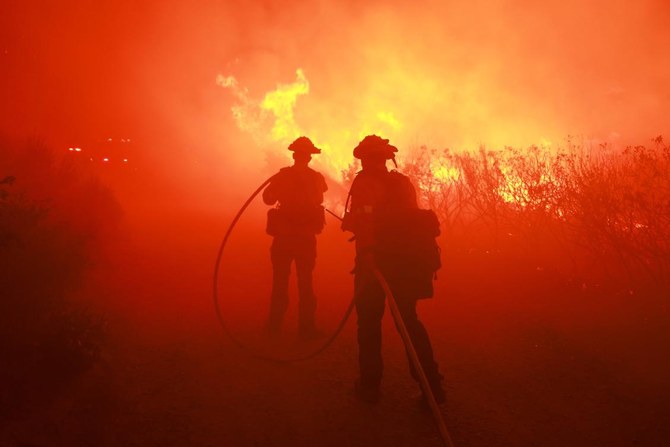
GORMAN, California: Strong winds pushed flames through dry brush in mountains along Interstate 5 north of Los Angeles on Sunday, and officials warned residents in the wildfire’s path to be prepared to leave if it explodes in size again.
Los Angeles County’s first major wildfire of the year swiftly grew to nearly 23 square miles (60 square kilometers), one day after it forced the evacuation of at least 1,200 campers, off-roaders and hikers from the Hungry Valley recreation area.
The blaze, dubbed the Post Fire, was just 2 percent contained Sunday evening. No injuries were reported. The cause was under investigation.
Firefighters working in sweltering conditions and steep terrain raced to douse spot fires that erupted as unpredictable winds blew embers ahead of the flames, said Kenichi Haskett, a section chief for the LA County Fire Department. The gusts also hampered efforts by aircraft crews to drop water and fire retardant, he said.
“When it’s windy, it just sprays the water everywhere we don’t need it. So that’s a challenge,” Haskett said.
Meanwhile in Northern California, a small wildfire sparked Sunday prompted evacuation orders and warnings for a sparsely populated area near Lake Sonoma. The so-called Point Fire sent up a huge plume of dark smoke as it churned through brush and timber about 80 miles (130 kilometers) north of San Francisco. It was 15 percent contained.
The Southern California fire erupted Saturday afternoon near I-5 in Gorman, about 60 miles (100 kilometers) northwest of Los Angeles. Two structures burned within the evacuated recreation area.
Flames were moving toward Pyramid Lake, a popular destination for boaters that was closed as a precaution on Father’s Day. No houses were threatened Sunday, but officials warned residents of Castaic, home to about 19,000 people, that they should prepare to leave if the fire pushes further south.
“If you’re in a warning area, be prepared with a ‘go bag,’ with overnight clothes and your cellphone, your medicines, your glasses. Have your car fueled up,” said Haskett. “Be ready to evacuate.”
Low humidity and gusts around 50 mph (80 kph) were expected throughout the day, and winds could pick up speed after sundown, warned the National Weather Service office for Los Angeles.
About 75 miles (120 kilometers) to the east, the nearly 2-square-mile (5-square-kilometer) Hesperia Fire forced road closures and prompted evacuation warnings after it broke out Saturday near mountain communities in San Bernardino County. The blaze was 19 percent contained Sunday evening.

Strong winds, steep terrain hamper crews battling Los Angeles area’s first major fire of the year
Short Url
https://arab.news/ye9u4
Strong winds, steep terrain hamper crews battling Los Angeles area’s first major fire of the year
- Los Angeles County’s first major wildfire of the year swiftly grew to nearly 60 square kilometers
- The blaze, dubbed the Post Fire, was just two percent contained Sunday evening
Barcelona train crash kills 1 in Spain's second deadly rail accident in days
- The northeastern region's Interior Minister, Nuria Parlon, told local media the crash killed one person and injured 37
BARCELONA: A commuter train near Barcelona ploughed into the rubble of a collapsed wall on Tuesday, killing one and injuring dozens in Spain's second deadly rail accident in days.
The latest incident is likely to raise more questions about Spanish transport safety, coming two days after the collision of two high-speed trains in the southern region of Andalusia killed 42 people -- the country's deadliest rail accident in more than a decade.
On Tuesday, "a retaining wall collapsed onto the tracks, causing an accident involving a passenger train" in the municipality of Gelida, around 40 kilometres (25 miles) west of Barcelona, the Catalonia region's civil protection agency posted on social media.
The northeastern region's Interior Minister, Nuria Parlon, told local media the crash killed one person and injured 37 -- several seriously.
"We regret to announce the death of one of the passengers on the train," said Parlon, adding authorities had not yet completed the identification process of the deceased.
"Of the total number of people treated, five are in serious condition," she added.
Emergency workers used torches to survey the wreckage of the derailed train carriage, which had turned into a mass of crumpled metal, an AFP reporter saw on Tuesday night.
Spanish rail infrastructure operator Adif said a storm caused a wall to fall, creating the rubble that the train slammed into. Catalan commuter trains would remain suspended, it added.
Earlier on Tuesday, Spain's king and queen visited the site where two high-speed trains collided on Sunday as well as survivors of the accident that injured more than 120 people, 37 of whom are still in hospital.
The country's deadliest rail accident in more than 12 years took place when a train operated by rail company Iryo, travelling from Malaga to Madrid, derailed near Adamuz in the southern Andalusia region.
It crossed onto the other track, where it crashed into an oncoming train heading to the southern city of Huelva, which also derailed.
Dressed in dark clothing, King Felipe VI and Queen Letizia shook hands with emergency services workers near the spot where the mangled wreckage of the trains lay.
They then visited a hospital in the nearby city of Cordoba, where some of the injured are being treated.
Speaking to reporters after leaving the hospital, Felipe said he wanted to "convey the affection of the entire country" to the victims.
Santiago Salvador, a Portuguese national who broke a leg in the accident, said he felt lucky to be alive.
"I was thrown through the carriage; it felt like being on a carousel," Salvador, his face covered in cuts, told Portuguese state television RTP.
"It looked like hell. There were people who were very seriously injured."
- Crack on tracks -
Sunday's derailment was Spain's deadliest rail accident since 2013, when 80 people were killed after a train veered off a curved section of track outside the northwestern city of Santiago de Compostela.
Flags flew at half-mast on public buildings, television anchors wore black, and cabinet ministers curtailed public appearances as Spain observed the first of three days of national mourning.
The government has vowed a full and transparent investigation into the cause of the accident.
Unlike the 2013 disaster, the derailment occurred on a straight section of track, and the trains were travelling within the speed limit of 250 kilometres (155 miles) for the area concerned, officials said.
Spanish media report that the probe is focusing on a crack more than 30 centimetres (12 inches) long in the track at the site of the accident.
The crack may have resulted from "a poor weld or a weld that deteriorated due to train traffic or weather", daily newspaper El Mundo reported, citing unidentified technicians with access to the inquiry.
Transport Minister Oscar Puente said investigators were looking to see if a broken section of rail was "the cause or the result" of the derailment.
He said the Iryo train was "practically new" and the section of track where the disaster happened had been recently renovated, making the accident "extremely strange".
- Sabotage ruled out -
Interior Minister Fernando Grande-Marlaska said "the possibility of sabotage was never considered" and that "there has never been any element suggesting otherwise."
The head of state rail operator Renfe, Alvaro Fernandez Heredia, said human error has "been practically ruled out".
Rail operator Adif on Tuesday also imposed a temporary 160 kph speed limit on parts of the high-speed line between Madrid and Barcelona after train drivers reported bumps.
Maintenance crews will inspect the tracks overnight, and the restriction is expected to be lifted if no issues are found, the company added.
The latest incident is likely to raise more questions about Spanish transport safety, coming two days after the collision of two high-speed trains in the southern region of Andalusia killed 42 people -- the country's deadliest rail accident in more than a decade.
On Tuesday, "a retaining wall collapsed onto the tracks, causing an accident involving a passenger train" in the municipality of Gelida, around 40 kilometres (25 miles) west of Barcelona, the Catalonia region's civil protection agency posted on social media.
The northeastern region's Interior Minister, Nuria Parlon, told local media the crash killed one person and injured 37 -- several seriously.
"We regret to announce the death of one of the passengers on the train," said Parlon, adding authorities had not yet completed the identification process of the deceased.
"Of the total number of people treated, five are in serious condition," she added.
Emergency workers used torches to survey the wreckage of the derailed train carriage, which had turned into a mass of crumpled metal, an AFP reporter saw on Tuesday night.
Spanish rail infrastructure operator Adif said a storm caused a wall to fall, creating the rubble that the train slammed into. Catalan commuter trains would remain suspended, it added.
Earlier on Tuesday, Spain's king and queen visited the site where two high-speed trains collided on Sunday as well as survivors of the accident that injured more than 120 people, 37 of whom are still in hospital.
The country's deadliest rail accident in more than 12 years took place when a train operated by rail company Iryo, travelling from Malaga to Madrid, derailed near Adamuz in the southern Andalusia region.
It crossed onto the other track, where it crashed into an oncoming train heading to the southern city of Huelva, which also derailed.
Dressed in dark clothing, King Felipe VI and Queen Letizia shook hands with emergency services workers near the spot where the mangled wreckage of the trains lay.
They then visited a hospital in the nearby city of Cordoba, where some of the injured are being treated.
Speaking to reporters after leaving the hospital, Felipe said he wanted to "convey the affection of the entire country" to the victims.
Santiago Salvador, a Portuguese national who broke a leg in the accident, said he felt lucky to be alive.
"I was thrown through the carriage; it felt like being on a carousel," Salvador, his face covered in cuts, told Portuguese state television RTP.
"It looked like hell. There were people who were very seriously injured."
- Crack on tracks -
Sunday's derailment was Spain's deadliest rail accident since 2013, when 80 people were killed after a train veered off a curved section of track outside the northwestern city of Santiago de Compostela.
Flags flew at half-mast on public buildings, television anchors wore black, and cabinet ministers curtailed public appearances as Spain observed the first of three days of national mourning.
The government has vowed a full and transparent investigation into the cause of the accident.
Unlike the 2013 disaster, the derailment occurred on a straight section of track, and the trains were travelling within the speed limit of 250 kilometres (155 miles) for the area concerned, officials said.
Spanish media report that the probe is focusing on a crack more than 30 centimetres (12 inches) long in the track at the site of the accident.
The crack may have resulted from "a poor weld or a weld that deteriorated due to train traffic or weather", daily newspaper El Mundo reported, citing unidentified technicians with access to the inquiry.
Transport Minister Oscar Puente said investigators were looking to see if a broken section of rail was "the cause or the result" of the derailment.
He said the Iryo train was "practically new" and the section of track where the disaster happened had been recently renovated, making the accident "extremely strange".
- Sabotage ruled out -
Interior Minister Fernando Grande-Marlaska said "the possibility of sabotage was never considered" and that "there has never been any element suggesting otherwise."
The head of state rail operator Renfe, Alvaro Fernandez Heredia, said human error has "been practically ruled out".
Rail operator Adif on Tuesday also imposed a temporary 160 kph speed limit on parts of the high-speed line between Madrid and Barcelona after train drivers reported bumps.
Maintenance crews will inspect the tracks overnight, and the restriction is expected to be lifted if no issues are found, the company added.
© 2026 SAUDI RESEARCH & PUBLISHING COMPANY, All Rights Reserved And subject to Terms of Use Agreement.


