

Karachi’s professional butchers are the real heroes of Eid Al-Adha 

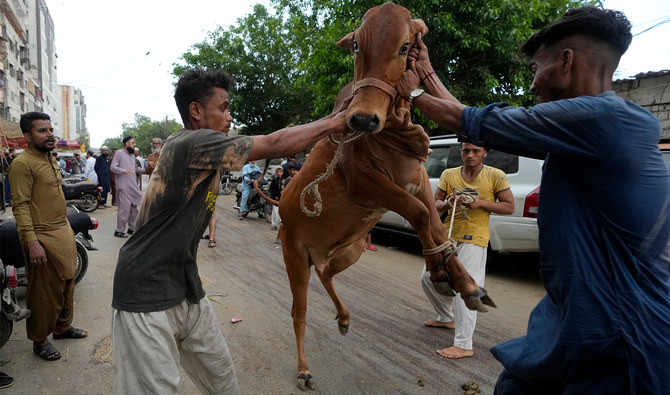
People struggle to control a bull prepared for slaughtering on the occasion of the Eid al-Adha holiday, in Karachi, Pakistan, on June 17, 2024. (AP)
Short Url
Updated 17 June 2024
Follow

Karachi’s professional butchers are the real heroes of Eid Al-Adha 

  • Butchers are booked in advance by customers ahead of Eid holiday 
  • Seasonal butchers also use the holiday to make some extra income 

KARACHI: Qayamuddin Qureshi, a 70-year-old butcher affectionately known as Qamo Bhai, works year-round near Jubilee Chowk in the Old City Area of Pakistan’s largest city of Karachi. 

But ahead of Eid Al-Adha each year, the third-generation butcher’s phone rings off the hook as customers call him for advance bookings to visit their homes and slaughter cows, sheep and goats to mark the annual religious holiday.

The demand for professional butchers surges on Eid Al-Adha, or the Feast of the Sacrifice, traditionally marked by the slaughter of animals, whose meat is shared with family members and the poor, while amateur and seasonal butchers also try to make an extra buck during the holiday season.

“People book us [professional butchers] in advance and those who book in advance get the benefit of this early reservation,” Qureshi, a self-described ‘man of his word’ who has been working as a butcher since the age of 10, told Arab News, as he cut up a piece of meat at a shop in Hassan Ali Hothi Market. 

“By the grace of Allah, I am a family butcher... and this is our second and third generation in the profession … I do a lot of work, execute the job in the best manner and make customers satisfied and that’s why they keep calling me back again.”

Last year, Pakistanis sacrificed over six million animals worth $1.9 billion during the three-day Eid Al-Adha festival, according to estimates shared by the Pakistan tanners’ association.

“What we earn during the three days [of Eid Al-Adha] is enough to eat for the six months,” Qureshi said.

Earlier this month, the Meat Merchants Association in Karachi announced the official rates for animal slaughtering services during Eid, with the price for cows set at around $70, for goats at $32 and camels at $144. Amateur butchers often charge as low as $18.

The service charges are highest on the first day of Eid.

“There is a lot of demand for the first day. For example, a cow that costs about a million rupees would be slaughtered for Rs50,000 on the first day,” Qureshi said, adding that the charges gradually decreased by the third day.

Muhammad Naseem Qureshi, another longtime butcher, said he had many returning customers. 

“You can’t find good butchers,” he said. “So the people catch us by themselves. They know that we are good butchers.”

Naseem said he was now refusing orders as his services were fully booked. 

“We have so much work that we have to refuse people,” he said. “We have a ‘Housefull’ sign displayed outside.”

SEASONAL BUTCHERS

Old hands like Qureshi said amateur butchers were easy to identify, particularly though their “tools and slaughtering skills.” 

“They slaughter and work on one animal with the help of four people, but a professional butcher works on the animal alone,” he said. 

But with butchers in such high demand over Eid, not everyone gets to book the craftsman of their choice, particularly as the professionals charge more. 

“The animals are also very expensive,” Karachi resident Hajji Noshad said. “We are [often] compelled to bring in unprofessional butchers who mostly ruin the meat and our sacrifice.”

But for seasonal butchers, Eid Al-Adha is too good an opportunity to let go to generate some extra income.

“We have a family business of sanitary hardware,” Saeed Akbar Ali, who works as a butcher over Eid, told Arab News.

“The job of butcher we do... we slaughter 10-12 animals a day... to meet the expenses for Eid.”


IMF board to approve Pakistan reviews today ‘if all goes well,’ say officials

Updated 4 sec ago
Follow

IMF board to approve Pakistan reviews today ‘if all goes well,’ say officials

  • IMF’s executive board is scheduled to meet today to discuss the disbursement of $1.2 billion
  • Economists say the money will boost Pakistan’s forex reserves, send positive signals to investors

KARACHI: The International Monetary Fund’s (IMF) executive board is scheduled to meet today, Monday, to approve the release of about $1.2 billion for Pakistan under the lender’s two loan facilities, said IMF officials who requested not to be named.

The IMF officials confirmed the executive board was going to decide on the Fund’s second review under the $7 billion Extended Fund Facility (EFF) and first review under the $1.4 billion Resilience and Sustainability Facility (RSF), a financing tool that provides long-term, low-cost loans to help countries address climate risks.

“The board meeting will be taking place as planned,” an IMF official told Arab News.

“The board is on today yes as per the calendar,” said another.

A well-placed official at Pakistan’s finance ministry also confirmed the board meeting was scheduled today to discuss the next tranche for Pakistan.

The IMF executive board’s meeting comes nearly two months after a staff-level agreement (SLA) was signed between the two sides in October.

Procedurally, the SLAs are subject to approval by the executive board, though it is largely viewed as a formality.

“If all goes well, the reviews should pass,” said the second IMF official.

On approval, Pakistan will have access to about $1 billion under the EFF and about $200 million under the RSF, the IMF said in a statement in October after the SLA.

The fresh transfer will bring total disbursements under the two arrangements to about $3.3 billion, it added.

Experts see smooth sailing for Pakistan in terms of the passing of the two reviews, saying the IMF disbursements will help the cash-strapped nation to strengthen its balance of payments position.

Samiullah Tariq, group head of research at Pakistan Kuwait Investment Company Limited, said the IMF board’s approval will show that Pakistan’s economy is on the right path.

“It obviously will help strengthen [the country’s] external sector, the balance of payments,” he told Arab News.

Until recently, Pakistan grappled with a macroeconomic crisis that drained its financial resources and triggered a balance of payments crisis.

Pakistan has reported financial gains since 2022, recording current account surpluses and taming inflation that touched unprecedented levels in mid-2023.

Economists also viewed the IMF’s bailout packages as crucial for cash-strapped Pakistan, which has relied heavily on financing from bilateral partners such as Saudi Arabia, China and the United Arab Emirates, as well as multilateral lenders.

Saudi Arabia, through the Saudi Fund for Development, last week extended the term of its $3 billion deposit for another year to help Pakistan boost its foreign exchange reserves, which stood at $14.5 billion as of November 28, according to State Bank of Pakistan statements.

“In our view this [IMF tranche] will be approved,” said Shankar Talreja, head of research at Karachi-based brokerage Topline Securities Limited.

“This will help strengthen reserves and will eventually help a rating upgrade going forward,” he said.

The IMF board’s nod, Talreja said, would also send a signal to the international and local investors regarding the continuation of the reform agenda by Pakistan’s government.