 Turkey has welcomed a US missile strike on Syria’s Shayrat Airbase but called the move insufficient, renewing its call for no-fly and safe zones in the war-torn country.
President Recep Tayyip Erdogan said Washington’s move was positive but that more needs to be done to tackle the situation in Syria.
During an inauguration ceremony in the southern province of Hatay, Erdogan said: “I don’t see this as sufficient although it is a tangible and positive move against the war crimes of Syria.”
“We think that the latest developments clearly justified Turkey’s stance on creating terror-free safe zones in Syria,” he added. “Time has come to take serious and result-oriented steps to protect Syrian people.”
Turkey’s Foreign Minister Mevlut Cavusoglu confirmed that Turkey, which is part of the US-led coalition fighting Daesh, was informed about the US strike beforehand.
He told reporters in Antalya that creating safe zones for civilians in Syria has now become more important than ever.
Ibrahim Kalin, Turkey’s presidential spokesman, said that chemical attacks targeting civilians could not “go unpunished.”
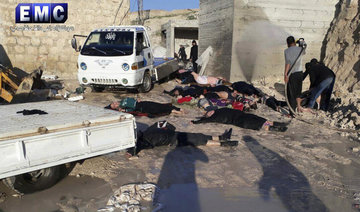
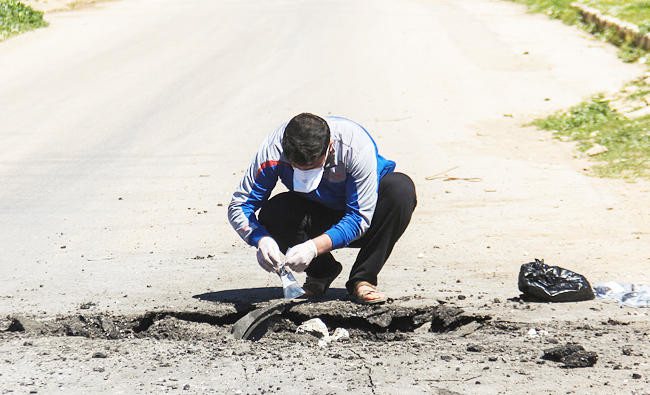
Kalin reiterated the need to implement a no-fly and safe zones in Syria urgently to avoid similar massacres like the one following the apparent chemical attack in Idlib province. Some victims of that attack were treated in Turkey.
Turkey’s Defense Minister Fikri Isik also welcomed the US strikes by saying that “it is important that Mr. Trump kept his promise and staged the operation.” He called for “solidarity” in the international community on the issue.
Turkey recently ended its Euphrates Shield military operation it launched in August to fight Daesh in Syria, while Erdogan announced that the country is planning new operations this spring.
Turkey also participated in the Astana cease-fire negotiations with the Syrian government, along with Russia.
Turkey’s strategic support
Experts told Arab News that the US strike seems to be a cosmetic one, and is unlikely to escalate further. However, in the case of an escalation, the US would surely need to use Turkey’s strategic southern airbase of Incirlik as a staging area for major incursions into Syria.
Ahmet Han, international relations professor at Istanbul’s Kadir Has University, said Turkey will now have to follow a more reactive policy on Syria that will be mainly focused on the preferences of Russia and the US.
“The priorities of Turkey and Russia are clearly divergent on the Syria issue. Turkey may search for a common understanding with the US, but the latter does not seem to transform its position in favor of Turkey,” Han told Arab News.
Han also noted that Ankara’s calls for a no-fly zone in Syria would probably remain unanswered. He added: “Whenever parties that are able to enforce such a measure in Syrian quagmire refer to a ‘no-fly zone’, what they mean by the concept seems to involve vast differences.”
Metin Gurcan, an ex-military officer and security analyst at the Istanbul Policy Center, said it is still too early to talk about any implications regarding Ankara’s calls for a no-fly zone in Syria.
“The east of the Euphrates is under the US zone of influence, while Russia thinks that the west part of it is under its influence in terms of airspace dominance; and this strike strengthened the profile of the US for the first time in the western part of the Euphrates,” Gurcan told Arab News.
However, according to Gurcan, Ankara unnecessarily makes hasty statements against this US-Russia imbroglio about northern Syria.
“Ankara looks sandwiched between Trump and Putin in its Syria policy, and its policy stances, which are changing each week, create unpredictability and a confidence problem,” he said.
“In order to get support for its demands for a no-fly zone, Turkey should stick to its principles while taking Russia as a counterpart for a no-fly zone in the western Euphrates, and the US for the eastern part.”
Choice over Russia
According to Gurcan, Ankara will be influenced the most, especially after Russia announced that it would reduce military cooperation with the US, and Ankara will have to make a choice.
In this regard, Cavusoglu told reporters on April 7 that Turkey has initiated contacts with Russian Foreign Minister Sergei Lavrov and US Secretary of State Rex Tillerson, who already paid a strategic visit to Ankara to discuss possible cooperation avenues with Turkey against Daesh.
Gurcan also noted that from now on Turkey should not respond militarily in the region around the Euphrates, as neither the US nor Russia would tolerate this when designing their own regional plans.
“Creating de facto micro realities to gain more leverage at a diplomatic level in Syria is now over for Ankara,” Gurcan said.
Oytun Orhan, a researcher on Syria at Ankara-based think-tank Orsam, said the latest US attack might create a suitable environment for cooperation over safe zones in Syria.
“But the problem is that it is too hard for both to unite on where to establish these safe zones. Turkey will oppose to establish a safe zone in YPG (Kurdish People’s Protection Units) areas, which will consolidate their entity,” Orhan told Arab News.
According to Orhan, a Turkish military response in Syria would totally depend on possible Turkey-US cooperation.
“If this latest attack paves the way for a US-Turkey cooperation, then we could expect that the country may extend its military operations in Syria, including Manbij, Afrin and Idlib,” he noted.