Festival-goers: ‘Films open up doors to other people, cultures and countries’

1 / 2
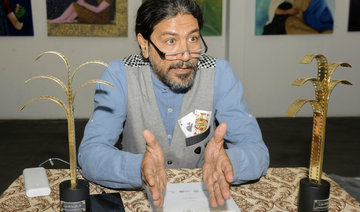
In his three-minute movie, ‘Sound,’ Mansour Asad Khan depicts the life and trials of deaf people and how society tends to treat them.
2 / 2
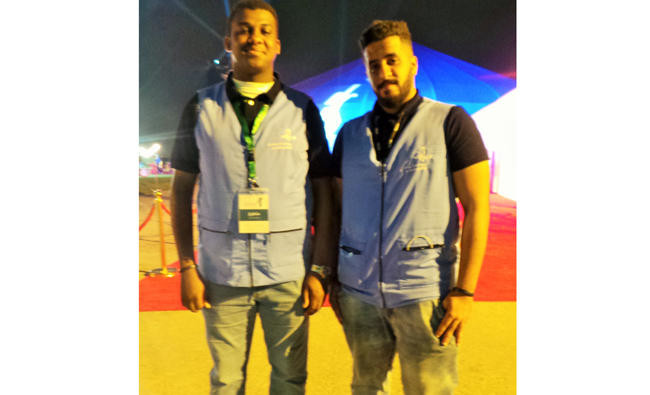
Student volunteers Mohammed Al Shahri (left) and Yousef Al Rumaihi (right) are keen film enthusiasts.
Updated 31 March 2017
Follow

Festival-goers: ‘Films open up doors to other people, cultures and countries’

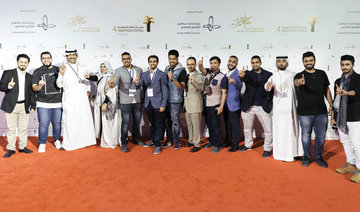
DHAHRAN: As the fourth edition of the Saudi Film Festival in Dhahran continues to delight audiences, Arab News got to the heart of the issue and asked festival-goers what movies mean to them.
For some, films are a window to another world while for others, movies can bridge the gap between various cultures and promote a sense of understanding.
“Films and the cinema are a reflection of our lives. At the same time, they open up doors to other cultures and countries. They might be similar to our culture or they might be different but in either case, we get to witness how the world works,” Mohammed Al Shahri, a young student trainee at the University of Dammam’s Nursing College and festival volunteer, told Arab News.
Al Shahri further talks about how the emerging filmmaking industry in Saudi Arabia is promising, saying: “We have stories that are particular to Saudi Arabia. We can open up that window and let people see our culture, both negative and positive. These stories reflect on our image.”
Echoing Al Shahri’s comments, Yousef Al Rumaihi, a student trainee at the King Abdulaziz Center for World Culture, states that encouraging filmmaking is very important.
As a volunteer who dedicates his time to crowd management at the event, Al Rumaihi says he has had the opportunity to watch only one movie so far — “Sami,” which tells the story of a gangster whose daughter has been kidnapped.
Young filmmaker Mansour Asad Khan talks about using cinema to understand people. In his three-minute movie, “Sound,” Khan depicts the life and trials of deaf people and how society tends to treat them.
Despite lasting only three minutes, it was a challenge to bring together the seven crew members needed to shoot the movie. It took Khan two months to complete the filmmaking process for what is his first-ever entry in a nation-wide competition.
Some movies that were screened on the fourth day of this year’s Saudi Film Festival include: “Predicament in Sight” (drama, comedy), “Invitation” (drama, comedy), “Daesh Girl” (drama, thriller) and “Red Rose” (animation, music)


Israel arrests 2 Turkish CNN journalists over live broadcast outside IDF HQ

Updated 03 March 2026
Follow

Israel arrests 2 Turkish CNN journalists over live broadcast outside IDF HQ

  • Police said reporter Emrah Cakmak and cameraman Halil Kahraman were detained on suspicion of filming a sensitive security facility
  • Since the Gaza war began, restrictions have expanded significantly, including tighter limits on filming soldiers on duty and sensitive or strategic sites

LONDON: Israeli police have arrested two Turkish CNN journalists who were broadcasting live outside the Israel Defense Forces’ headquarters in Tel Aviv.

Police said the pair were detained on suspicion of filming a sensitive security facility, according to the Israel Police Spokesperson’s Unit.

Reporter Emrah Cakmak and cameraman Halil Kahraman, from the network’s Turkish-language channel, had been reporting near the IDF’s Kirya military headquarters on Tuesday after Iran launched another missile barrage at Tel Aviv and other parts of central Israel.

During the live broadcast, two men believed to be soldiers approached the crew and seized the reporter’s phone, according to initial reports and a video circulating online that could not be independently verified.

Police said officers were dispatched after receiving reports of two people carrying cameras and allegedly broadcasting in real time for a foreign outlet.

Israel’s long-standing military censorship system, overseen by the IDF Military Censor, has long barred journalists and civilians from publishing material deemed harmful to national security.

Since the Gaza war began, restrictions have expanded significantly, including tighter limits on filming soldiers on duty and sensitive or strategic sites.

After a series of similar incidents involving foreign media — most of them Palestinian citizens of Israel working for Arab-language and international media, along with foreign journalists — during the 12-Day War, Israeli police halted live international broadcasts from missile impact sites, citing concerns that exact locations were being revealed.

The Government Press Office later imposed a blanket ban on live coverage from crash and impact areas.

Communications Minister Shlomo Karhi and National Security Minister Itamar Ben-Gvir subsequently ordered that all foreign journalists obtain prior written approval from the military censor before broadcasting — live or recorded — from combat zones or missile strike locations.

Police said that when officers asked the CNN Turk crew to identify themselves, they presented expired press cards and were taken in for questioning.

Burhanettin Duran, head of Turkiye’s Directorate of Communications, condemned the arrests as an attack on the press and said Ankara is working to secure the journalists’ release.