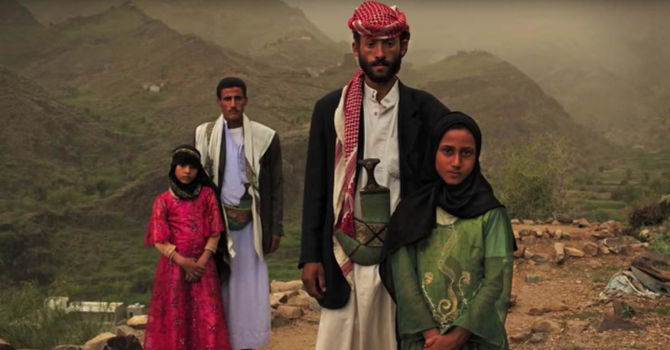
Child marriage soars in Yemen as famine looms — UN

Yemeni child brides with their husbands. (Video grab)
Updated 27 March 2017
Follow

Child marriage soars in Yemen as famine looms — UN

LONDON: Child marriage has soared in Yemen as families struggle to feed their children amid a conflict that has left the country on the brink of famine, the UN children’s agency said on Monday.
More than two thirds of girls in Yemen are married off before they reach 18, compared to half of girls before the conflict escalated, UNICEF said in a report to mark the second anniversary of the war.
It said parents struggling with deepening poverty were increasingly marrying off their daughters to reduce costs and the number of mouths to feed or because they believed a husband’s family could offer better protection.
Around 80 percent of families in Yemen are in debt or are borrowing money to feed their children, the agency said.
Dowry payments — paid by the husband’s family in Yemen — are an additional incentive for poor parents to marry daughters off early, it added.
There is no minimum age of marriage in Yemen where campaigners say girls are sometimes wed at eight or nine. Some die from rape injuries or childbirth complications after becoming pregnant before their bodies are fully developed.
Yemen’s hunger crisis follows two years of civil war pitting the Iran-allied Houthi group against a Saudi-backed coalition, which has caused economic collapse and severely restricted food and fuel imports.
More than 10,000 people have been killed in the conflict and around 3 million people have fled their homes, although some are now returning.
Early marriage is especially common in Al Hudaydah, Hajah and Ibb governorates that host large numbers of uprooted people, UNICEF said.
“One of the first casualties when families are displaced and lose their incomes is girls,” UNICEF’s spokesman in Yemen, Rajat Madhok, told the Thomson Reuters Foundation.
Initial results from a new UNICEF study on child marriage suggest around 44 percent of girls and women are married under the age of 15 in some parts of Yemen.
Bilkis, 16, told researchers how life had become unbearable after she was married at 13.
“I was a child who was not mentally and physically able to be a wife,” the report quoted her as saying. “I was warned not to do anything that children do. Through the window, I could watch other children play.”
Child marriage not only endangers girls’ lives but deprives them of education and opportunities, and increases the risk of domestic and sexual violence, campaigners say. 


Ceasefire with Kurdish-led force extended for another 15 days, Syrian army says

Updated 25 January 2026
Follow

Ceasefire with Kurdish-led force extended for another 15 days, Syrian army says

  • The defense ministry said the extension was in support of an operation by US forces to transfer accused Daesh militants to Iraq
  • The Kurdish-led Syrian Democratic Forces confirmed the ceasefire extension

RAQQA, Syria: Hours after the expiration of a four-day truce between the Syrian government and Kurdish-led fighters Saturday, Syria’s defense ministry announced the ceasefire had been extended by another 15 days.
The defense ministry said in a statement that the extension was in support of an operation by US forces to transfer accused Daesh militants who had been held in prisons in northeastern Syria to detention centers in Iraq.
The Kurdish-led Syrian Democratic Forces confirmed the ceasefire extension.
“Our forces affirm their commitment to the agreement and their dedication to respecting it, which contributes to de-escalation, the protection of civilians, and the creation of the necessary conditions for stability,” the group said in a statement.
Over the past three weeks, there have been intense clashes between government forces and the SDF, in which the SDF lost large parts of the area they once controlled.
Earlier in the day, the Kurdish-led force called on the international community to prevent any escalation.
The end of the truce came as government forces have been sending reinforcements to Syria’s northeast.
Syria’s interim government signed an agreement last March with the SDF for it to hand over territory and to eventually merge its fighters with government forces. In early January, a new round of talks failed to make progress over the merger, leading to renewed fighting between the two sides.
A new version of the accord was signed last weekend, and a four-day ceasefire was declared Tuesday. Part of the new deal is that SDF members will have to merge into the army and police forces as individuals.
The SDF said in a statement Saturday that military buildups and logistical movements by government forces have been observed, “clearly indicating an intent to escalate and push the region toward a new confrontation.” The SDF said it will continue to abide by the truce.
On Saturday, state TV said authorities on Saturday released 126 boys under the age of 18 who were held at the Al-Aqtan prison near the northern city of Raqqa that was taken by government forces Friday. The teenagers were taken to the city of Raqqa where they were handed over to their families, the TV station said.
The prison is also home to some of the 9,000 members of the Daesh group who are held in northeastern Syria. Most of them remain held in jails run by the SDF. Government forces have so far taken control of two prisons while the rest are still run by the SDF.
Earlier this week, the US military said that some 7,000 Daesh detainees will be transferred to detention centers in neighboring Iraq.
On Wednesday, the US military said that 150 prisoners have been taken to Iraq.