North Korea rocket test shows ‘meaningful progress’: South

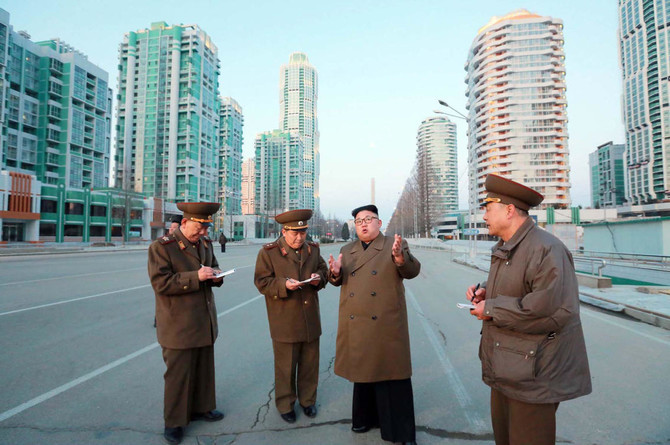
North Korean leader Kim Jong-Un (C) visiting construction sites of Ryomyong street in Pyongyang. (AFP PHOTO/KCNA VIA KNS)
Updated 20 March 2017
Follow

North Korea rocket test shows ‘meaningful progress’: South

SEOUL: North Korea’s latest rocket engine test showed “meaningful progress” in its missile capabilities, Seoul said Monday, as the nuclear-armed state steps up its controversial weapons development programs.
The North’s leader Kim Jong-Un oversaw the “successful” test of the powerful new rocket engine, state media said Sunday, in a move apparently timed to coincide with a trip to Asia by new US Secretary State Rex Tillerson.
It was the latest in a series of moves by Pyongyang, which have recently included the firing of four missiles to its east in what it described as practice for an attack on US army bases in Japan.
“The latest test is believed to have made some meaningful progress in engine functions,” Seoul’s defense ministry spokesman told reporters.
“But we need more analysis on its exact propulsive power and applicable use,” said Lee Jin-Woo.
The North’s last ground test of a high-powered rocket engine — which can be used in missiles — was in September last year, and also observed by Kim.
The weekend’s experiment came as the top US diplomat wrapped up his trip to Tokyo, Seoul and Beijing, having declared Washington would drop the “failed” approach of “strategic patience” with Pyongyang.
In Seoul, Tillerson also warned that US military action against Pyongyang was possible — a sharp divergence from China’s insistence on a diplomatic approach to its neighbor, which it has long protected.
The impoverished, isolated North insists that it needs nuclear and missile weapons for self-defense against “hostile forces,” including the US and its ally South Korea.
It has conducted five nuclear tests since 2006 — three under Kim Jong-Un — and launched a number of missiles as it seeks to develop a weapon capable of reaching the US mainland.
Expert opinions vary on how advanced the North’s missile capabilities are, but most agree it has made significant progress in recent years.
A growing threat from the North has prompted Seoul and Washington to begin installing a powerful US missile defense system in the South — angering Beijing, which views it as a threat to China’s own missile capabilities.
The deployment of Terminal High Altitude Area Defense (THAAD) has prompted angry protests in China and boycotts of South Korean businesses, and further strained ties between Beijing and Washington.


WHO chief says reasons US gave for withdrawing ‘untrue’

Updated 25 January 2026
Follow

WHO chief says reasons US gave for withdrawing ‘untrue’

  • US Secretary of State Marco Rubio and US Health Secretary Robert F. Kennedy Jr. announced in a joint statement Thursday that Washington had formally withdrawn from the WHO
  • And in a post on X, Tedros added: “Unfortunately, the reasons cited for the US decision to withdraw from WHO are untrue”

GENEVA: The head of the UN’s health agency on Saturday pushed back against Washington’s stated reasons for withdrawing from the World Health Organization, dismissing US criticism of the WHO as “untrue.”
Tedros Adhanom Ghebreyesus warned that US announcement this week that it had formally withdrawn from the WHO “makes both the US and the world less safe.”
And in a post on X, he added: “Unfortunately, the reasons cited for the US decision to withdraw from WHO are untrue.”
He insisted: “WHO has always engaged with the US, and all Member States, with full respect for their sovereignty.”
US Secretary of State Marco Rubio and US Health Secretary Robert F. Kennedy Jr. announced in a joint statement Thursday that Washington had formally withdrawn from the WHO.
They accused the agency, of numerous “failures during the Covid-19 pandemic” and of acting “repeatedly against the interests of the United States.”
The WHO has not yet confirmed that the US withdrawal has taken effect.

- ‘Trashed and tarnished’ -

The two US officials said the WHO had “trashed and tarnished” the United States, and had compromised its independence.
“The reverse is true,” the WHO said in a statement.
“As we do with every Member State, WHO has always sought to engage with the United States in good faith.”
The agency strenuously rejected the accusation from Rubio and Kennedy that its Covid response had “obstructed the timely and accurate sharing of critical information that could have saved American lives and then concealed those failures.”
Kennedy also suggested in a video posted to X Friday that the WHO was responsible for “the Americans who died alone in nursing homes (and) the small businesses that were destroyed by reckless mandates” to wear masks and get vaccinated.
The US withdrawal, he insisted, was about “protecting American sovereignty, and putting US public health back in the hands of the American people.”
Tedros warned on X that the statement “contains inaccurate information.”
“Throughout the pandemic, WHO acted quickly, shared all information it had rapidly and transparently with the world, and advised Member States on the basis of the best available evidence,” the agency said.
“WHO recommended the use of masks, vaccines and physical distancing, but at no stage recommended mask mandates, vaccine mandates or lockdowns,” it added.
“We supported sovereign governments to make decisions they believed were in the best interests of their people, but the decisions were theirs.”

- Withdrawal ‘raises issues’ -

The row came as Washington struggled to dislodge itself from the WHO, a year after US President Donald Trump signed an executive order to that effect.
The one-year withdrawal process reached completion on Thursday, but Kennedy and Rubio regretted in their statement that the UN health agency had “not approved our withdrawal and, in fact, claims that we owe it compensation.”
WHO has highlighted that when Washington joined the organization in 1948, it reserved the right to withdraw, as long as it gave one year’s notice and had met “its financial obligations to the organization in full for the current fiscal year.”
But Washington has not paid its 2024 or 2025 dues, and is behind around $260 million.
“The notification of withdrawal raises issues,” WHO said Saturday, adding that the topic would be examined during WHO’s Executive Board meeting next month and by the annual World Health Assembly meeting in May.
“We hope the US will return to active participation in WHO in the future,” Tedros said Saturday.
“Meanwhile, WHO remains steadfastly committed to working with all countries in pursuit of its core mission and constitutional mandate: the highest attainable standard of health as a fundamental right for all people.”