PESHAWAR: The closure of the border between Pakistan and Afghanistan is more than inconvenient; it is costly.
Officials on both sides of the border say in just one month, the closure has resulted in hundreds of thousands of dollars in lost trade, and tons of perishable goods have rotted in stranded trucks.
The two countries accuse the other of harboring their militant enemies. Both countries deny the other’s charges. This longstanding tension reached a breaking point when Pakistan closed all border crossings on Feb. 16 after a string of brutal suicide attacks last month that killed more than 125 people. Islamabad claims the attacks were orchestrated from safe havens in Afghanistan.
Kabul too has been battered by horrific attacks, the latest a coordinated assault against a military hospital that killed more than 30 people.
Afghanistan’s ambassador to Pakistan Omar Zakhilwal has asked Pakistan’s political leadership to reconsider the closure. Pakistan recently agreed, but only for two days to allow an estimated 35,000 stranded Afghans and Pakistanis to return to their homes. Families on both sides of the border share relationships and cultural roots.
But aside from the political back-and-forth and personal inconveniences, the closure is hurting business in the region. The border is one of the most lucrative trade crossings in South Asia. Cross-border trade includes everything from supplies destined for NATO troops still stationed in Afghanistan to Afghan goods transiting through Pakistan to the Arabian Sea port of Karachi destined for international markets, said senior Pakistani customs officer Samad Khan.
Ziaul Haq Sarhadi, senior vice president of the Afghanistan/Pakistan Joint Chamber of Commerce, said the annual trade target of $2 billion has plunged to $1.5 billion because of frequent border closures. The real potential, if the two neighbors could get along, is up to $4 billion in annual trade, Sarhadi said.
“We understand the sensitivities,” Sarhadi said in a telephone interview, referring to border security. However the closures are already creating shortages of goods in Afghanistan.
“Afghanistan depends on Pakistan for everything from needles to helicopters,” he said. Some of the Afghan members of Sarhadi’s organization called the closure both illegal and illogical.
The two countries share a 2,400-kilometer (1,500-mile) border known as the Durand Line — named for Sir Henry Mortimer Durand, the former British diplomat who first established the border in 1896. The two countries routinely squabble over the border, at times escalating into armed conflict. Earlier this month, former Afghan President Hamid Karzai said that Afghanistan would never accept the Durand Line as an international border, stoking fears on the Pakistani side.
The bulk of the trade between the two countries is construction material, meat, poultry, fresh and dry fruits. And the real victims, Sarhadi said, are the small traders for whom a truckload or two that spoils while waiting at the border could be devastating.
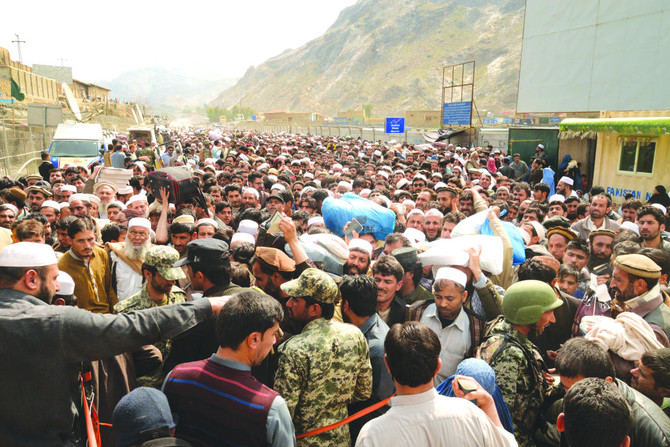
Since last month’s decision, more than 2,000 trucks have been stranded at the Torkham crossing on Afghanistan’s northwest border. The prolonged closure “has affected us badly,” said Lal Raheem Shinwari, president of the Traders Association in the nearby Pakistani town of Landi Kotal. “We, the residents and traders, are the worst affected.”
The Pakistani government will not say when the border might re-open. Each country has given the other a list of militants they want apprehended and handed over. Afghanistan has also identified 23 insurgent sanctuaries in Pakistan that it wants closed.
In Kabul, Azrakhsh Hafizi, a member of the international relations committee of the Afghan Chamber of Commerce, said the two countries need a regional cooperation agreement. Politics, he said, is devastating the business communities in both nations. In the markets in Kabul, prices are already soaring, Hafizi said.
“All the time we are facing many many challenges because of politics,” he said. “The business community suffers a lot of losses and a lot of problems. We need to find a solution to this.”


Afghan-Pakistani border tensions costing millions
Afghan-Pakistani border tensions costing millions

French publisher recalls dictionary over ‘Jewish settler’ reference
- The entry in French reads: “In October 2023, following the death of more than 1,200 Jewish settlers in a series of Hamas attacks”
- The four books are subject to a recall procedure and will be destroyed, Hachette said
PARSI: French publisher Hachette on Friday said it had recalled a dictionary that described the Israeli victims of the October 7, 2023 attacks as “Jewish settlers” and promised to review all its textbooks and educational materials.
The Larousse dictionary for 11- to 15-year-old students contained the same phrase as that discovered by an anti-racism body in three revision books, the company told AFP.
The entry in French reads: “In October 2023, following the death of more than 1,200 Jewish settlers in a series of Hamas attacks, Israel decided to tighten its economic blockade and invade a large part of the Gaza Strip, triggering a major humanitarian crisis in the region.”
The worst attack in Israeli history saw militants from the Palestinian Islamist group kill around 1,200 people in settlements close to the Gaza Strip and at a music festival.
“Jewish settlers” is a term used to describe Israelis living on illegally occupied Palestinian land.
The four books, which were immediately withdrawn from sale, are subject to a recall procedure and will be destroyed, Hachette said, promising a “thorough review of its textbooks, educational materials and dictionaries.”
France’s leading publishing group, which came under the control of the ultra-conservative Vincent Bollore at the end of 2023, has begun an internal inquiry “to determine how such an error was made.”
It promised to put in place “a new, strengthened verification process for all its future publications” in these series.
President Emmanuel Macron on Wednesday said that it was “intolerable” that the revision books for the French school leavers’ exam, the baccalaureat, “falsify the facts” about the “terrorist and antisemitic attacks by Hamas.”
“Revisionism has no place in the Republic,” he wrote on X.
Hamas’s October 7, 2023 attack on Israel resulted in the deaths of 1,221 people, with 251 people taken hostage, according to an AFP tally based on official Israeli figures.
Authorities in Gaza estimate that more than 70,000 people have been killed by Israeli forces during their bombardment of the territory since, while nearly 80 percent of buildings have been destroyed or damaged, according to UN data.
Israeli forces have killed at least 447 Palestinians in Gaza since a ceasefire took effect in October, according to the Hamas-run health ministry.


