Egypt’s ex-president Mubarak denies killing protesters as final retrial begins

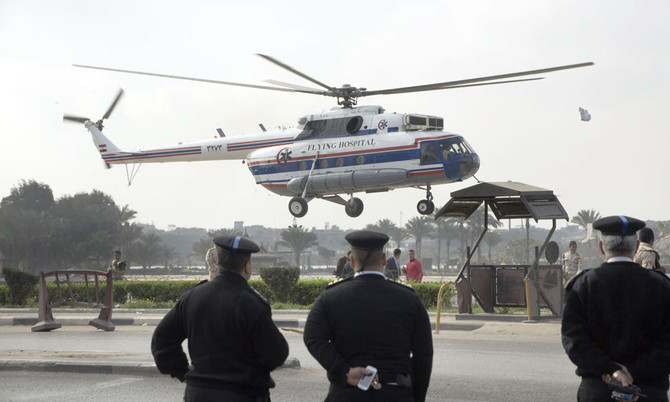
Policemen watch a helicopter ambulance as it takes off carrying ousted former Egyptian President Hosni Mubarak from Maadi Military Hospital, where he is hospitalized, to be taken to the Cairo Police Academy-turned-court, in Cairo, Egypt, on Thursday. (AP Photo/Amr Nabil)
Updated 02 March 2017
Follow

Egypt’s ex-president Mubarak denies killing protesters as final retrial begins

CAIRO: Egypt’s former president Hosni Mubarak denied on Thursday involvement in the killing of protesters during the 2011 uprising that ended his 30-year rule as his final retrial in the case began.
Mubarak, 88, was originally sentenced to life in prison in 2012 for conspiring to murder 239 demonstrators, sowing chaos and creating a security vacuum during an 18-day revolt which began in Jan. 2011, but an appeals court ordered a retrial.
That retrial culminated in 2014 in an Egyptian court dropping the case. But the public prosecution appealed the decision and ordered another retrial by Egypt’s top appeals court.
That began on Thursday, with the judge reading Mubarak the charges, in which he and his interior minister were accused of providing vehicles and weapons used to assault protesters and failing to take action to prevent deaths.
Sitting in a wheelchair in the defendant’s cage without his trademark dark sunglasses, Mubarak responded: “It did not happen.”
Mubarak has long maintained his innocence in the case and has said history would judge him a patriot who served his country selflessly. He waved at supporters among the journalists and other attendees in the courtroom.
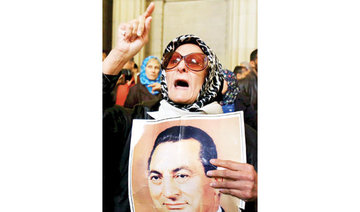
Outside the court house, a small group of Mubarak supporters gathered, unfurling posters of the former president and demanding that he be freed and honored for his service.
Hundreds of people died when security forces clashed with protesters in the weeks before Mubarak was forced from power.
Many Egyptians who lived through Mubarak’s rule view it as a period of autocracy and crony capitalism. His overthrow led to Egypt’s first free election, which brought in Islamist President Mohamed Mursi.
Mursi only lasted a year in office, however, after mass protests against his rule in 2013 prompted an overthrow by then army chief General Abdel Fattah El-Sisi, who later went on to win a presidential election in 2014.
Sissi has since launched a crackdown on Mursi and his Muslim Brotherhood, which has been banned as a terrorist organization.
Hundreds of Mursi supporters were killed in a single day and thousands have been jailed with the dragnet quickly widening to include secular activists who were at the forefront of the 2011 uprising but opposed Muslim Brotherhood rule.
By contrast, Mubarak-era figures are gradually being cleared of charges and a series of laws limiting political freedoms has raised fears among activists that the old regime is back.
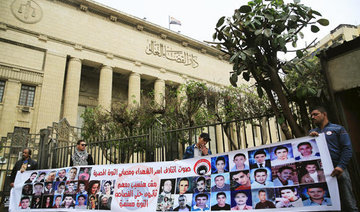
Lawyers representing the families of those killed in the 2011 uprising called for the charges against Mubarak to be upgraded to murder and demanded that the court also summon Sissi, who was head of military intelligence at the time.
(Reporting by Mahmoud Mourad and Haitham Ahmed)


Ceasefire with Kurdish-led force extended for another 15 days, Syrian army says

Updated 25 January 2026
Follow

Ceasefire with Kurdish-led force extended for another 15 days, Syrian army says

  • The defense ministry said the extension was in support of an operation by US forces to transfer accused Daesh militants to Iraq
  • The Kurdish-led Syrian Democratic Forces confirmed the ceasefire extension

RAQQA, Syria: Hours after the expiration of a four-day truce between the Syrian government and Kurdish-led fighters Saturday, Syria’s defense ministry announced the ceasefire had been extended by another 15 days.
The defense ministry said in a statement that the extension was in support of an operation by US forces to transfer accused Daesh militants who had been held in prisons in northeastern Syria to detention centers in Iraq.
The Kurdish-led Syrian Democratic Forces confirmed the ceasefire extension.
“Our forces affirm their commitment to the agreement and their dedication to respecting it, which contributes to de-escalation, the protection of civilians, and the creation of the necessary conditions for stability,” the group said in a statement.
Over the past three weeks, there have been intense clashes between government forces and the SDF, in which the SDF lost large parts of the area they once controlled.
Earlier in the day, the Kurdish-led force called on the international community to prevent any escalation.
The end of the truce came as government forces have been sending reinforcements to Syria’s northeast.
Syria’s interim government signed an agreement last March with the SDF for it to hand over territory and to eventually merge its fighters with government forces. In early January, a new round of talks failed to make progress over the merger, leading to renewed fighting between the two sides.
A new version of the accord was signed last weekend, and a four-day ceasefire was declared Tuesday. Part of the new deal is that SDF members will have to merge into the army and police forces as individuals.
The SDF said in a statement Saturday that military buildups and logistical movements by government forces have been observed, “clearly indicating an intent to escalate and push the region toward a new confrontation.” The SDF said it will continue to abide by the truce.
On Saturday, state TV said authorities on Saturday released 126 boys under the age of 18 who were held at the Al-Aqtan prison near the northern city of Raqqa that was taken by government forces Friday. The teenagers were taken to the city of Raqqa where they were handed over to their families, the TV station said.
The prison is also home to some of the 9,000 members of the Daesh group who are held in northeastern Syria. Most of them remain held in jails run by the SDF. Government forces have so far taken control of two prisons while the rest are still run by the SDF.
Earlier this week, the US military said that some 7,000 Daesh detainees will be transferred to detention centers in neighboring Iraq.
On Wednesday, the US military said that 150 prisoners have been taken to Iraq.