- The average yield has declined from 500-700 kg per dunam before 2000 to 300-400 kg now, with some farmers reporting as low as 250 kg this season
DAMASCUS: Syria’s peanut production this season is expected to reach 17,970 tonnes from 6,256 hectares, according to the Agriculture Ministry.
The Al-Ghab region in Hama accounts for the largest share of cultivated land. However, declining yields, rising production costs and a shortage of specialized harvesting equipment continue to hamper the sector’s development and its potential to become a strategic agricultural commodity.
Peanuts improve soil fertility through nitrogen fixation, supply raw materials for food industries and provide livestock feed. Expanding cultivation and processing could also create opportunities for small businesses, generate higher value products and improve farmers’ returns.
Ali Youssef Diab, supervisor of the peanut group within the Family Projects Group, said that cultivation began with selecting healthy seeds and keeping them in their shells until planting.
Farmers prepare the land through plowing, soil conditioning and fertilization. The optimal planting period extends from early April to May 10, after the risk of spring frost has passed. Planting in March could weaken germination, Diab said.
The crop requires temperatures of 20-25 degrees Celsius during germination and flowering, along with adequate moisture and warm soil.
In coastal areas, peanuts can also be grown as a second-season crop after the wheat and barley harvest in late June and early July, although yields are lower than during the main season.
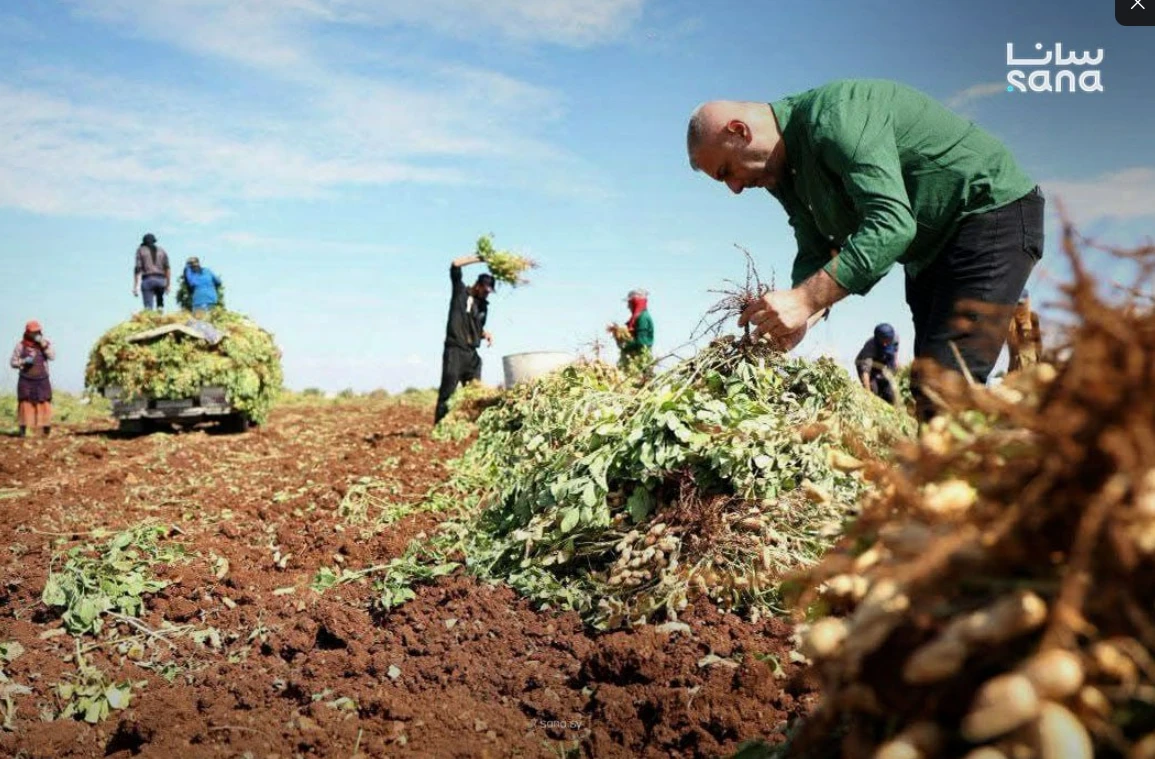
The crop’s yellow flowers develop above ground before slender stems extend into the soil, where the pods and seeds form. Proper harvesting and drying are essential to quality.
Farmers examine field samples to ensure the pods have matured and the seeds have turned brown.
Kazem Ali, a peanut grower in Al-Ghab, said that farmers relied mainly on rainfall during the main growing season, supplementing it with groundwater when necessary.
After harvesting, traders purchase the crop directly from farmers’ homes or storage facilities before transporting it to shelling facilities for sorting and processing.
Diab said that three main peanut varieties were traded in the Syrian Arab Republic: the Turkish variety, known as Virginia, which produces large, elongated pods, the local variety, characterized by smaller pods and thinner shells, and improved varieties, including Al-Sahel and Giza, imported from Egypt.
The improved varieties offer higher yields and more uniform seed sizes, making them suitable for mechanical shelling and the production of peanut butter and halva.
Peanuts are used in roasted snacks, confectionery, chocolate, halva, nougat and peanut butter. Their seeds contain 45-50 percent oil, which can be extracted for vegetable oil production.
The resulting press cake can be used in animal feed. The foliage provides feed for cattle and sheep, while outer shells can serve as heating fuel and plant residues can be converted into organic fertilizer.
Despite these applications, the shortage of specialized processing facilities limits demand and the development of additional uses. Local consumption remains largely concentrated on peanuts sold for direct consumption or roasting.
Production expenses include land preparation, seeds, fertilizers, fuel, pesticides, harvesting and crop protection.
Farmers also face water shortages and drought, while the lack of specialized mechanical harvesting equipment increases costs.
Regular field monitoring is necessary to control pests and diseases, including stem rot, worms and red spider mites. Other threats identified by the Agriculture Ministry include green caterpillars and powdery mildew.
Harvesting presents additional difficulties because peanuts must be dried under sunlight, making autumn weather an important factor in crop quality and safety.
Diab said that yields before 2000 ranged from 500 to 700 kg per dunam (1,000 sq. meters), encouraging farmers to expand cultivation. In some areas, peanuts replaced cotton and sugar beet.
But average yields had since fallen to about 300-400 kg per dunam, he said.
Ali reported a similar decline. His production has fallen from about 600-700 kg per dunam five years ago to about 250 kg this season.
Despite lower productivity, farmers continue cultivating peanuts because traders buy the harvest directly at production sites and pay in cash.
However, growers can face pressure to accept lower prices to cover seasonal expenses.
The Al-Ghab Plain in western Syria is the country’s main peanut-growing area, accounting for about 40 percent of cultivated land, while Idlib accounts for 18 percent, according to Agriculture Ministry figures published in October.
The ministry said that the area planted with peanuts had remained almost unchanged from the previous season.
Maher Al-Dajj, the ministry’s director of plant production, said yields could reach 3-4 tonnes per dunam under favorable conditions and increase further with improved agricultural services and crop management.
This potential yield estimate differs from the actual yields reported by Diab and Ali, reflecting the distinction between favorable growing conditions and production achieved in the fields.
Marketing difficulties also constrain the sector. Traders’ influence over prices, fluctuating market conditions and a shortage of reliable sales outlets leave farmers exposed to changes in supply and demand, creating uncertainty over their returns.
Agricultural extension units monitor fields from planting through harvesting and provide technical advice on crop management, according to the ministry.
Agricultural development expert Akram Afif said that expanding peanut processing could create opportunities for small and family-run food businesses, generate higher value products and provide employment.
But high production costs, difficulties securing financing, fluctuating selling prices and traders’ influence over prices continued to constrain farmers’ returns and their ability to maintain or expand cultivation, he said.
Using crop residues to feed cattle, sheep and goats would help integrate peanut cultivation into a broader agricultural and food production chain, he said.
Diab said that bacterial nodules on peanut roots fixed atmospheric nitrogen, improving soil fertility and benefiting subsequent crops, including wheat and winter vegetables.
Developing the sector required improved agricultural services, better access to irrigation, reliable supplies of production inputs and specialized machinery for harvesting, sorting and drying peanuts, he said.
Establishing food-processing and oil-extraction facilities would also reduce reliance on selling raw produce, increase its added value and improve farmers’ economic returns, he said.