- The Gulf Cooperation Council (GCC) is advancing 20 joint industrial investment opportunities, with five already completed and approved in the first phase.
- Promotional workshops are taking place in Saudi Arabia and Oman to engage investors in these industrial opportunities.
RIYADH: Gulf Cooperation Council states are advancing a pipeline of 20 joint industrial investment opportunities, with five completed and approved in the first phase, as the bloc seeks to deepen industrial integration and strengthen supply-chain resilience.
GCC Secretary-General Jasem Mohamed Albudaiwi said the five opportunities had been approved by the GCC Industrial Cooperation Committee and would serve as a foundation for subsequent ventures. Promotional workshops are already underway in Saudi Arabia and Oman in coordination with the Federation of GCC Chambers, with positive engagement from investors.
The official release did not disclose the sectors, investment values or implementation timelines for the 20 opportunities.
The three-day forum, which opened on Oct. 6 at Exhibition World Bahrain in Sakhir, is focused on industrial integration, global market access, supply-chain resilience, financing mechanisms and industrial partnerships, as well as smart factories, economic zones and the development of Gulf talent.
The initiative comes as the six-member bloc seeks to make manufacturing a larger driver of economic diversification and regional integration. GCC states host more than 22,000 factories employing over 1.7 million workers, while manufacturing contributes 13 percent of the bloc’s gross domestic product, Albudaiwi said.
“Made in the GCC 2026 embodies a shared vision agreed upon by the Leaders of the GCC states that industry is a foundational pillar for diversifying the Gulf economy, and that the strength of our economies is measured not only by the resources we possess, but by what we produce and export,” he said.
Manufacturing integration
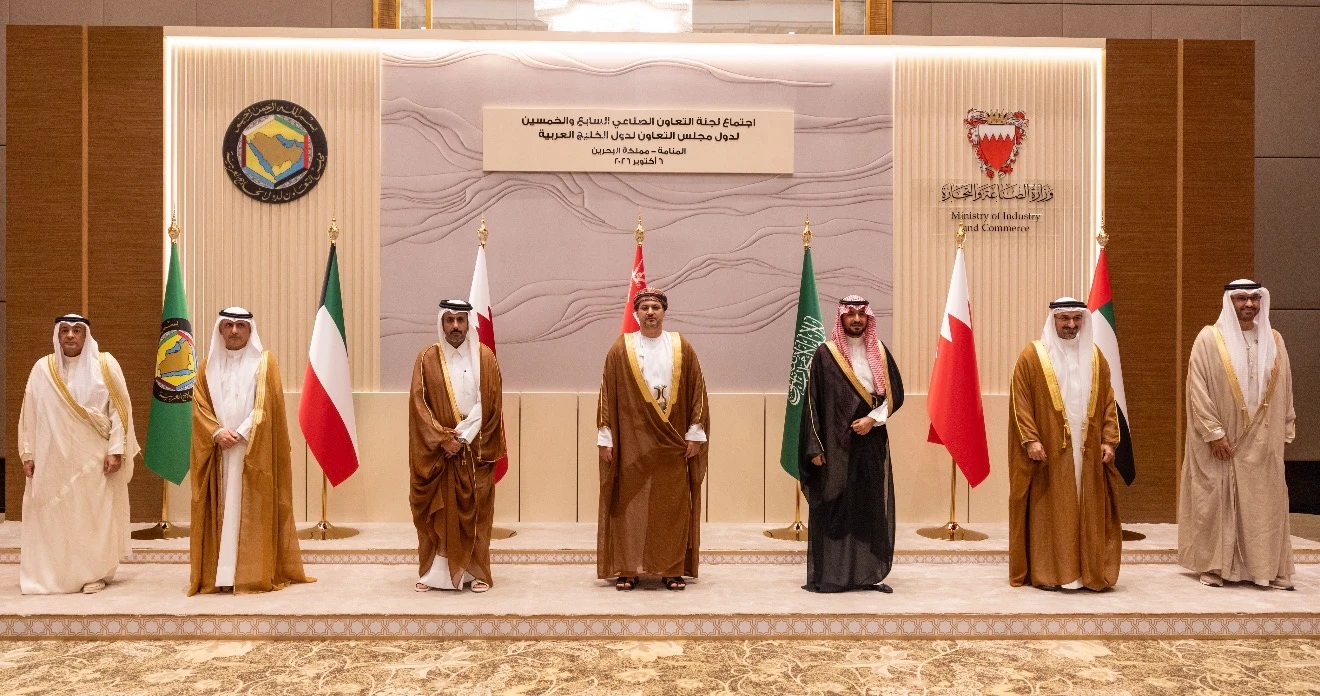
The 57th meeting of the GCC Industrial Cooperation Committee, held in Manama alongside the forum, also saw the launch of the Gulf Centre for the Fourth Industrial Revolution and its digital platform.
The center is intended to support the adoption of advanced manufacturing and emerging technologies, as well as digital transformation across Gulf manufacturing facilities.
The committee’s priorities include coordinating industrial policies and strategies, developing regulatory and legislative frameworks, strengthening supply-chain resilience and raising the global competitiveness of Gulf manufacturing amid rapid technological change.
Trade and infrastructure
The industrial push coincided with the 15th consultative meeting between GCC commerce ministers and heads of regional chambers on Oct. 7. Officials discussed challenges facing the Gulf private sector and sought to develop initiatives to support its growth and strengthen economic integration.
At a separate 71st meeting of the GCC Commercial Cooperation Committee on Oct. 6, ministers reviewed efforts to develop the GCC Common Market, complete the requirements of the Customs Union and elevate the flow of trade and investment between member states.
The wider economic backdrop includes combined GCC gross domestic product of around $2.4 trillion, with non-oil activities accounting for about 79 percent, according to figures cited by the General Secretariat.
Net foreign assets held by Gulf central banks stood at approximately $829 billion at the end of June, covering about 11 months of imports.
Officials also highlighted regional infrastructure integration. GCC electricity generation reached about 876,000 gigawatt-hours in 2025, up 9.6 percent, while desalinated-water production increased 10.8 percent to around 8.5 billion cubic meters.
The GCC electricity interconnection generated savings exceeding $952 million in 2025, taking cumulative savings since the project began to more than $5.2 billion, according to the council.