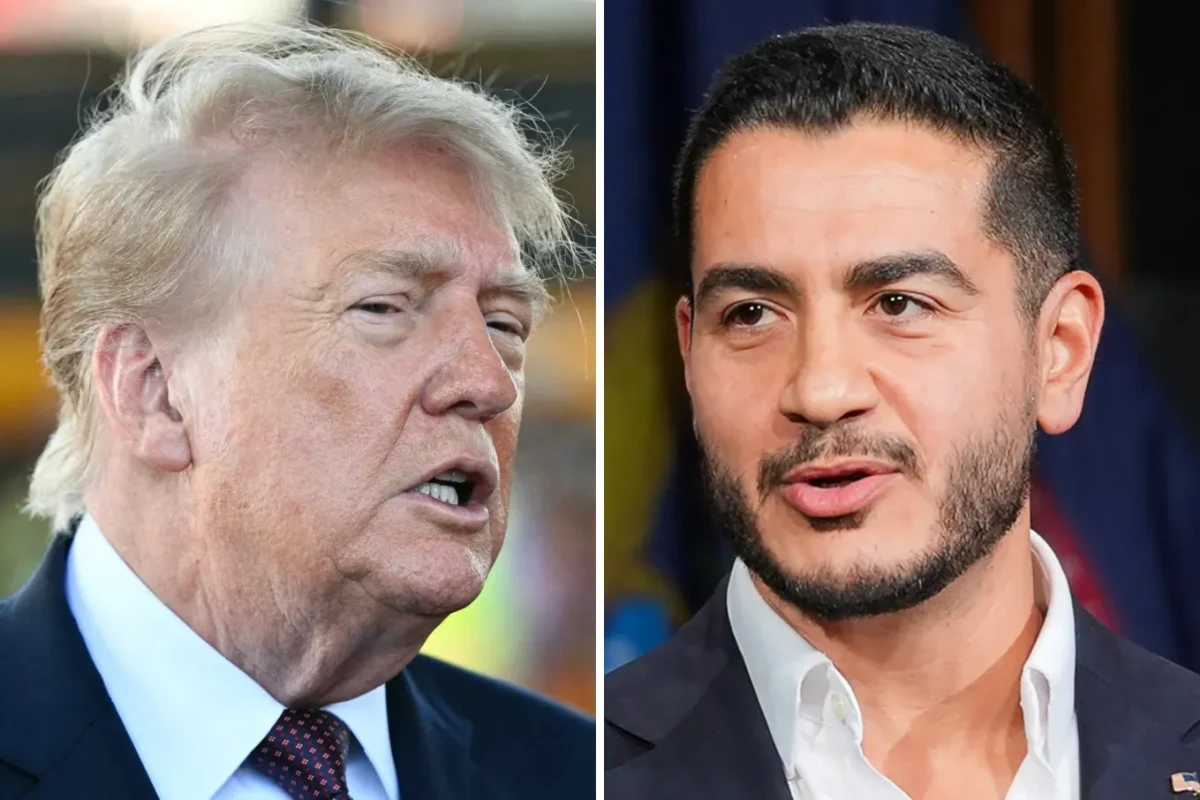
- Democrats capture both chambers of Congress as Abdul El-Sayed, singled out by Trump over his opposition to US aid to Israel, wins Michigan Senate race
- Arab American leaders question whether the proposed $4bn cutoff is a genuine policy shift or an election-day gesture
CHICAGO: President Donald Trump’s election-day pledge to end almost $4 billion in annual US military aid to Israel has come under renewed scrutiny after Democrats won control of both chambers of Congress and Abdul El-Sayed, the Michigan Senate candidate Trump singled out over the issue, defeated his Republican opponent.
El-Sayed won the state’s open Senate seat against Mike Rogers with about 52.5 percent of the vote to Rogers’ 45.5 percent, according to results reported on Wednesday, becoming the first Muslim elected to the US Senate. His victory came amid broader Democratic gains in Tuesday’s midterm elections, which will give the party control of the House and Senate when the new Congress convenes in January.
The results shift attention from whether Trump’s announcement could influence voters to how his administration intends to carry it out. The president has offered no detailed plan for ending the assistance ahead of an existing agreement that runs through 2028, while the incoming Democratic majorities are expected to increase scrutiny of US support for Israel.
Trump announced the proposed cutoff in a telephone interview with Fox News on Tuesday morning, saying he and Israeli Prime Minister Benjamin Netanyahu had reached an understanding months earlier and that Israel no longer needed American grants.
“The left uses the $4 billion payment — that everybody knows about, it’s no secret — as a signal of unfairness,” Trump said. “And we can’t allow that to happen. I don’t like that, because it’s too easy. It’s almost too easy a target. And Bibi and I have been talking, and we’ve agreed. He was very understanding of it.”
Trump specifically mentioned El-Sayed, whose criticism of unconditional US support for Israel had become a major issue in Michigan’s Senate contest. His comments came just hours before voters delivered a victory to the Democrat, despite Republican attacks and an unusual endorsement of Rogers by El-Sayed’s former Democratic primary rival, Rep. Haley Stevens.
Stevens, a staunch supporter of Israel who had benefited from spending by pro-Israel groups during the Democratic primary, endorsed Rogers two days before the general election following a public dispute with El-Sayed. Her endorsement did not prevent the Democrat from winning the seat.
The contentious contest reflected a wider debate over Israel’s place in US politics. In October, the American Israel Public Affairs Committee said it would stop directly endorsing candidates and making contributions through its political action committee, while continuing to mobilize individual donors and operate its affiliated super PAC, United Democracy Project.
The question now is whether the election result will translate into a substantive change in Washington’s relationship with Israel. Democrats’ control of Congress could bring closer examination of weapons transfers, military financing and Israel’s conduct in Gaza and the occupied West Bank, although the president retains veto powers over legislation.
The current US-Israel memorandum of understanding, signed under former President Barack Obama in September 2016, provides $38 billion in military assistance over the 2019-2028 fiscal years. It includes $33 billion in foreign military financing and $5 billion for missile defense.
Although the memorandum itself is not legally binding, the money is subject to congressional appropriations and other statutory commitments. Ending annual grants at the close of 2026 would therefore raise questions about funds already authorized or planned and about weapons orders extending beyond the existing agreement.
The Wall Street Journal reported on Thursday that a State Department letter to Congress indicated about $10 billion would still be needed after 2028 to cover previously placed weapons orders. It remained unclear whether such obligations would be met through further US assistance or payments by Israel.
Netanyahu had previously discussed phasing out American military aid over a decade, rather than ending it abruptly. His office did not immediately confirm Trump’s assertion that the two leaders had agreed to a year-end cutoff, while Israeli opposition figures criticized the way the proposed change was announced.
Arab American leaders who spoke to Arab News on election day questioned whether Trump intended to follow through, arguing that the timing appeared designed to blunt criticism of US support for Israel.
Jenin Younes, president of the American-Arab Anti-Discrimination Committee, said the organization welcomed an end to US military aid to Israel, arguing that American funding had enabled Israeli military actions against Palestinians, Iranians and Lebanese.
“However, given that President Trump does not have the authority to unilaterally take this step without congressional approval, it is likely yet another empty promise. The timing — the throes of the midterm elections — makes the statement particularly suspect,” Younes told Arab News.
“What is a positive development is that the president appears to believe this promise — however unrealistic — will help the Republicans in the midterms. That suggests he recognizes the drastic shift in public opinion on this issue and is trying to attract voters on those grounds.”
Chuck Freilich, a former deputy national security adviser to Israel and an associate fellow at the Middle East Institute, said discussions about reducing assistance had preceded the election, but questioned whether Trump meant an immediate halt to every element of the program.
“Trump and Netanyahu reached an agreement last year. Netanyahu spoke about a 10-year phase-out of the current program that ends in 2028,” Freilich told Arab News.
“We have to wait for a clarification from the president. Does he really mean ending all of the aid immediately. Does he mean the missile defense? Assistance for 2027 has already been allocated. Is all of this stopping at the end of the year? I think part of this is a lack of precision in Trump’s understanding, but we have to wait for the details.”
Warren David, president of Arab America, a Washington-based media organization, said an end to direct grants would not necessarily stop the sale of US military equipment to Israel for use in Gaza, Iran, Lebanon and elsewhere.
“This appears to be a last-minute election maneuver aimed at appealing to voters who stand in solidarity with the Palestinian people. It raises serious questions about whether this is a meaningful policy shift or simply political theater,” David told Arab News.
“At the end of the day, even if the US ends the approximately $4 billion in annual military aid to Israel, it could continue selling billions of dollars in bombs, munitions and other military equipment. Ending direct aid does not necessarily mean ending US military support for Israel. The real test will be whether there is a substantive change in US policy, not simply an election-season announcement.”
Neither the White House nor the Israeli Embassy responded to Arab News’ requests for comment on Tuesday.
With the elections over and Democrats preparing to assume control of Congress, the focus has shifted from the possible electoral impact of Trump’s announcement to the legal, financial and political decisions that would be required to put it into effect.