- Crimes involved attacking four women, dating back to 2004
- Prosecutors highlighted his abuse of fame to access women
Russell Brand, the British comedian and actor, was sentenced to 10½ years in prison by Southwark Crown Court in London for raping one woman and sexually assaulting three others, according to official court records and statements from presiding Judge Joel Bennathan. The verdict and sentencing were delivered on Friday (June 7), following a jury trial that examined offenses occurring between 2004 and 2009. The court record, as cited by Reuters and the BBC, noted that Brand’s behavior during this period was widely publicized and, according to the court, often overlooked by those around him.
Judge Joel Bennathan stated that Brand demonstrated a “casual and arrogant disregard” for women who refused his advances, and criticized Brand for providing false testimony in denying the assaults. The judge’s remarks were delivered during sentencing on Friday, following Brand’s conviction by a jury on four counts related to sexual assault and rape. Brand was acquitted of two counts of rape and one count of attempted indecent assault.
“About 20 years ago, Russell Brand, you were becoming famous. You were clever — and in many people’s eyes, funny and charismatic. You had also become a sexual predator,” Judge Bennathan said.
Brand, aged 51, showed little emotion during the sentencing, according to court observers. He mouthed “we’ll be OK” to his wife as he was led from the courtroom by officers. Brand, known for his provocative stand-up routines and public persona, maintained throughout the trial that all sexual encounters were consensual. His defense was led by lawyer Ian Winter, who cited Brand’s charitable work and the impact of the sentence on his family, including his three young children. Winter also noted that Brand’s only previous conviction was for marijuana possession in 1995.
Institutional response and media scrutiny
The convictions have prompted renewed scrutiny of the media and entertainment institutions that employed Brand during the period in question, including the BBC. The case follows the #MeToo movement, which brought widespread attention to sexual abuse and misconduct by prominent figures. Judge Bennathan stated that Brand “abused the influence and power that came with his fame,” using it to facilitate access to women and to act with apparent impunity.
“Mr. Brand abused the influence and power that came with his fame. He used it to facilitate access to women without which the offending could not have taken place. It also fed his own view that he could commit such offenses with impunity,” Judge Bennathan said.
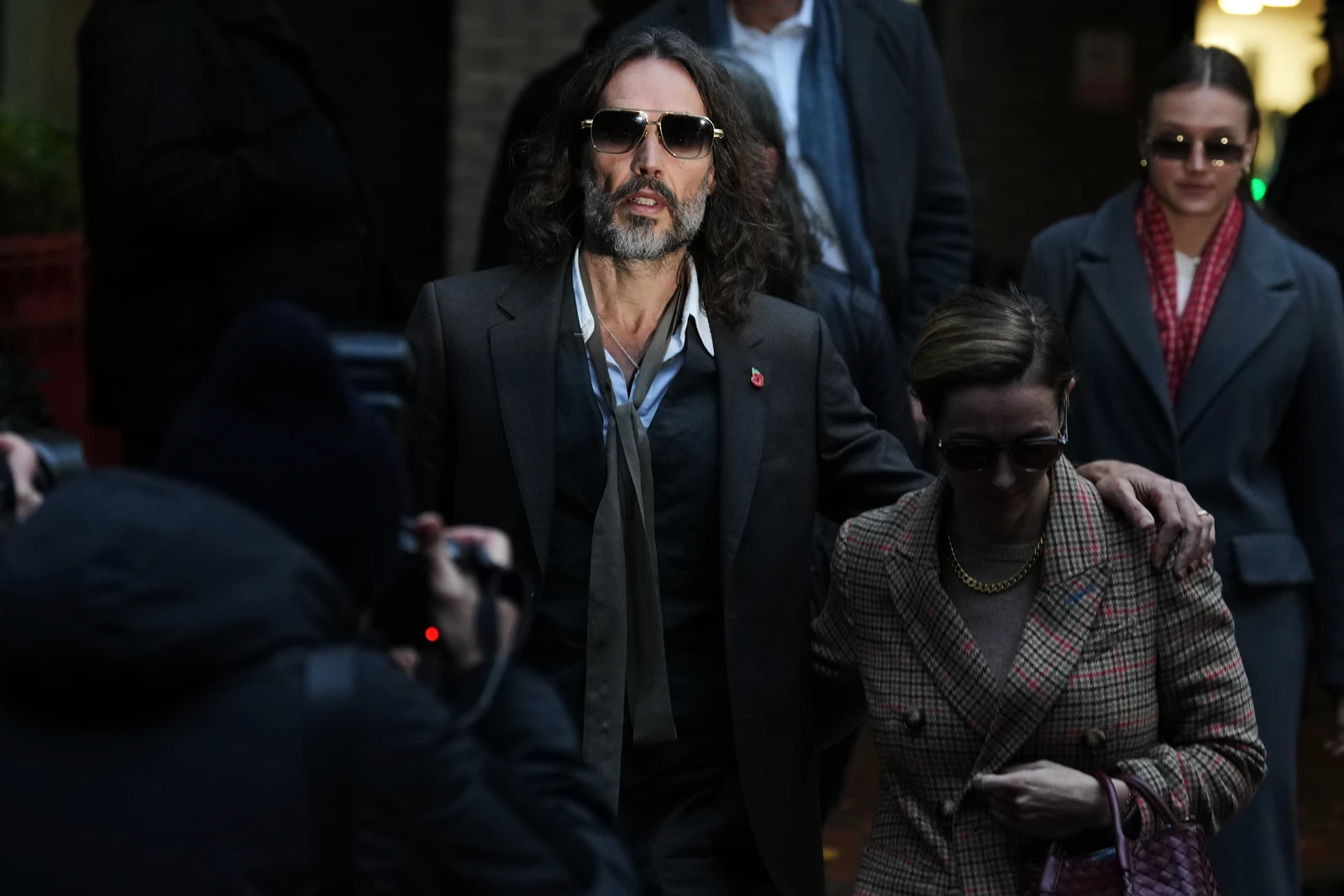
Brand appeared in court wearing a gray suit, an open-collar shirt, and a loose white tie. His hair was pulled back in a man bun, and he held a crucifix in his right hand. He was supported in court by his wife, Laura Brand, and his father, Ron Brand. Laura Brand entered the courthouse separately; Brand had been in custody since the jury delivered its verdict on Thursday.
Supporters of Brand, referencing his recent conversion to Christianity, displayed a banner outside the courthouse with crosses and the message: “Russell Brand we stand with you. Christ was crucified for telling the truth. Russell is the truth.”
Testimony from accusers and impact statements
The women who accused Brand of sexual assault came forward following a 2023 investigation by The Times and Channel 4. According to The Times, the outlets aired accounts from women alleging abuse and degradation, which prompted police to open a formal inquiry. One woman, whom Brand was convicted of abusing, delivered a statement in court describing the trauma she experienced. Other victims provided statements that were read by the prosecutor.
A woman whom Brand groped at a London bar in 2004 stated that the assault left her in shock and turmoil, making her feel like “damaged goods.” She testified from behind a curtain to protect her identity. Judge Bennathan noted that Brand’s entourage may have dismissed the incident as “laddish” behavior, but emphasized that it constituted a criminal sexual offense.
“It was outrageous and possibly laddish, but also a criminal sexual offense, and as it turns out you haven’t got away with it,” Judge Bennathan said.
Another woman, a former fan, testified that Brand raped her at his home after meeting her backstage at a comedy show in 2009. She described feeling anxious, humiliated, and experiencing difficulty eating and sleeping, as well as periods of heavy drinking. She stated that she feared contracting HIV and only came forward after police opened an investigation following the documentary.
“I felt that if I reported him, I would not be believed. His fame, wealth and influence created a power imbalance which made me feel powerless,” the woman said in her statement.
Brand’s defense argued that he should be regarded as “a man who went too far and overrode consent that had been given” following consensual sex. Judge Bennathan cited Brand’s disrespectful treatment of one woman, including saving her contact information as “T” for “tart.” Another woman, whom Brand was convicted of kissing and groping at a London radio station in 2004 or 2005, said the incident had a lasting impact on her life.
“Since the sexual assault ... Russell Brand has managed to move on and even forget. Over the years, hearing his voice on television, on social media or seeing his image made me jump,” the woman said.
The final conviction was for sexually assaulting a woman during the recording of an advertisement in 2009, when Brand demanded a massage and pressed his face into her groin. The woman stated that she reported the incident immediately, but it was “brushed under the carpet by senior management.” She described a culture at the time that discouraged her from pursuing the matter further.
“Immediately after the incident I spoke up, and sadly it was brushed under the carpet by senior management. There was a culture at the time which meant I felt I had to just carry on and not talk about it anymore, which meant I did not give myself time to lament on it, boxed it up and pushed it aside,” the woman said.
Brand was acquitted of raping another woman in a hotel room during the Labour Party’s annual conference in Bournemouth in 1999, and of attempting to indecently assault a woman at the London office of music channel MTV.
Brand’s career and public profile
Brand rose to prominence in the early 2000s as a television and radio host, including on the BBC, and became known for his provocative stand-up routines and public battles with drugs and alcohol. He later appeared in Hollywood films such as “Forgetting Sarah Marshall” and “Get Him to the Greek,” and was briefly married to pop singer Katy Perry.
In recent years, Brand relocated to Florida and shifted his focus to online media, building a large following with videos that combine wellness themes, conspiracy theories, and discussions of his religious beliefs.
The case against Brand has drawn attention to the broader issue of institutional accountability in the entertainment industry, as well as the challenges faced by survivors of sexual assault in coming forward. The investigation that led to Brand’s prosecution was initiated after media reports by The Times and Channel 4 prompted police to open a formal inquiry, according to both outlets.