- Emergency council meeting follows lightning Houthi advance along Red Sea coast and seizure of port city of Mokha and islands in and around Bab Al-Mandab Strait
- US envoy describes escalation as Iranian project executed by proxy, and attacks against Saudi Arabia and international shipping reflect ‘active cooperation with Tehran’
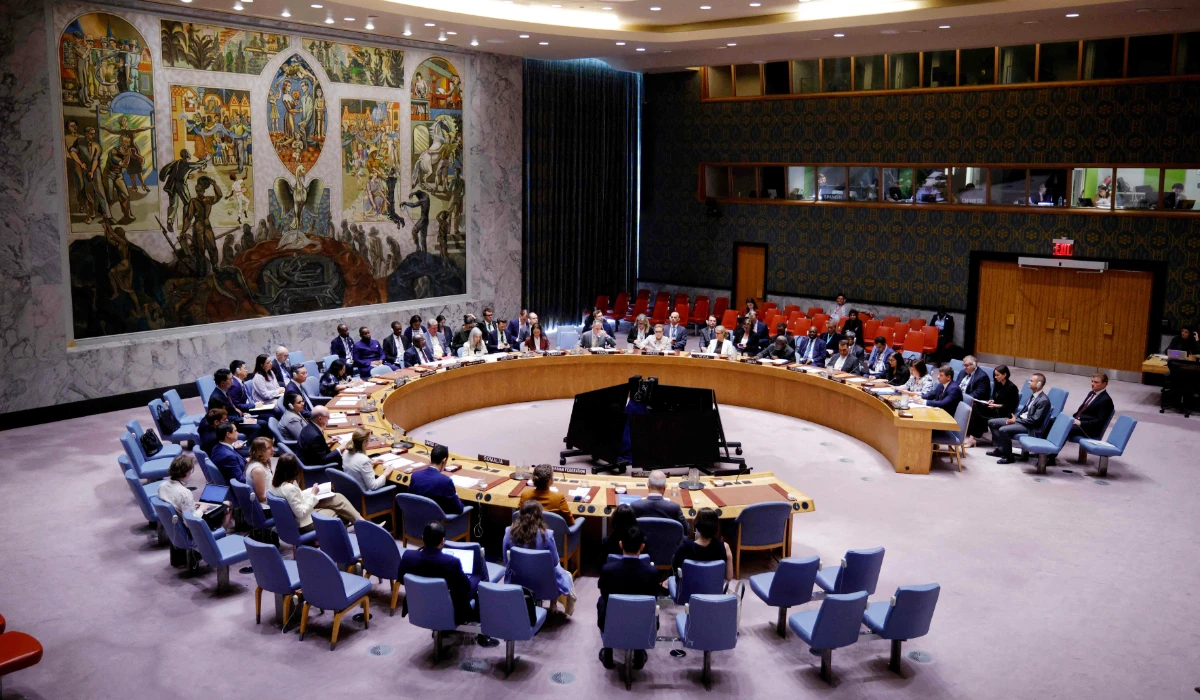
NEW YORK CITY: Houthi forces “bear full responsibility” for the rapidly escalating crisis in and around Bab Al-Mandab Strait, Britain’s deputy ambassador to the UN told an emergency session of the Security Council on Monday.
Member states demanded an end to to the flows of arms reaching the Houthis, and the renewed enforcement of a UN-imposed embargo on the supply of weapons to the militia.
The meeting, which was requested by Bahrain, the UK, Denmark, France, Greece and Latvia, came five days after Houthi forces completed a lightning advance down Yemen’s Red Sea coast during which they seized the port city of of Mokha, Perim Island and the Hanish Islands, and declared a blockade on Saudi-flagged shipping.
The consolidation of Houthi control over the strait, through which about 12 percent of global trade passes, has already pushed oil prices back above $100 a barrel and opened a new front in the wider war with Iran, alongside Tehran’s disruption of maritime traffic in the Strait of Hormuz.
Briefing the council, the UN’s assistant secretary-general, Khaled Khiari, said Houthi forces had continued their advance toward Bab Al-Mandab over the past week while the internationally recognized Yemeni government launched a counteroffensive across multiple front lines, including Marib, Taiz and Saada
He renewed the UN’s condemnation of Houthi strikes against Saudi civilian and energy infrastructure, called for navigational rights in both Bab Al-Mandab and the Strait of Hormuz to be fully restored, and urged all parties involved in the conflict to engage with UN-led political efforts to resolve the crisis, rather than further escalation.
A UN tally put the toll of the escalation so far this month at about 125,000 people displaced across Yemen and 40 civilian casualties, with women and children accounting for half of those killed and more than half of those injured. Several thousand more people have crossed into Djibouti.
Yemen’s envoy to the UN, Abdallah Al-Saadi, told the council the Houthi offensive was no longer simply a domestic matter but “a growing threat to the security of the region, freedom of navigation, energy supplies and one of the most important arteries of global trade.”
He said his government’s forces were regrouping in an effort to prevent the militia from turning its coastal gains into a permanent platform. He highlighted in particular the recapture of Aden and more than 70 percent of Yemeni territory overall since the war began, and accused the Houthis of recruiting children into their ranks.
He urged council members to formally hold the Houthis responsible for the escalation, to enforce the arms embargo under relevant resolutions on the matter, and to boost support for Yemen’s coast guard and navy.
Bahrain’s permanent representative to the UN, Jamal Alrowaiei, said the Houthis had “squandered every opportunity for confidence building” and had proven themselves to be “a tool for destabilization in the region,” as he accused the international community of so far failing to impose decisive measures to deter them.
Manama backed the right of Saudi Arabia and Yemen to defend themselves under Article 51 of the UN Charter, he said. He urged the council to go beyond its existing sanctions architecture, calling for strict enforcement of the arms embargo, accountability for violators, and an expansion of sanctions to explicitly cover drone strikes and attacks on commercial shipping, arguing that the current scope for reporting understated the true extent of Houthi violations.
The US, represented by Ambassador Jennifer Locetta, described the latest escalation as an Iranian project executed by proxy. She said the pattern of attacks against Saudi Arabia and international shipping reflected “active cooperation with Tehran,” as she demanded that Iran “cease its support for Houthi terrorist activities,” and the Houthis withdraw from territory they have seized.
Washington was working with regional partners to protect freedom of navigation, Locetta said. She reiterated the US backing for Yemen’s government, and pressed the council to fully implement the arms embargo imposed by UN resolutions, and to treat the continued Iranian support for the militia as a council-level accountability issue rather than a bilateral dispute.
The UK’s deputy ambassador, Kate Foster, delivered the most direct condemnation during the meeting.
“The Houthis bear full responsibility for this escalation,” she said, warning that their push to consolidate control of the Red Sea coast and Bab Al-Mandab posed a direct threat to international shipping, and the effects would be “felt first and hardest by developing countries.”
She called for an immediate Houthi de-escalation, and the release of all detained UN and diplomatic workers.
Foster also cited Iran’s “long-standing support” for the Houthis as the driver of the crisis, and said Security Council resolutions left no ambiguity about the obligations of member states to cut off the flow of arms and prevent military support from reaching the group.