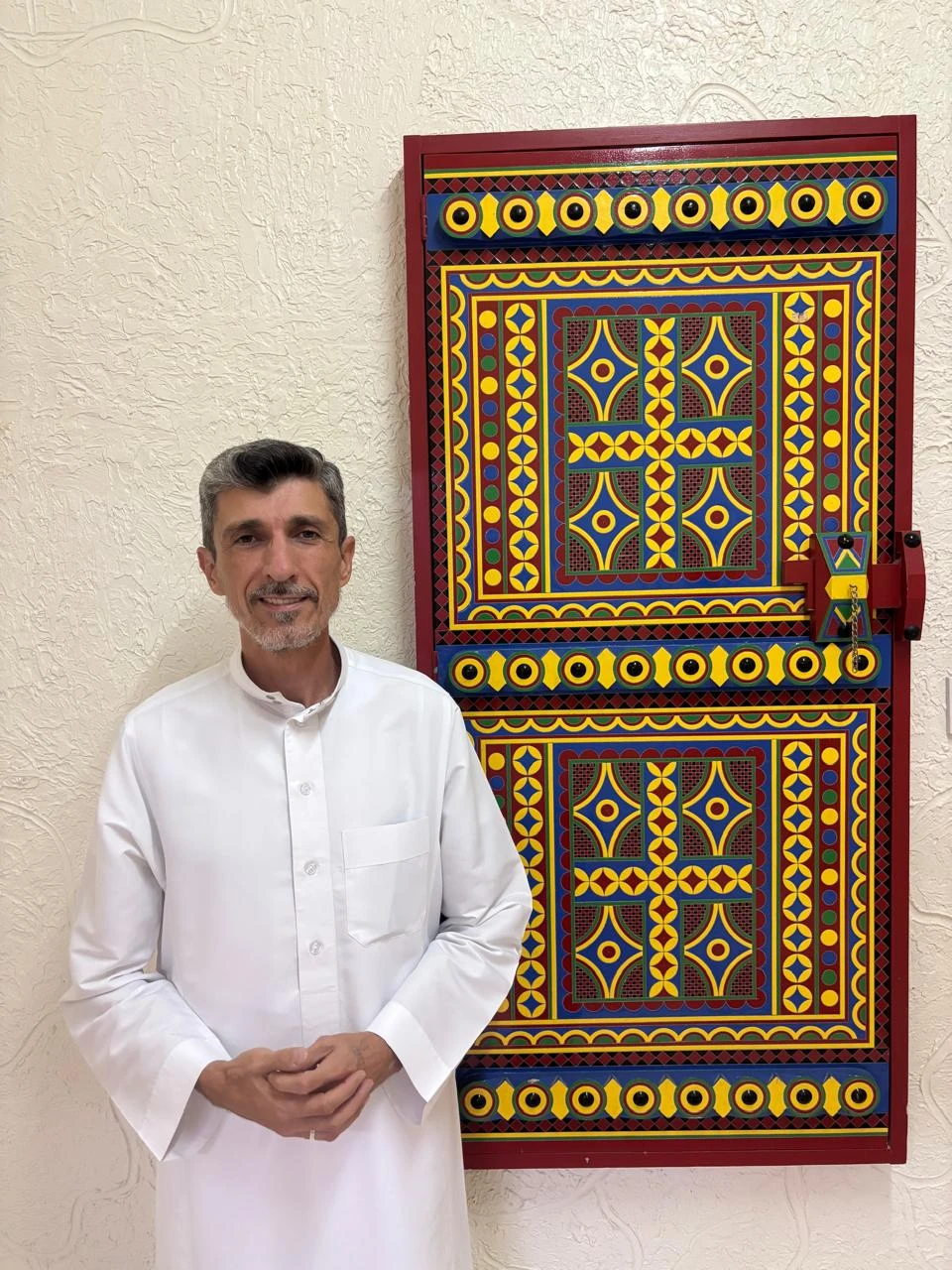
- Personal journeys from France, Spain and Canada reveal why some are finding a stronger sense of belonging in Saudi Arabia
- After reverting to Islam, Diaz-Patch moved to Syria to learn Arabic
RIYADH: When Alejandro Diaz-Patch left France for the Middle East, he intended to stay for just one year to study Arabic.
Instead, he stayed for decades.
“The only problem is that I left and never came back. It was a one-way ticket,” he told Arab News.
Diaz-Patch’s life has unfolded across cultures and continents. Born in Jordan to a Spanish diplomat father and French mother, he spent five years in Morocco, 14 in Syria, and the past 12 in Saudi Arabia, a country he now considers home.
He describes himself as “half Spanish through my father, half French through my mother, and half Arab through my life.”
After reverting to Islam, Diaz-Patch moved to Syria to learn Arabic. There, he married a Syrian woman, raised a family, founded an Arabic-language institute, and built a life that made returning to Europe increasingly difficult to imagine.
“I had too many friends there,” he said. “I was not going to return and restart my life from zero.”
My children are a bridge between Europe and the Arab world. Alejandro Diaz-Patc, Spanish French Riyadh resident
When the conflict in Syria eventually forced the family to leave, they relocated to Spain. Soon afterwards, a Spanish company offered him a position in Saudi Arabia, where his language skills and understanding of Arab culture were in demand.
“They told me: ‘You are Spanish, and you studied in Spain, but you understand Arab culture and speak Arabic. We do not speak Arabic or understand the culture, so we are going to send you to Saudi Arabia’.”
His wife’s response to the move was immediate.
“Do not think twice,” she told him.
More than a decade later, neither regrets that decision.
“Obviously, nobody stays in a country that long unless they feel comfortable,” Diaz-Patch said. “Would I go back to Europe? For holidays, visits, tourism, and to see my family, yes. But to live there? No. We prefer to remain here.”
Over the years, he became involved in Saudi Arabia’s language-learning community, joining a Spanish-speaking group where he encountered Saudis whose fluency surprised him.
“I found Saudis who spoke Spanish better than I did,” he said. “I would close my eyes and hear perfect Spanish; then I would open them and see a Saudi.”
Inspired by the experience, he launched Cafe en Francais de Riyadh, a gathering designed to bring together French speakers and learners from different backgrounds.
“I thought, if there are Saudis who speak Spanish, there must also be Saudis who speak French. So, I decided to create a French-language group.”
His family embodies the cultural blending that has defined his journey. French, Spanish, Syrian and Arab influences coexist under one roof.
“I raised them in European culture and Arab Muslim culture,” he said. “I never cut one side from the other. So, my children are a bridge between Europe and the Arab world.”
That sense of belonging became clear when his children left Saudi Arabia for university abroad. Diaz-Patch assumed they would spend their holidays in Europe. Instead, they wanted to return to Riyadh.
He recalls his son telling him: “My memories, my references, my restaurants and my favorite places are in Riyadh.”
For Abdullah Abolouz, a Ph.D. candidate in sociocultural anthropology at the University of Michigan, stories such as Diaz-Patch’s reflect a broader shift in global migration patterns.
“Reverse migration can be understood as people leaving the Global North to settle in their countries of origin or elsewhere in the Global South,” he told Arab News.
While motivations vary, Abolouz believes questions of identity often sit at the center of such decisions.
“There are many reasons behind this phenomenon, and the Saudi context may have its own particular characteristics. However, I believe it stems primarily from questions of identity. A degree of separation is developing between these individuals and the societies in which they live.”
For Muslims in particular, he said, those feelings can be intensified by debates surrounding immigration, representation and religious identity.
“They are directly related to the politics of representation, which appears to be experiencing significant failures in Western societies, particularly with the rise of the political right.”
Diaz-Patch has observed some of those dynamics firsthand.
“In France, they are not very tolerant toward Muslims, while it is less of an issue in Spain,” he said.
But Abolouz argues that dissatisfaction with life in the West is not limited to Muslim communities.
“This phenomenon is not limited to Muslims,” he said. “There is a broader feeling that the model of life offered by Western countries is beginning to deteriorate. The political and financial power of the United States, the American dream and the promise of economic prosperity are increasingly being questioned. The same applies to Europe, where Eurocentrism itself is being placed under scrutiny.”
“For many people, the decision to leave the West is not simply economic. It reflects a reassessment of what constitutes a good life,” he added.
That broader reassessment resonates with Vincent Martin, a 33-year-old French Brazilian professional whose interest in Saudi Arabia stems less from economics than from culture, language and personal growth.
“From the very beginning, when I was 18 or 19 and just starting university in France, I wanted to explore the world,” he said.
His journey took him from France to London, Boston, and Brazil before work led him to the Middle East. After living in the UAE and Egypt, where he deepened his Arabic proficiency, Saudi Arabia emerged as his preferred destination.
“Saudi is number one on my list. I prefer Saudi over the Emirates. The reason is that, from a cultural point of view, I think life in Saudi is somewhere I can really grow much more. In Saudi, you have the chance to meet Saudis, become friends with them, practice the language and take part in the culture. That is important to me.”
Since 2020, Martin has traveled regularly to the Kingdom and is exploring opportunities in the Saudi financial sector with the aim of relocating permanently.
His view of the region contrasts sharply with stereotypes that often define the Middle East through conflict or restriction. Instead, he points to safety, cultural depth and opportunities for personal development.
“If you ask me today where I would consider living, my preference would still be to stay in the Middle East. There is a mix of practical and personal considerations. There is, of course, a competitive financial aspect, but for me, there is also a very important cultural element. I really like the language. I really like the culture. If I don’t live in a place where I feel I’m growing across those dimensions, I get bored very quickly, or I don’t find that taste for life, that sense of excitement.”
Safety also features prominently in his thinking.
“For me, safety starts at your doorstep. It means not being afraid to go out at 10 p.m. because the street isn’t well lit, or having to look behind yourself. After seven years in the Middle East, I sometimes forget to be cautious about these things when I travel abroad.”
Martin also points to affordability and quality-of-life concerns that he believes are increasingly shaping decisions among younger Europeans.
“If you make a certain amount of money, especially in countries I know such as Italy and France, and even the UK to some extent, it starts to feel like it is just not worth it. You pay a lot of tax; you are still exposed to the social and demographic issues Europe is facing, and then there is housing. In places like Paris, people can save for an entire lifetime to buy a 40 sq. meter flat.
“I am convinced that Europeans are increasingly looking beyond Europe, particularly younger people. Some will move for culture, others for safety, housing, or quality of life, but increasingly they are questioning whether staying in Europe still makes sense,” he added.
For Sami Azeem, however, the pull of Saudi Arabia is less about opportunity than familiarity.
“I was born and raised in Riyadh. It’ll always be home,” he said.
The Canadian Indian, who has a Saudi wife, has lived in Canada for almost a decade and is now preparing to move back to the Kingdom.
“It would be lovely to escape the cold winters, and the location is very central, which makes it very convenient to travel around Europe and Asia.”
But climate and geography are only part of the equation.
“When I have children, I would like to raise them in Saudi Arabia, where I was raised; it’s more family-friendly,” he added.
The experiences of Diaz-Patch, Martin, and Azeem differ in detail but converge around a common theme: Home is not always where people are born, nor where they hold citizenship. Increasingly, it is where they find community, opportunity, shared values and a sense of belonging.
For some Westerners, that place is no longer in the West. It is in a region they once considered temporary, but now call home.