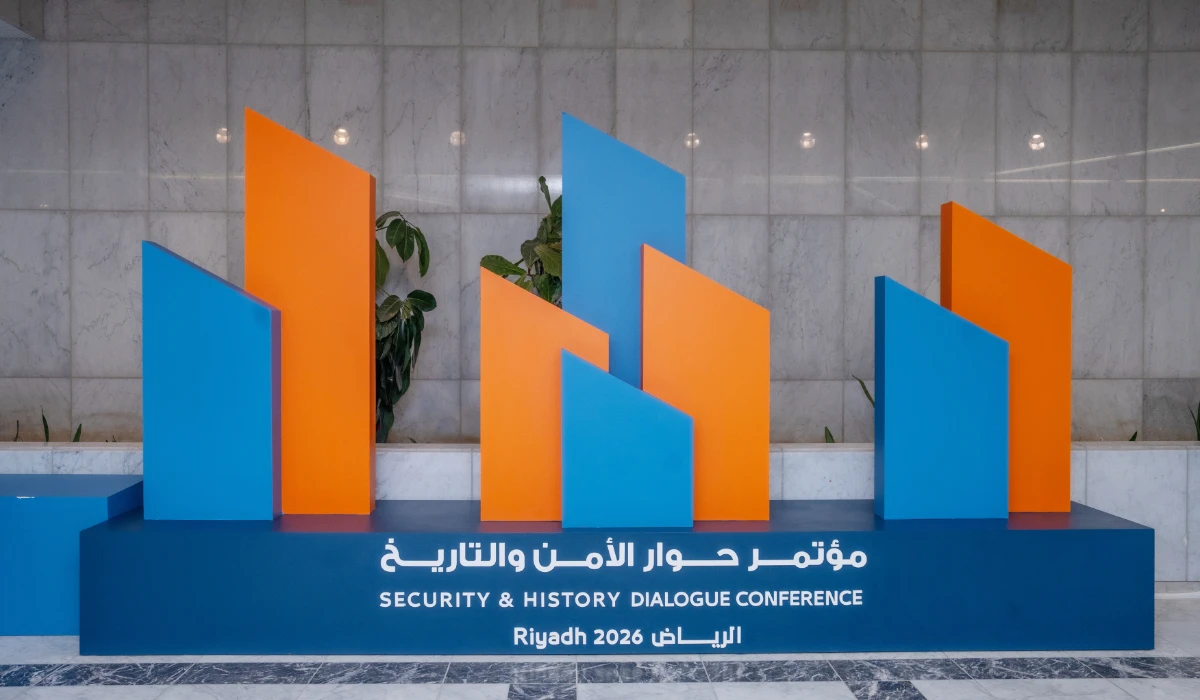
RIYADH: Cultural institutions, artists, and individuals all play a role in strengthening intellectual security, preserving national identity and ensuring Saudi cultural heritage is carried authentically to future generations, speakers told the Security and History Dialogue Conference in Riyadh on the event’s final day.
The three-day conference takes a holistic approach to security and history, exploring their intersection with business, technology, heritage, culture and other sectors.
The panel, titled Culture and Arts and Strengthening Intellectual Security: The Role of Cultural Institutions and Artists in Building Awareness, brought together Princess Haifa bint Abdulmohsen bin Abdulaziz Al-Saud, director of development and partnerships at the Saudi Arabian Society for Culture and Arts; artist and producer Meshaal Al-Mutairi; and Abdulrahman Al-Sayed, CEO of the Translation Association. They discussed how culture moves beyond preservation to shape collective awareness.
Princess Haifa said security is a shared responsibility.
“Security is broader than any one sector. It is a collective responsibility that should be deeply rooted in everyone, from the individual to the institution,” she added. “The cultural field is one of the most important channels shaping collective thought, and its influence and the public’s engagement with it should not be underestimated.
“Intellectual security is not a luxury or a choice; for cultural institutions, it is an obligation,” she said. “Their role is to take ideas from archives and shelves and turn them into lived experiences, so that people carry them into their everyday lives and pass them to future generations without distortion, addition or omission.”
She added that cultural institutions had a particular responsibility to move heritage beyond archives and institutional walls, and turn it into experiences that people, particularly younger generations, could engage with.
The cultural field is one of the most important channels shaping collective thought, and its influence and the public’s engagement with it should not be underestimated. Princess Haifa bint Abdulmohsen, Director of development and partnerships at Saudi Arabian Society for Culture and Arts
“Culture builds awareness, and the arts transmit the values contained within that awareness,” she said.
Al-Mutairi said cultural confidence should not be viewed as incompatible with openness to the world.
“There is a common assumption that being proud of your culture means you cannot be open to other cultures,” he said. “But the more grounded and secure you are in your own culture, the more prepared you are to engage and communicate with cultures around the world,” he told the conference.
For Al-Mutairi, that confidence should also be reflected in Saudi artistic production.
“We need authentic artistic works that are rooted in local culture. We need to spread Saudi theater and Saudi cinema more and more,” he said.
While international expertise could contribute to artistic productions locally, he said the cultural message should remain grounded in local understanding.
“The world wants to see our culture and our reality. It does not want to see something that simply resembles what already exists elsewhere,” he said, adding that “universality begins with the local.”
Al-Sayed placed culture at the center of the conference’s broader discussion of security and history.
“Culture lies at the heart of it (Security and History Dialogue), our history shapes our culture, while our security is shaped by the extent of our belonging to that culture.”
He said cultural institutions’ responsibility is to first preserve knowledge and then serve as a bridge between culture and society.
“The responsibility of cultural institutions begins with preserving knowledge, and then serving as a mediator between culture and society in communicating that knowledge, whether through an experience, research, or a meaning that reaches people and shapes their awareness,” Al-Sayed said.
He added that institutions should make cultural archives accessible by transforming them into products that reach different segments of society.
“Art is feeling; it makes the person part of the experience,” he said. “We may receive a great deal of information about our history, memory and heritage, but what remains in our minds is the scene that embodies a historical figure, or depicts a Saudi village and the way people lived in it.”
Al-Mutairi similarly said drama carried a particular responsibility because it could communicate not only information, but the lived emotions of those historical moments.
“Anyone can read a historical story, but the role of art is to convey the feelings of the people who lived through that period,” he said. “Drama therefore carries a great responsibility to preserve that feeling and present it truthfully, and no one can do that better than the people of the culture themselves,” referring to the importance of investing in Saudi talent and therefore productions, to keep culture authentic.
He added that drama could also strengthen intellectual security by telling stories of security achievements and reflecting pride in Saudi culture and society.
Princess Haifa concluded by stressing that preserving culture ultimately meant preserving national memory.
“When you preserve the arts and culture, you are not simply preserving the artwork itself; you are preserving the memory, history and heritage of a nation,” she said.
“I keep coming back to one word: responsibility. What we say is a responsibility, the information we pass on is a responsibility, and the way we preserve it is a responsibility.”
Culture is key to strengthening intellectual security, Saudi panel hears