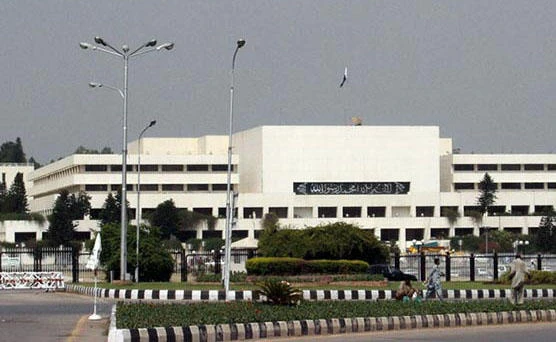
ISLAMABAD: Polling for the Senate elections started at 9 a.m. Saturday, across all four provincial assemblies and the national assembly.
One hundred and thirty-one candidates across the country are contesting 52 Senate seats from the province, Federally Administered Tribal Areas (FATA) and the federal capital.
Rangers and Frontier Constabulary (FC) personnel have also been deployed outside the assemblies and Parliament to maintain order.
A total of 20 candidates are battling for 12 seats from Punjab, 33 contenders for 12 seats from Sindh, 26 aspirants for 11 seats from Khyber Pakhtunkhwa (KP), 25 candidates for 11 seats from Balochistan, 24 contenders for four seats from FATA and five candidates for two seats from Islamabad.
At the National Assembly (NA) in Islamabad Speaker NA Sardar Ayaz Sadiq was the first to cast his vote, while in Punjab, Pakistan Muslim League-Nawaz (PML-N) MPA Malik Muhammad Iqbal Channar was the first one to cast his vote, followed by Punjab Law Minister Rana Sanaullah. In Sindh, Pakistan People’s Party (PPP) MPA Rubina Qaimkhani was the first to cast a vote, followed by former chief minister Syed Qaim Khan Shah.
The four provincial assemblies vote for their respective representatives, while senators in FATA are elected by MNAs from the tribal areas. In the federal capital senators are elected by NA members.
Senate polls are held every three years when half of the senators complete their six-year term, out of a 104-member house. The Senate comprises 66 general seats, 17 reserved for women, 17 for technocrats and four for non-Muslims.
Sindh & Punjab: Of the 12 seats, seven are general seats with two women seats, two technocrat and one non-Muslim seat.
K-P & Balochistan: Of 11 seats, two are reserved for women, two for technocrats and seven general.
On Friday, the Election Commission of Pakistan (ECP) issued a code of conduct according to which no one would be allowed to carry mobile phones to the polling stations and assembly members would be allowed inside only upon producing their secretariat cards.
MNAs and MPAs were also urged to ensure the secrecy of their votes.
According to ECP, the punishment for violating the code of conduct includes a fine of up to Rs100,000 and/or a jail term anywhere between six months and two years.
Addressing the media before entering Parliament, State Minister for Information Marriyum Aurangzeb said: “Never in the history of any country has an elected premier been removed on the basis of an Iqama [foreign work permit]. Despite no proof of corruption, he was still removed,” she said, adding that a sea of people await to welcome deposed prime minister Nawaz Sharif.
“Nawaz will come out as the winner in today’s elections,” she said.
Talking to the media outside the National Assembly, Pakistan Tehreek-e-Insaf (PTI) MNA Shafqat Mahmood said PTI chief Imran Khan will not be coming to the assembly today as he has other commitments.
The voting is scheduled to conclude without a break at 4 p.m. today.
One hundred and thirty-one candidates across the country are contesting 52 Senate seats from the province, Federally Administered Tribal Areas (FATA) and the federal capital.
Rangers and Frontier Constabulary (FC) personnel have also been deployed outside the assemblies and Parliament to maintain order.
A total of 20 candidates are battling for 12 seats from Punjab, 33 contenders for 12 seats from Sindh, 26 aspirants for 11 seats from Khyber Pakhtunkhwa (KP), 25 candidates for 11 seats from Balochistan, 24 contenders for four seats from FATA and five candidates for two seats from Islamabad.
At the National Assembly (NA) in Islamabad Speaker NA Sardar Ayaz Sadiq was the first to cast his vote, while in Punjab, Pakistan Muslim League-Nawaz (PML-N) MPA Malik Muhammad Iqbal Channar was the first one to cast his vote, followed by Punjab Law Minister Rana Sanaullah. In Sindh, Pakistan People’s Party (PPP) MPA Rubina Qaimkhani was the first to cast a vote, followed by former chief minister Syed Qaim Khan Shah.
The four provincial assemblies vote for their respective representatives, while senators in FATA are elected by MNAs from the tribal areas. In the federal capital senators are elected by NA members.
Senate polls are held every three years when half of the senators complete their six-year term, out of a 104-member house. The Senate comprises 66 general seats, 17 reserved for women, 17 for technocrats and four for non-Muslims.
Sindh & Punjab: Of the 12 seats, seven are general seats with two women seats, two technocrat and one non-Muslim seat.
K-P & Balochistan: Of 11 seats, two are reserved for women, two for technocrats and seven general.
On Friday, the Election Commission of Pakistan (ECP) issued a code of conduct according to which no one would be allowed to carry mobile phones to the polling stations and assembly members would be allowed inside only upon producing their secretariat cards.
MNAs and MPAs were also urged to ensure the secrecy of their votes.
According to ECP, the punishment for violating the code of conduct includes a fine of up to Rs100,000 and/or a jail term anywhere between six months and two years.
Addressing the media before entering Parliament, State Minister for Information Marriyum Aurangzeb said: “Never in the history of any country has an elected premier been removed on the basis of an Iqama [foreign work permit]. Despite no proof of corruption, he was still removed,” she said, adding that a sea of people await to welcome deposed prime minister Nawaz Sharif.
“Nawaz will come out as the winner in today’s elections,” she said.
Talking to the media outside the National Assembly, Pakistan Tehreek-e-Insaf (PTI) MNA Shafqat Mahmood said PTI chief Imran Khan will not be coming to the assembly today as he has other commitments.
The voting is scheduled to conclude without a break at 4 p.m. today.