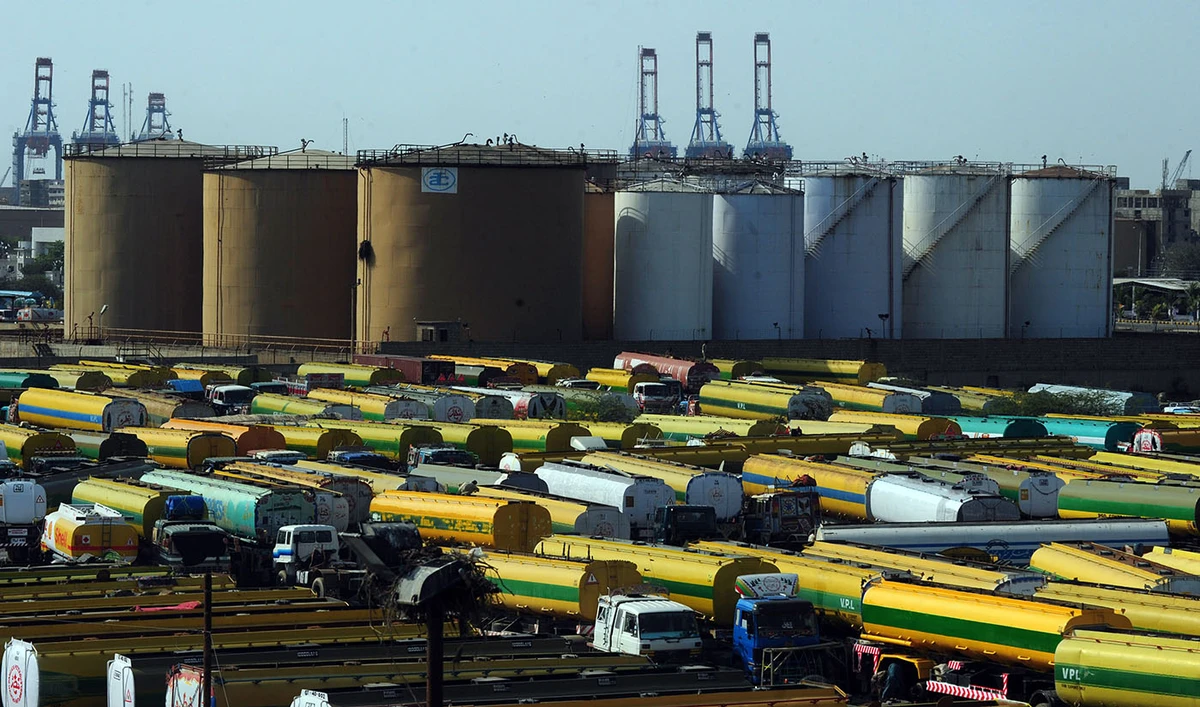
- The country spends more than $16 billion each year to import 26 million tons of petroleum products
- Saudi investors keen to explore diverse sectors including oil and gas, says Kingdom’s envoy to Pakistan
ISLAMABAD: Pakistan said on Monday it was trying to convince foreign businesses to invest in the country’s oil and gas sector to boost the capacity of its refineries, adding that the government was also doing its best to increase the share of renewable energy in the system from the existing three percent to 20 percent by 2025 to reduce its import bill.
The energy-starved country spends more than $16 billion each year to import 26 million tons of petroleum products, including 800 million cubic feet of liquefied natural gas from Saudi Arabia, the United Arab Emirates and other Gulf countries.
A high-powered Saudi delegation is also scheduled to visit Islamabad this month to explore investment opportunities in the energy sector.
“The demand for energy in our industry is increasing and so is our energy import bill,” said Nadeem Babar, special assistant to Prime Minister Imran Khan on petroleum, while speaking at the Pakistan Oil and Gas Conference 2019 in Islamabad.
He said that Pakistan was thinking of “deregulating petroleum prices to attract foreign investment in its oil refineries.”
Speaking on the occasion, Federal Minister for Power and Petroleum Omar Ayub said it was imperative for Pakistan to be self-sufficient in the energy sector to achieve its economic targets. “We are introducing a new policy on renewable energy to benefit our industry and domestic consumers,” said the minister, noting the need to explore the solar and wind potential to join the global trend of switching to renewable energy resources.
“The share of renewable energy will reach thirty percent by 2030,” said Ayub.
Saudi Arabia and Pakistan signed seven memoranda of understanding and an agreement to undertake projects worth $21 billion in February this year during the official visit of Saudi Crown Prince Mohammed bin Salman to Islamabad. This included a $10 billion Saudi investment to build an oil refinery in Balochistan’s Gwadar port that would help Pakistan cut its annual crude oil import bill by nearly $3 billion.
“We are still engaged with Saudi Arabia [for investment in the oil refinery],” Moin Raza Khan, managing-director of Pakistan Petroleum Limited, told Arab News. “Work on feasibility and technical studies is already underway.”
Earlier, Saudi Ambassador to Pakistan Nawaf bin Said Al-Malki told Arab News that the Kingdom had “repeatedly stressed” its desire to participate in the China-Pakistan Economic Corridor (CPEC) projects and had taken “concrete steps in this regard.”
These steps came in the form of a number of Saudi economic and technical delegations that visited Pakistan to see CPEC projects, he said, which was an initiative in line with the ambitious Vision 2030 adopted by Crown Prince Mohammed bin Salman.
“His Royal Highness...promised to establish an oil refinery at Gawadar strategic port in order to achieve the objectives of joint work between the two countries and the Kingdom is determined to move forward in this project,” Al-Malki said.
The desire of Saudi investors to invest in Pakistan has increased, he continued, adding that the Saudi embassy was taking all measures to facilitate that investment, which cut across many sectors including oil, natural resources, livestock, agriculture and fertilizer.