- The country’s economic situation is improving and the next news will be positive, says Dr. Reza Baqir
- The central bank allows importers to make advance payments of up to $10,000 for all inputs
KARACHI: The State Bank of Pakistan acknowledged on Tuesday that the Saudi deferred oil payment facility helped the country mitigate the impact of a balance-of-payments crisis, adding that the government was reporting the facility transparently.
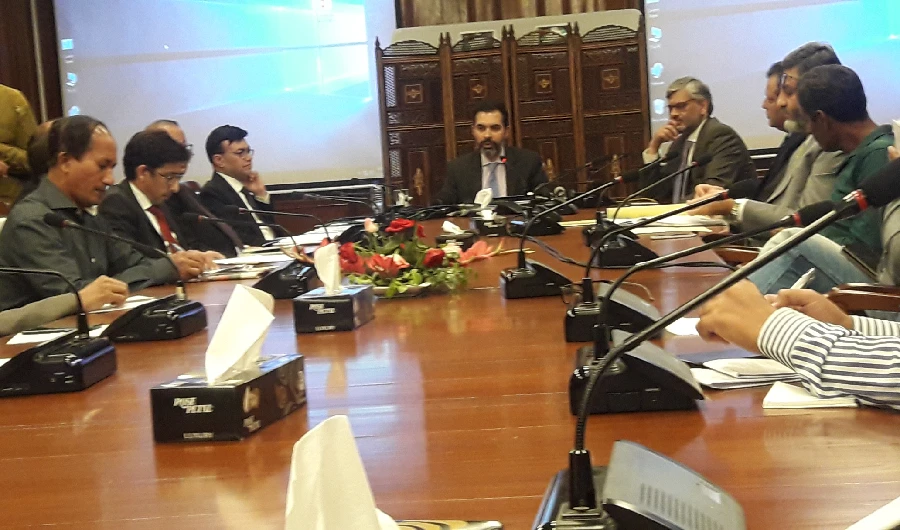
“The Saudi oil facility is definitely helpful and transparently reported in our balance of payments,” SBP Governor Dr. Reza Baqir said at a news conference held in Karachi.
He expressed confidence that the country’s economy would soon be out of the woods since investor sentiment was improving at the local and foreign fronts.
“Under the circumstances, we are confident that hard times will soon be left behind and the next news will be positive,” he added.
Last week, Pakistan’s central bank reported an increase of $443 million in its reserves without explaining where the money had come from. This made rumor mongers speculate that the increased amount had been paid by the Pakistan Muslim League-Nawaz’s founding leader, Nawaz Sharif, as part of his deal with the Pakistan Tehreek-e-Insaf (PTI) government to go abroad.
However, the SBP governor negated the perception.
“The increase in our foreign reserves last week did not owe to payments made by a single individual. The buildup of reserves was due to the improvement in the country’s economic sentiment and lowering of forward book liabilities,” he clarified. “The external position of the country is improving and consequently the buildup of net international reserves is taking place at a faster rate. The inflow in treasury bills is also helping but that is not the only reason behind the increase in the reserves.”
The SBP chief announced measures to improve the ease of doing business in the country and facilitate exporters. The central bank relaxed the restriction imposed in July 2018 that barred advance payments against exports due to the weak external economic position.
“Today we will allow importers advance payments for all inputs of up to $10,000,” he announced. “Businesses also required to seek permission from the State Bank for certain services, such as consultancies. But that condition has also been removed.”
Dr. Baqir announced that the central bank would take facilitating steps in a phased manner.
“Steps have been taken to give benefits to small exporters and traders,” he said. “Foreign exchange market conditions are far better than the previous year. That has enabled us to take such steps.”
The SBP governor added that exporters played an important role in strengthening the economy of a country and reducing its poverty level. This, he added, also explained why the government was giving priority to the export sector.
Their refunds issue, he continued, would be resolved and they would be paid without issuing any bonds.
Dr. Baqir said the central bank supported exports by providing short- and long-term loans to local exporters. The interest rate on the short-term loans, he informed, was three percent, and it was five to six percent for long term loans.
Asked about the inflation forecast, he pointed out that the International Monetary Fund had revised its projection from 13 to 11.8 percent, adding it was closer to Pakistan’s own estimate of 11 to 12 percent.