- Lahore commerce chamber president says both international and local investors showing fresh interest
- Stock market remains in the red due to growing tensions between Pakistan and India, weak corporate earnings
KARACHI: Prominent members of Pakistan’s business community hope investment deals signed with Saudi Arabia last week will attract other foreign investors to the country currently struggling to secure its financial future in the face of a yawning current account deficit.
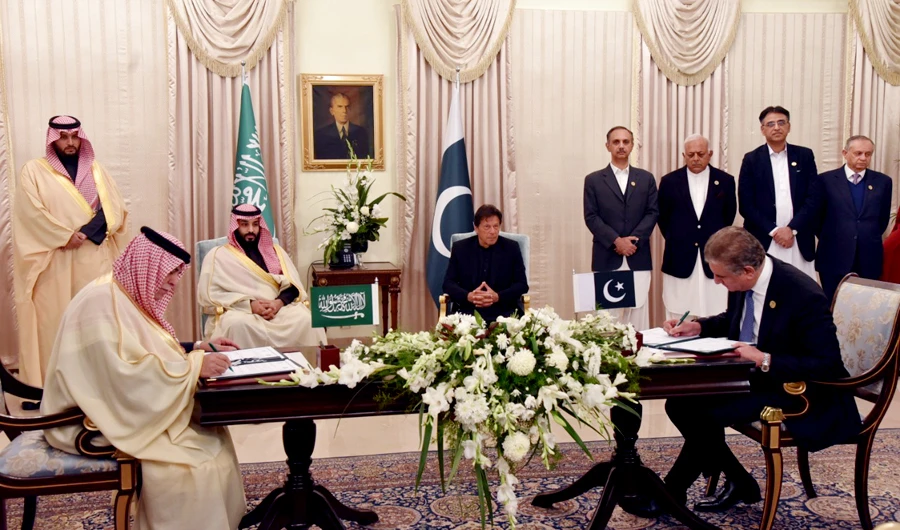
Pakistan and Saudi Arabia signed seven memoranda of understanding (MoUs) worth $21 billion during the crown prince’s visiting, including for a $10 billion Aramco oil refinery to be set up in the coastal town of Gwadar in southern Pakistan.
But despite the investments, Pakistan’s stock market has failed to show a positive trend mainly due to political uncertainty caused by escalating tensions between Pakistan and arch-rival India. Falling foreign exchange reserves and concerns over circular debt, which has surged to over PKR 1.5 trillion, are other factors keeping the market in the red.
“Due to this [ Saudi investment], not only foreign investors, but Pakistani investors too have started investing,” Almas Hyder, president of the Lahore Chamber of Commerce and Industry, said. “People are coming for the revival of industrial units which were earlier shutdown, particularly in the textile sector.”
Dr. Mirza Ikhtiar Baig, senior vice president at the chamber, said the group of Saudi investors who accompanied the crown prince to Islamabad had told Pakistani businessmen that the crown prince wanted to see the investment agreements become a reality.
“He wants practical steps to be taken to implement investment decisions in Pakistan ... to materialize projects,” Baig said, adding that Saudi investment in the industrial sector was a long-term commitment, and one which demonstrated that the Saudis believed Pakistan’s economy would stablise in the future.
“Twenty one billion dollars is much higher than what the kingdom has invested in the past,” said M. Abdul Aleem, secretary general of the Overseas Investors Chamber. “It will encourage others to take Pakistan seriously as a potential investment destination.”
Ahsan Mehanti, CEO at Arif Habib Corporation, one of Pakistan’s leading business groups, said stocks closed lower due to Friday’s negative outcome of the global watchdog Financial Action Task Force review and uncertainty over the fate of ongoing negotiations with the International Monetary Fund for a bailout package.
During the week, the benchmark index continued its downward trend and shed 471 points, closing in the red for a third consecutive week.
On Friday, FATF said Pakistan had only made “limited progress” on an action plan to curb terrorism financing and money laundering and urged it to take at least ten necessary actions by May to avoid being placed on a blacklist.
“The visit by the Saudi Crown prince was unable to alter investors’ sentiments due to crumbling Indo‐Pak relations and weak corporate earnings,” said Misha Zahid, an equity analyst at Arif Habib. “We expect the benchmark index to witness a rebound given improvement in the economy coupled with tensions between Pakistan and India cooling off and the materialization of a Saudi deal.”