- The AJK Assembly comprises 53 members, including 45 lawmakers directly elected by residents
- The development follows months of protests in the Himalayan territory by a civil rights group
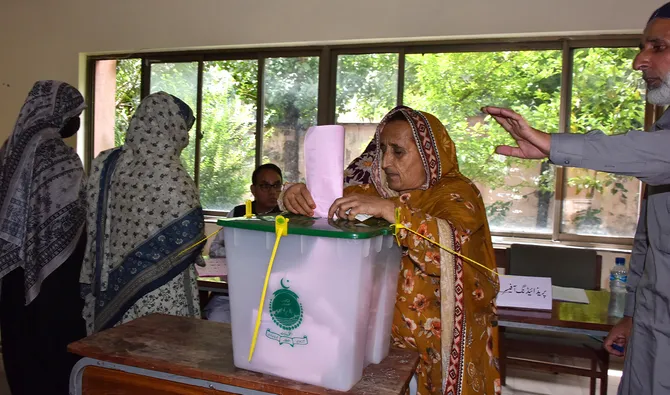
ISLAMABAD: Lawmakers in the Azad Jammu and Kashmir (AJK) Legislative Assembly on Monday voted to elect members on eight reserved seats, according to the AJK election commission, with official results yet to be announced.
The AJK Legislative Assembly comprises 53 members, including 45 lawmakers directly elected by the masses and eight members who are chosen by elected regional representatives.
The reserved seats included five slots for women and one each for religious scholars, Jammu and Kashmir state residents who reside abroad, and technocrats.
Polling for the reserved seats began at 10am Pakistan time and concluded at 1pm on Monday, with six women contesting elections on five reserved seats.
“A contest will be held between Hafiz Tariq Mahmood and Muhammad Mazhar Saeed for a reserved seat of Ulema-e-Din and Mashaikh,” the regional election commission said on Sunday.
“Similarly, a contest will be held between Syed Iftikhar Gilani and Sahibzada Zulfiqar Ali for a reserved seat of Technocrats and Professionals.”
The nomination papers of only one candidate were accepted for a seat reserved for state residents residing abroad.
The development follows months of protests in the territory by a civil rights group, the Joint Awami Action Committee (JAAC), which forced authorities to conduct phase-wise elections in different divisions on July 27, Aug. 2 and Aug 10.
The third phase was originally meant to cover all of Poonch Division that comprises 11 constituencies, including three in Bagh, one in Haveli, five in Poonch district and two in Sudhnoti district. But polls were only held in Bagh and Haveli because of concerns over the law-and-order situation.
So far, the Pakistan Muslim League-Nawaz has secured 25 seats, while the Pakistan People Party has won 12 seats in direct elections in 38 constituencies. The lone MLA-elect of the Awami Dast-o-Bazu party has also joined the PML-N.
Muslim-majority Kashmir is claimed in full by both India and Pakistan but has been divided between them since their independence from British rule. The area is considered highly sensitive by the Pakistani military and government after years of frequent skirmishes and full-blown wars with India.