- Fifth edition of Karachi Biennale, a two-week long event, was scheduled to be held from Jan. 16-31
- Regional wars squeezed funding for art event in Europe and Pakistan, says Karachi Biennale Trust chair
KARACHI: Regional wars affected funding for Karachi Biennale 2027, arguably the country’s largest contemporary art event, forcing its cancelation, the organizer said on Sunday.
The Karachi Biennale Trust (KBT) was founded in 2016 by a group of art professionals and educators as a platform to promote creativity, innovation and criticality in the visual arts through art exhibitions. The Karachi Biennale is a core project of the KBT, which works closely with a network of philanthropists and local and international cultural, and educational organizations.
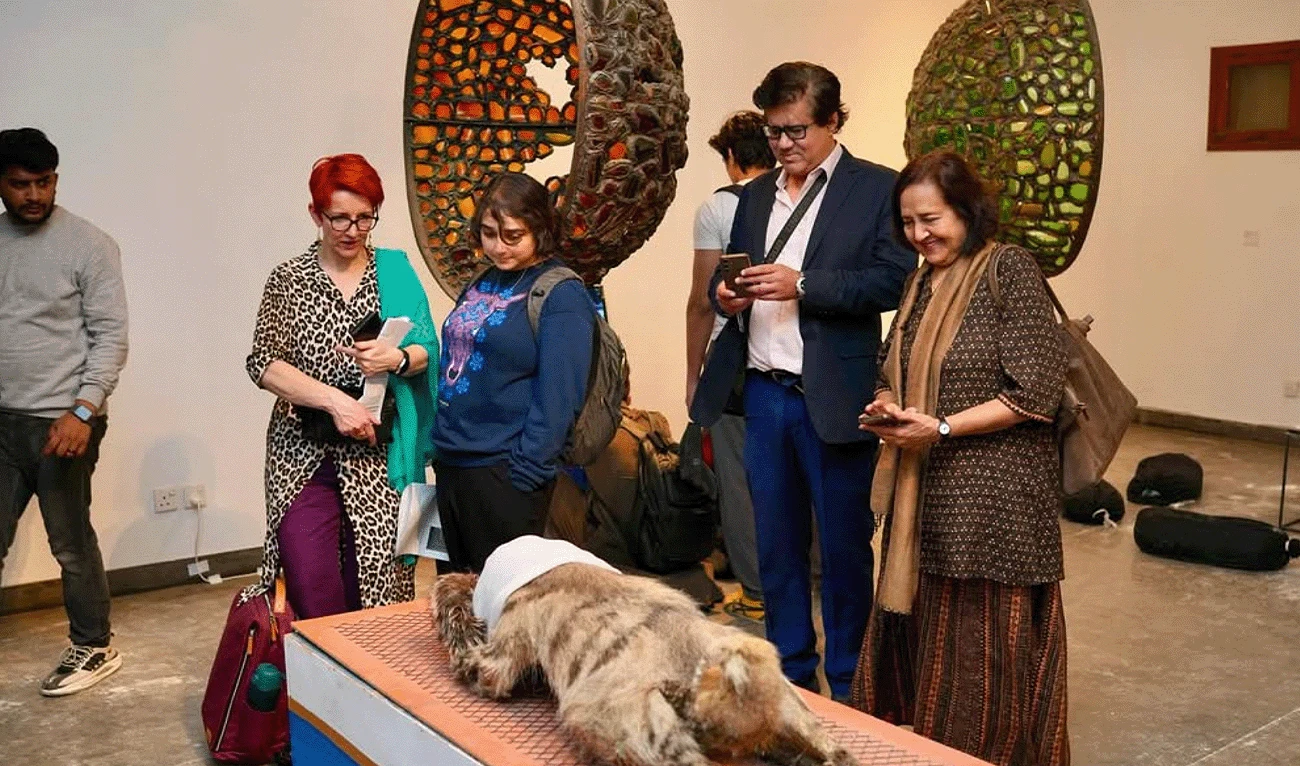
A two–week event, the biennale attracts visitors from all over Pakistan and abroad who are keen to experience art through exhibitions, artist talks, seminars and guided tours.
The KBT announced in a public post earlier this month that its fifth edition, scheduled to be held from Jan. 16-31, had been canceled on account of “the war conditions prevailing in the region and the resultant logistical constraints and incertitude.”
“The regional wars have severely affected funding in Pakistan and Europe, and with no end to the uncertainty in sight, a citywide biennale could not responsibly be delivered,” KBT chairperson Atteqa Malik told Arab News.
“After considering scaled-down and postponed options, the trustees took the difficult decision to cancel.”
The KBT’s published curatorial vision for the fifth edition envisaged exhibitions in public spaces, ports and parks. It said the fifth edition would explore Karachi’s history of migration and its relationship with the sea, alongside environmental pressures such as rising sea levels and damaged mangroves.
The war between the US and Iran, as well as recent attacks by Iran-backed Houthi rebels targeting civilian infrastructure in Saudi Arabia, has sent the region into turmoil. An attack by Houthi rebels on the international airport in Riyadh killed 12 people and injured over 300, forcing several carriers such as the Pakistan International Airlines to suspend flights to the Saudi capital.
Curator Noor Ahmed told Arab News the program had engaged 103 artists, pairing Pakistani and international practitioners with communities in Pakistan to jointly produce works on water, port cities and mobility.
The cancelation has removed an exhibition platform for those collaborations, which she said were intended to build lasting connections between Pakistan and the international art world.
Ahmed said the program was intended to bring different experiences and perspectives to issues shared across borders.
“The curatorial methodology paired international and domestic artists with communities in Pakistan for them to jointly produce a work for the Biennale so that topics of global concern were presented by diverse voices through the powerful medium of art,” she said.
Alongside the 103 artists, Ahmed said she had invited three curators to develop different sections with her. An extensive section on water was being developed with Zurich-based curator Martina Huber.
Now, Ahmed said the future of artists’ prepared work remained unresolved.
“As of now, KBT has not sent any way forward for the work that artists have prepared,” she said.
The biennale’s cancelation also disrupted plans for a Saudi-Pakistani sound project exploring shared maritime heritage, Huber said.
Huber said the biennale team was developing the project, named “Refugia,” with Saudi cultural practitioner Tara Al Dughaither.
Conceived with Pakistani artist Dostain Baloch, local musicians and Karachi communities, the project was intended to connect musical and oral traditions of the Arabian Gulf and Arabian Sea through listening sessions, performances and community gatherings.
Huber said the biennale involved collaborations with Al Dughaither and fellow Saudi artist Abdulnasser Gharem, alongside artists from 25 countries.
Arab News saw a copy of the signed cancelation notice, dated Sept. 30. It said events, appointments, and engagements connected with the edition would be terminated, subject to applicable notice periods. The notice said contractual commitments would be honored.
The notice also said the KBT would contact donors to arrange refunds of funds received for the canceled exhibition.
Ahmed said she first learned of the cancelation on Oct. 1, when the announcement was delivered to her by courier.
“In the following days, I then heard from a number of artists, cultural partners, and the KB27 staff who were being contacted by KBT at different times, confused by the cancelation and expressing disappointment in how commitments to them are being handled,” she said.
“As curator I have a very different point of view and feel very strongly that at a time of stated ‘war,’ collaboration is all the more important and all artists feel this way too, which they have expressed to me with confusion at the cancelation announcement by the trust,” Ahmed added.
Malik, meanwhile, said office-bearers had discussed the financial situation and options to scale down or postpone with Ahmed before a Sept. 25 trustees’ meeting.
No artist contracts had been signed by the Sept. 30 announcement, Malik said, adding that artists and donors were promptly sent the announcement and a letter.
Artists had generally supported the KBT’s position, she said, and concerns raised had been promptly addressed.
“KBT will honor its contractual commitments as announced on Sept. 30,” Malik said.
However, Ahmed said her concerns extended to the longer-term connections that had been built through preparations for the exhibition.
“A big part of my role and time as curator was spent creating avenues for sustained relationships between Pakistan and the international art world,” she said.