- Aurangzeb says businesses cannot face unexpected tax changes in successive budgets
- Minister says tax-to-GDP ratio has risen to 10.3 percent, fiscal deficit fallen to 22-year low
KARACHI: Pakistan’s Finance Minister Muhammad Aurangzeb called for greater predictability in tax policies on Tuesday, saying businesses could not continue to face unexpected changes in annual budgets as the government sought to encourage private investment and shift from economic stabilization to sustainable growth.
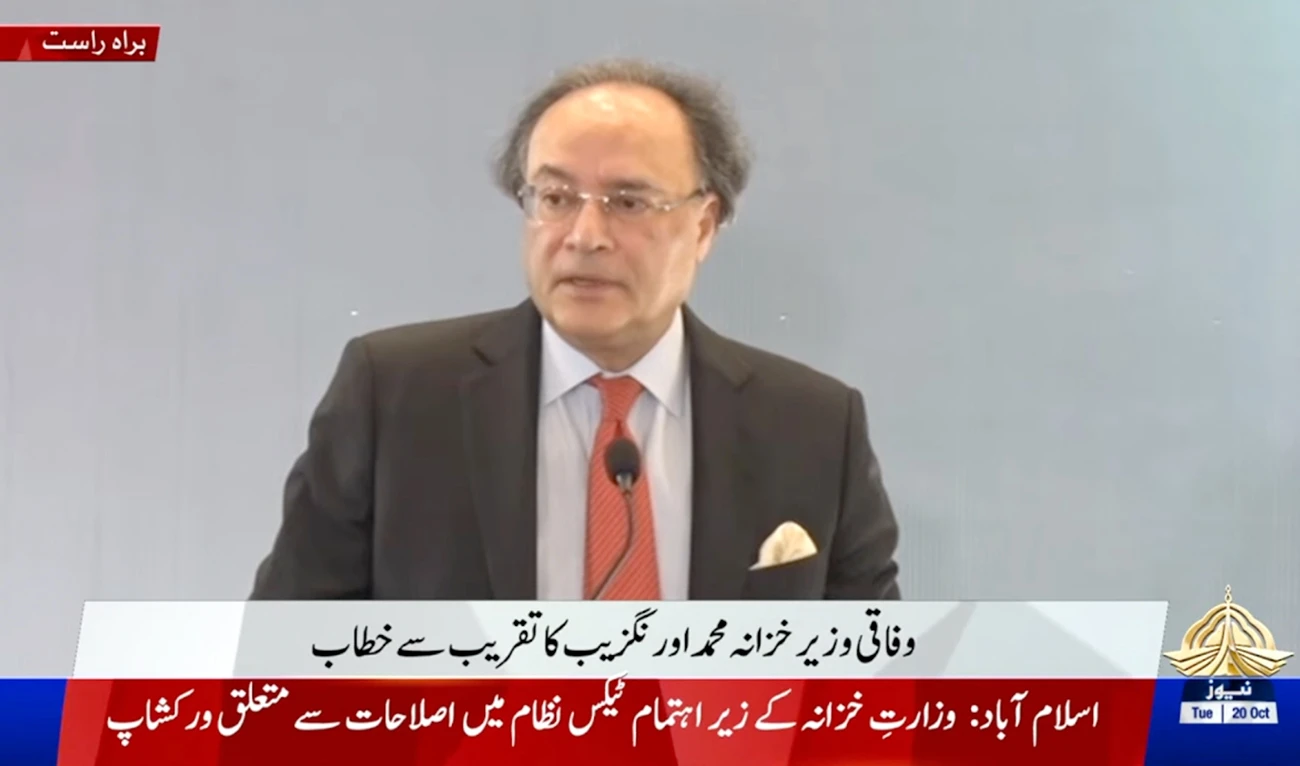
The minister made the remarks at a workshop on tax reforms, where he outlined plans to broaden the tax base, simplify the tax code and strengthen enforcement. Pakistan is implementing a $7 billion International Monetary Fund (IMF) program aimed at stabilizing its economy and addressing longstanding structural weaknesses, including a narrow tax base and persistent fiscal imbalances.
“We owe it to the private sector, we owe it to the nation, we owe it to the country,” Aurangzeb said in a televised address to the gathering in Islamabad. “We cannot continue to give surprises to private sector investment at every single budget.”
Pakistan has struggled for decades with a narrow tax base, weak revenue collection and repeated balance-of-payments crises, forcing successive governments to seek IMF assistance. Businesses have frequently complained about unpredictable taxation, high energy costs and policy uncertainty, which have discouraged long-term investment and undermined export competitiveness.
Aurangzeb said the government needed to move beyond designing tax policies primarily to meet revenue targets and instead consider their wider economic impact.
“We have to continue to have a tax design which is led by economic value considerations, not by making the math work,” he said.
The minister said the government had already begun recalibrating taxation for export-oriented industries in the last budget, with future efforts aimed at ensuring policy continuity and creating a more predictable environment for investment.
He also emphasized the importance of political consensus, coordination between federal and provincial governments, stronger institutions and restoring public confidence in tax authorities.
Turning to Pakistan’s economic performance, Aurangzeb said the country’s twin deficits — fiscal and external — had narrowed from a combined 12.5 percent of gross domestic product a few years ago to 2.6 percent in the last fiscal year.
“Last fiscal year, we had a fiscal deficit which is now at a 22-year low,” he said.
He said Pakistan had recorded three consecutive years of primary budget surpluses, while the tax-to-GDP ratio had increased from 8.8 percent to 10.3 percent.
The minister said the government would place greater emphasis on enforcement while continuing efforts to bring more taxpayers into the system.
He also warned against returning to consumption-driven growth financed by excessive liquidity, saying such policies had contributed to Pakistan’s repeated economic crises.
“Those have actually led us to the boom-and-bust cycles. And one thing is for sure: we will not let that repeat,” he said.
Aurangzeb said future economic expansion needed to be sustainable and export-led, supported by tax reforms that encouraged productive investment rather than short-term consumption.