- Lt. Gen. (r) Mazhar Jamil urges international community to reconsider India’s nuclear trade waiver
- He warns of rapid escalation in a future conflict, calls for dialogue, crisis-management mechanism
ISLAMABAD: A senior Pakistani nuclear adviser has warned that India may be moving toward an offensive nuclear first-strike posture, raising the risk of a catastrophic confrontation between the South Asian rivals following their deadly military conflict in May last year.
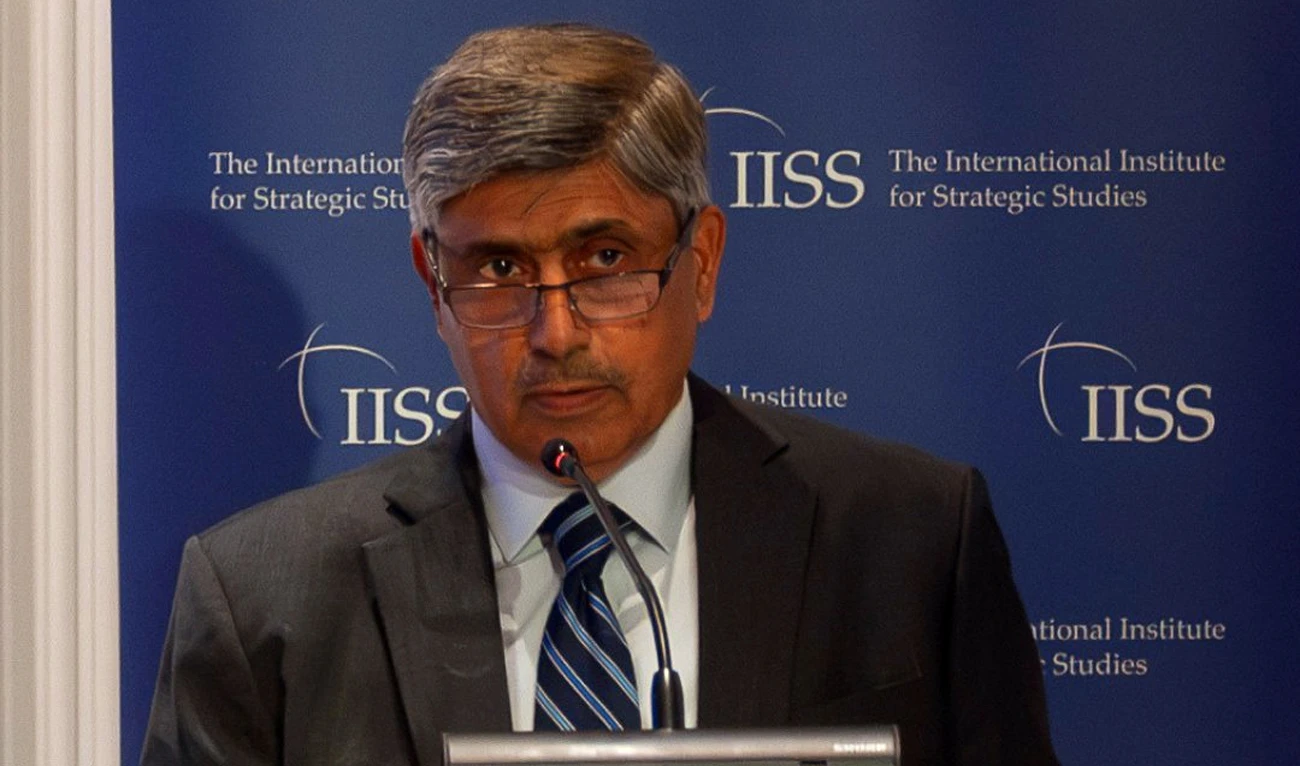
Lt. Gen. (r) Mazhar Jamil, an adviser to Pakistan’s National Command Authority (NCA), made the remarks during a keynote address at the International Institute for Strategic Studies (IISS) in London this month, according to a transcript published by the institute.
He also called for reconsidering India’s international nuclear trade waiver and warned that another military confrontation could escalate rapidly.
“India’s capability of maintaining ‘continuous-at-sea-deterrence’ ... dilutes the credibility of India’s claimed policy of NFU and points toward India adopting an offensive first-strike posture,” Jamil said, referring to New Delhi’s declared policy of no first use of nuclear weapons.
The remarks come more than a year after India and Pakistan fought their most intense military confrontation in nearly three decades, involving missiles, drones and air strikes across their disputed frontier and international border.
The four-day conflict in May 2025 was triggered by an April 22 attack that killed 26 people, mostly tourists, in Indian-administered Kashmir. New Delhi blamed Pakistan, an accusation Islamabad denied while calling for an impartial international investigation. India, however, launched strikes inside Pakistan and Azad Kashmir on May 7.
Pakistan retaliated, and the fighting escalated to attacks on military installations in both countries before a ceasefire was announced on May 10 following US diplomatic intervention.
The confrontation raised fears of a wider war between countries that have fought several conflicts since independence from British rule in 1947 and openly demonstrated their nuclear weapons capabilities through rival tests in May 1998.
Jamil, who headed Pakistan’s Strategic Plans Division from 2015 to 2017, was speaking at the 11th IISS–Center for International Strategic Studies Track 1.5 workshop on nuclear deterrence and strategic stability in South Asia.
He cited an assessment by the Stockholm International Peace Research Institute (SIPRI) that India had reportedly begun mating some nuclear warheads with submarine-launched ballistic missiles and conducting sea-based deterrence patrols.
Jamil argued that such developments, coupled with the absence of advance notification of Indian submarine-launched ballistic missile tests, increased the risk of miscalculation during a crisis.
India maintains a declared no-first-use nuclear policy, while Pakistan has not adopted a comparable pledge and has instead called on the two countries to sign a no-war pact.
“Pakistan has been saying that India NFU is just a diplomatic ruse,” he said. “It stands validated today.”
NUCLEAR TRADE WAIVER
Jamil also urged the international community to reconsider the waiver granted to India by the Nuclear Suppliers Group (NSG), which allowed New Delhi to engage in civilian nuclear trade despite not being a signatory to the Nuclear Non-Proliferation Treaty.
The 2008 waiver was a significant exception to international nuclear trade restrictions and enabled India to access foreign nuclear technology and fuel for its civilian energy program.
Jamil argued that the waiver and support from India’s technology partners had helped New Delhi expand its nuclear and missile programs, raising concerns about arms control and transparency.
“I think it is time that [the] international community should [be] thinking of reversing the NSG waiver of India because of [India’s] irresponsible nuclear behavior,” he said during the question-and-answer session.
He also expressed concern about India’s development of long-range missiles and its access to advanced military and dual-use technologies, arguing that these capabilities were altering the regional strategic balance.
RAPID ESCALATION
Turning to the possibility of another military confrontation, Jamil warned that the May 2025 fighting had made future crises more dangerous by narrowing the space between military action and escalation.
He said Pakistan would continue to rely on its “Quid Pro Quo Plus” strategy, involving a strong conventional military response to aggression backed by its broader nuclear deterrence capabilities.
He also criticized India’s decision to hold the Indus Waters Treaty in abeyance following the April 2025 Kashmir attack, saying the move had added another source of conflict between the neighbors.
During the discussion, Jamil warned that another confrontation might escalate more rapidly than previous crises, likening escalation in South Asia to an elevator rather than a ladder.
He argued that the May 2025 conflict had already crossed several thresholds, making it more difficult to contain another confrontation.
Despite his warnings, Jamil said Pakistan remained prepared to pursue political dialogue with India, including over the disputed Kashmir region, and proposed a bilateral mechanism to manage future crises.
“Pakistan as a responsible nuclear state is ready to move forward toward [a] political dialogue to resolve all conflicts, including Kashmir, and offers to establish a robust crisis management mechanism, as a first step in that direction,” he said.
Jamil also called for impartial international mediation to help resolve conflicts and manage crises in South Asia.