- Dar briefs British lawmakers in London on Islamabad’s diplomatic efforts to de-escalate Middle East tensions
- Iran says Pakistan, Oman talks stressed ‘regional solutions’ as temporary Hormuz corridor takes shape
ISLAMABAD: Pakistan’s Foreign Minister and Deputy Prime Minister Ishaq Dar said on Wednesday adherence by all parties to an Islamabad-brokered US-Iran peace framework was “critical” to achieving lasting regional stability, as diplomatic efforts intensify to prevent renewed conflict and restore navigation through the Strait of Hormuz.
Pakistan has emerged as one of the key mediators in the conflict since the US and Israel launched a war on Iran on Feb. 28, helping Qatar broker the Islamabad Memorandum of Understanding (MoU) between Washington and Tehran in June and continuing efforts to revive negotiations after implementation of the agreement stalled.
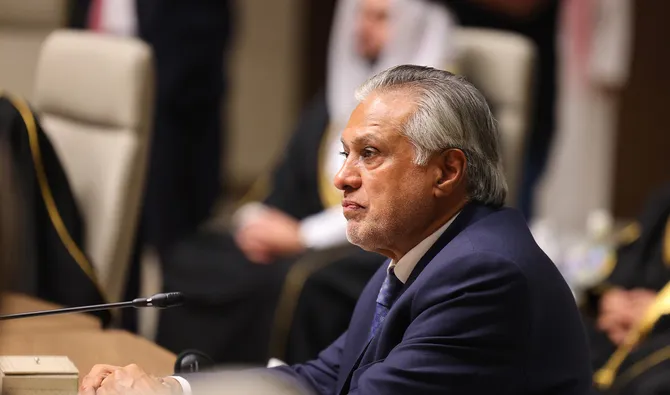
“DPM/FM shared Pakistan’s ongoing diplomatic initiatives for de-escalation and peace in the Middle East,” Pakistan’s Foreign Office said in a statement after Dar met a group of cross-party British parliamentarians of Pakistani origin at Pakistan House in London. He is on a five-day visit to the UK.
“He underscored that adherence to the Islamabad Memorandum of Understanding by all parties was critical to achieving durable peace and stability in the region.”
Dar also discussed the Makkah Joint Defense Agreement between Pakistan, Saudi Arabia and Türkiye, describing the pact as “purely defensive in nature” and saying it was intended to strengthen regional peace and stability. Signed earlier this month amid heightened Middle East tensions, the trilateral pact stipulates that an attack on any one of the three countries will be considered an attack on all three.
The Islamabad MoU Dar referred to was mediated by Pakistan and Qatar in June and established a framework for ending military operations between Washington and Tehran and moving toward negotiations on a permanent settlement.
Subsequent talks in Switzerland produced a 60-day roadmap toward a final agreement and established working groups dealing with nuclear issues, sanctions and monitoring and dispute resolution. The framework also created a communication mechanism intended to prevent incidents and miscalculation and facilitate the safe passage of commercial vessels through the Strait of Hormuz.
But negotiations later stalled and fighting resumed amid disputes over implementation, leaving the interim framework in place without the broader settlement it was intended to produce. The US and Iran have not exchanged major attacks in recent weeks, but Washington this week expanded sanctions targeting Tehran and significant differences between the two sides remain.
‘SIGNIFICANT PROGRESS’
Dar’s comments come days after Pakistan’s Defense Forces Chief Field Marshal Asim Munir and Interior Minister Mohsin Naqvi visited Tehran as part of Islamabad’s efforts to break the deadlock and restore the peace framework.
The Pakistani officials held meetings with Iranian President Masoud Pezeshkian, Foreign Minister Abbas Araghchi and other senior political and security officials.
Naqvi said discussions with Pezeshkian focused on the US-Iran conflict, wider Middle East tensions and steps required by both sides to restore the Islamabad MoU.
“Significant progress was made, and the meeting concluded on a highly positive note,” Naqvi said on Tuesday. “We remain hopeful that this momentum will help pave the way for further progress and lasting peace in the region.”
Pakistan’s military said Munir’s talks also focused on preventing further escalation, reopening the Strait of Hormuz and bringing the conflict to an “expedited” end through a negotiated settlement.
Araghchi and Munir spoke again by telephone on Tuesday, a day after their meeting in Tehran, with Iranian state media saying they discussed the latest regional developments and emphasized continued consultations and joint efforts to establish peace and security.
Ahead of Munir’s Tehran visit, US President Donald Trump also spoke to the Pakistani military chief, according to three Pakistani sources cited by Reuters. One source said Washington had asked Pakistan to use its influence to encourage Tehran to return to negotiations.
‘REGIONAL SOLUTIONS’
The Pakistani diplomatic push has coincided with parallel talks between Iran and Oman over one of the most consequential elements of the crisis: restoring navigation through the Strait of Hormuz.
Araghchi said on Wednesday that separate talks with Pakistani and Omani officials this week had emphasized “regional solutions,” citing a proposed new shipping corridor, joint mine-clearing and the future management of the strategic waterway.
“Iran’s commitment to peace and stability is matched by steadfast diplomacy with our neighbors. In talks with Pakistani and Omani guests, regional solutions were stressed,” Araghchi said in a post on X.
“Proposed framework for new corridor, joint mine-clearing, and future management of Hormuz is case in point.”
His comments followed Munir’s visit to Tehran on Monday and a separate visit by Omani Foreign Minister Badr Albusaidi on Tuesday, when he and Araghchi discussed a phased framework for restoring safe navigation through Hormuz.
Iran and Oman said the framework envisaged establishing a temporary joint maritime corridor through the strait and carrying out a joint mine-clearing project. Technical negotiations would continue toward a permanent corridor and future arrangements for administering the waterway, including information sharing, vessel-traffic management and maritime and security services.
Albusaidi said he hoped a temporary corridor and practical arrangements to restore safe navigation would be announced soon, with longer-term management of the strait to follow under the Islamabad MoU.
The Strait of Hormuz, which before the conflict carried about a fifth of globally traded oil and liquefied natural gas, has suffered severe disruption since the war began, making the restoration of shipping through the waterway a central part of efforts to stabilize the region.