- Government announces tax revenue target of Rs5.55 trillion, forecasts budget deficit of 7.1% of GDP
- Spending set to rise to Rs7.02 trillion, military budget to remain static at Rs1.5 trillion
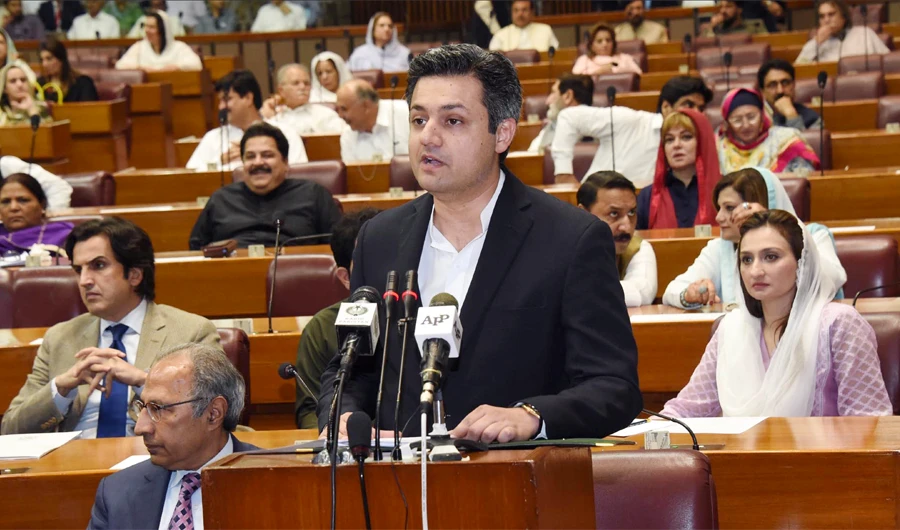
Pakistan on Tuesday announced a Rs8.2 trillion budget for the fiscal year to June 2020 with a tax revenue target of Rs5.5 trillion in a chaotic budget session marred by lawmakers’ jeers and scuffles.
In May, the government secured a provisional $6 billion loan from the International Monetary Fund, but the deal is contingent on measures being taken to cut a budget gap that the Fund forecast at 7% in 2018/19.
The government had already prepared the ground for massive belt-tightening in next year’s budget in order to seek final approval for the IMF package. But the goals set forth by Revenue Minister Hammad Azhar in parliament on Tuesday highlighted the the grave economic challenges that lie ahead for the government of Prime Minister Imran Khan.
Amid chaotic scenes in parliament, opposition lawmakers shouted slogans against the government and held up banners reading “Say no to IMF budget!”
Azhar said in his budget speech that the government had failed to hit last fiscal year’s tax goal of Rs4.44 trillion.
“Until we improve our tax system, Pakistan will not progress,” he said, adding that spending was set to rise to Rs7.02 trillion, 30% above last year’s target.
Successive governments have promised to rein in tax evaders and boost revenues but face fierce resistance to change, including from the many politicians and businessmen believed to be among those dodging their taxes. Only 1.8 million people file income tax returns in the fast-growing South Asian nation with a population of 208 million and a large informal economy.
With inflation at a five-year high and households increasingly squeezed by high prices for food, energy and household goods, the government has faced increasing anger and Azhar announced a 10% cut in ministerial salaries and an increase in the minimum wage to Rs17,500.
The government also said it had allocated Rs1,863 billion for development projects under the Public Sector Development Programme (PSDP) and would transfer Rs3,255 billion to the provinces under the National Finance Commission award, a programme aimed at fixing financial imbalances among the centre and provinces.
Azhar said the government had reduced its expenditures from Rs460 billion to Rs437 billion for the fiscal year to June 2020, adding that the defence budget would remain static at Rs1.15 trillion.
“There will be no compromise on the efficiency of the armed forces,” Azhar said.
Last year the government allocated the military about 20% of the Rs5.6 trillion federal budget.
The government has also proposed a 10 percent increase in the pensions of retired government employees, 10 percent ad hoc relief for government employees from grade 1 to 16, five percent ad hoc relief for government employees from grade 17 to 20, and 10 percent ad hoc relief for armed forces employees.
The minimum taxable income for salaried class would be Rs600,000 per annum, Azhar announced, adding that non-filers would be allowed to purchase property of over Rs5 million.
Proposing Rs40 billion in subsidies for the electricity and gas sectors, the state minister said measures taken by the Khan-led government had resulted in a Rs12 billion drop per month in circular debt, or pending power arrears, in the energy sector.
Azhar said general sales tax (GST) would remain unchanged at 17 percent while sales tax on sugar, fish, meat, and chicken had been increased to 17 percent and duties on liquefied natural gas (LNG) reduced from 7 percent to 5 percent.
The state minister also proposed allocating Rs20 billion and Rs15 billion respectively for the Diamer-Bhasha and Mohmand dams.
The government has already slashed its year to June 2019 growth forecast to 3.3% from the 6.2% predicted at the time of the last budget. The IMF’s estimates growth of around 2.9%. For the coming year to June 2020, the government expects growth at 4%.
Under the terms of the IMF loan, the government is also expected to let the rupee depreciate to help tackle an unsustainable current account deficit and aim for a primary budget deficit - excluding debt servicing costs - of 0.6 percent. The rupee has lost about a third of its value this year.