- Figure is just a fraction of total amount laundered by citizens, official says
- Team tasked with recovering illegally-obtained money seeks residency details of overseas nationals
ISLAMABAD: The government on Monday said that it had zeroed in on 10 countries where nationals have stocked their illegally-obtained money and assets worth $5.3 billion.
“This amount is just a fraction of the ill-gotten money laundered abroad. We have also unearthed more than 5,000 fake bank accounts used for money laundering,” Barrister Shahzad Akbar, Special Assistant to the Prime Minister on Accountability said, without disclosing the identities of the individuals involved.
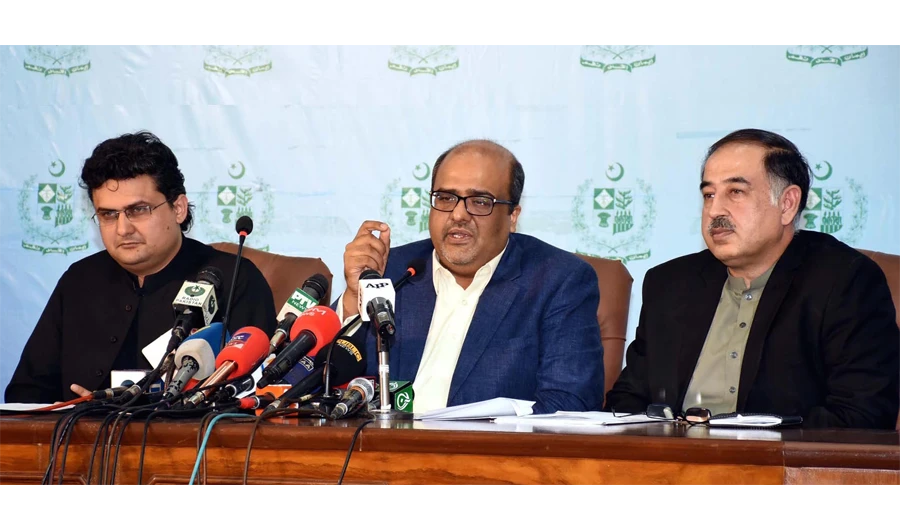
Addressing a press conference – where he was accompanied by Iftikhar Durrani, Prime Minister’s Special Assistant on Media, and Senator Faisal Javed Khan – Akbar said that the UK and the UAE featured among the list of countries, along with other “offshore locations”.
“The most difficult task was to trace the assets and we have done that in a short span of time,” Akbar, who also heads the Assets Recovery Unit (ARU) -- a group tasked with retrieving illegally-obtained money -- said. The Pakistan Tehreek-e-Insaf government set up the ARU in the first week of September to curb the issue of money laundering.
Akbar added that initially the team had narrowed down a list of individuals with more than $1 million worth of assets abroad. “We’re going after the big fish first,” he said, adding that they would be able to expediate the process just as soon as Pakistan completes the legal formalities in the host countries.
“Investigations are underway and a majority of owners of the assets have already been sent notices (to explain their positions),” he said.
He said that negotiations are underway with the UAE authorities to extract more details and facilitate the recovery process, after it emerged that Pakistanis were the third largest investors in the country’s real estate sector. “We are also seeking details of cash declarations made by Pakistanis on their arrival in the UAE,” he said.
Explaining the difficulties in tracking the offshore assets of Pakistanis, Akbar said that the iqama (residence/work permits) issued by the UAE helped money-launderers from Pakistan “hide their identity”, while some others bought assets in the names of their servants or domestic help.
Another issue at hand was that Pakistan’s ruling elite also featured among those who misused the permits to launder money and assets as this “changes the residence status of a person in the banking system and makes it difficult for relevant authorities to trace them”.
“We are getting details of all iqama holders from the UAE authorities as money-laundering has crippled our economy. Our former rulers didn’t try to stop it because their personal interests were also involved,” Akbar said, to which Durrani added that $15 billion worth of properties were owned by Pakistanis in the UAE alone.
He said that the ARU is currently pursuing old cases and has yet to register new ones, adding that the details of each and every case would be shared with the public at an appropriate time.
Senator Khan, on his part, said that this is the first time in Pakistan’s history that assets stashed abroad are being traced and loopholes in the system are being plugged to curtail money-laundering.
“The nation will hear good news soon about money stashed in Swiss banks. We are working on it,” Akbar said with a particular reference to the billions stocked by Pakistani nationals in Swiss banks.
Habibullah Khan, a Supreme Court advocate told Arab News that it was not easy to recover money stashed in foreign countries as the government would first have to prove to the host countries that the assets were bought with illegally-obtained cash. “Until and unless it is proved with evidence that a Pakistani bought an asset in a foreign country with illegal money, it cannot be recovered,” he said, adding that because they have fulfilled all legal requirements in the host countries before buying assets, “it'll be very difficult to charge them for a crime.”