- Oman backs unhindered navigation through Strait of Hormuz, praises Pakistan’s role in US-Iran diplomacy
- Both countries discuss labor mobility, institutional cooperation at joint ministerial commission meeting
ISLAMABAD: Pakistan and Oman on Wednesday condemned recent Houthi attacks on Saudi Arabia that killed one Pakistani and injured five others, reaffirming their commitment to regional security and diplomatic efforts to ease Middle East tensions, including restoring unhindered navigation through the Strait of Hormuz.
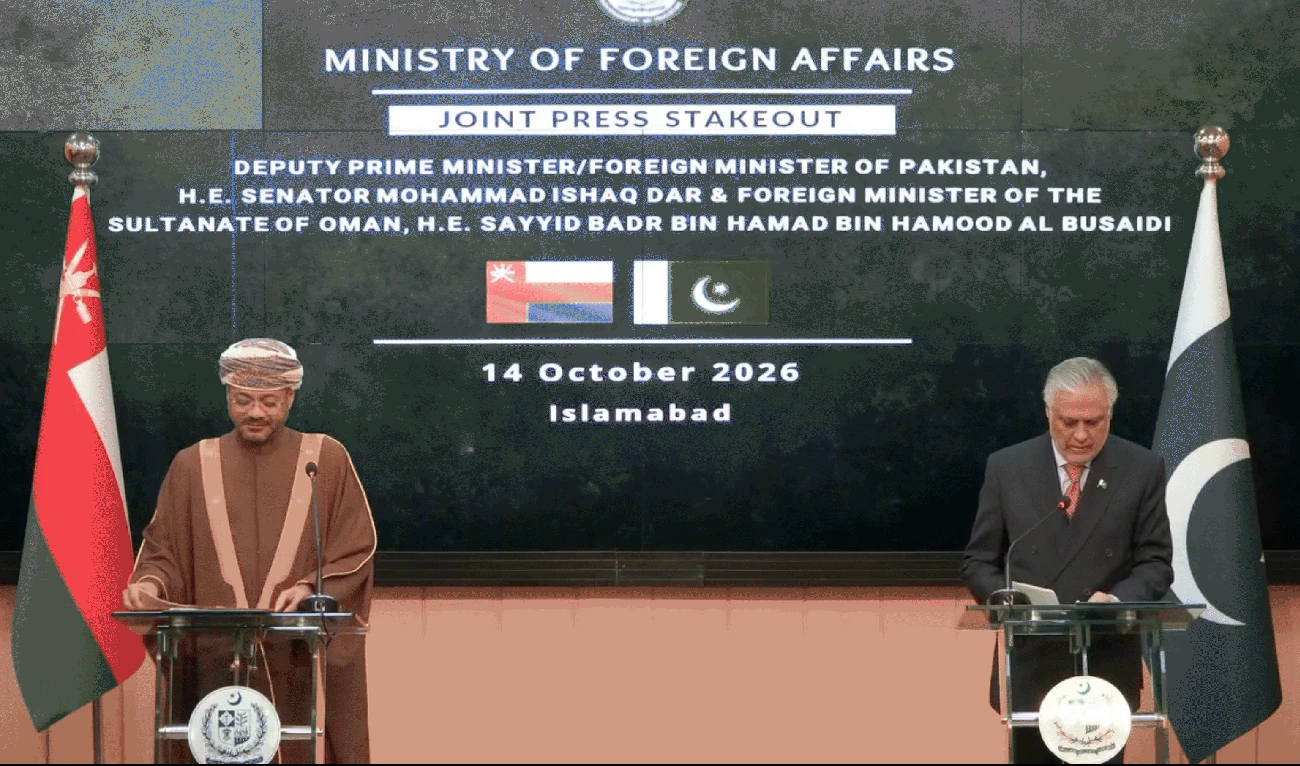
The remarks came during a joint news conference in Islamabad by Pakistan’s Deputy Prime Minister and Foreign Minister Ishaq Dar and his Omani counterpart, Sayyid Badr bin Hamad Albusaidi, following the eighth session of the Pakistan-Oman Joint Ministerial Commission.
The meeting took place amid heightened regional tensions stemming from the US-Iran conflict, Houthi attacks on Saudi Arabia and disruptions to shipping through the Strait of Hormuz, a vital route for global energy supplies and oil-importing countries such as Pakistan.
“During our discussions with my brother and his delegation, we also exchanged views on the recent Houthi attacks on Saudi Arabia,” Dar said.
“I conveyed Pakistan’s strongest condemnation of the attack, which resulted in injuries to several individuals, martyrdom of one Pakistani and injuries to five Pakistani nationals.”
Dar said attacks against civilians and civilian infrastructure were “totally unacceptable,” adding that his Omani counterpart shared Pakistan’s concerns over the threat to regional peace and security.
“I reaffirmed Pakistan’s full solidarity with the leadership and people of the Kingdom of Saudi Arabia, as well as our unwavering commitment to the Kingdom’s sovereignty, territorial integrity and security, in accordance with the Makkah Joint Defense Agreement,” he said.
The two officials also discussed security and freedom of navigation through the Strait of Hormuz and Bab Al-Mandab, two strategic waterways whose disruption has raised concerns about global energy and food security.
Iran’s restrictions on shipping through Hormuz, which handled roughly a fifth of global oil and liquefied natural gas trade before the conflict, have disrupted energy supplies and driven up costs for import-dependent economies, including Pakistan.
Oman, which shares the strait with Iran, has been engaged in discussions with Tehran over navigation arrangements while supporting broader diplomatic efforts to resolve the US-Iran conflict.
“We are committed as far as the Sultanate of Oman is concerned to free navigation, unhindered navigation, and the return of navigation through the Strait of Hormuz because of its vitality to the global economy and to the region,” Albusaidi said.
He said Oman would support efforts toward that objective, adding that discussions with Iran on temporary navigation arrangements were almost concluded, while a permanent settlement remained linked to progress in broader US-Iran negotiations.
Both ministers emphasized diplomacy as the preferred means of addressing regional disputes and preventing further escalation.
“Both Oman and Pakistan attach great importance to dialogue and diplomacy as essential means of addressing regional challenges, easing tensions, and promoting peace and stability,” Albusaidi said.
“Oman truly appreciates Pakistan’s constructive role in facilitating dialogue and supporting diplomatic efforts in the region, including its role in the negotiations between Iran and the United States.”
Dar said the two countries shared an understanding of the challenges confronting the region and had agreed to continue working together to promote stability.
“So, we are both on the same page. We have agreed to continue to work hard for the stability of this region,” he said.
Beyond regional security, the ministers discussed expanding bilateral cooperation in trade, investment, agriculture, energy, labor mobility and vocational training, including creating new opportunities for skilled Pakistani workers.
Dar described Oman as a strategically important partner and a natural gateway for Pakistan to the Gulf Cooperation Council, while pointing to Pakistan’s potential to connect Oman with markets in China and Central Asia.
The two sides also agreed to strengthen institutional cooperation through joint working groups and pursue closer engagement between their business communities, including a proposed investment forum in Pakistan.