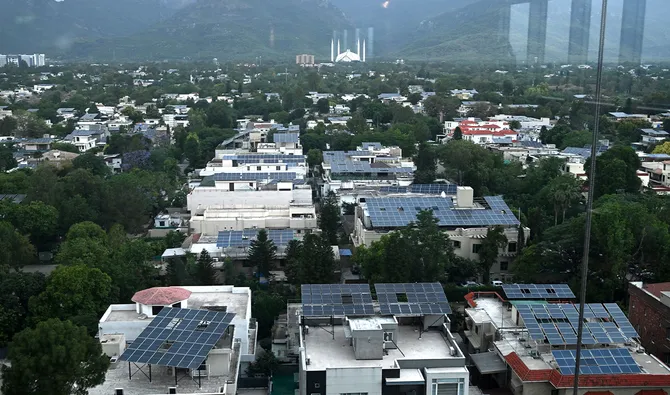
- Authorities order power companies to clear eligible connections initiated before new rules took effect in February
- Pakistan replaced generous net-metering regime as cheap solar panels, costly grid power drove rooftop boom
ISLAMABAD: Pakistan has moved this week to expedite thousands of pending rooftop solar connections that could qualify for benefits under its old net-metering regime, months after overhauling a policy that had helped drive a rapid shift toward solar power across the country.
Pakistan replaced its decade-old net-metering framework in February with a net-billing system for new rooftop solar consumers, significantly reducing the value of electricity they sell back to the grid. Under the old system, surplus solar power exported during the day could offset electricity drawn from the grid, while the new regime prices electricity bought from and sold to the grid separately, making self-consumption considerably more valuable than exports.
The overhaul followed years of rapid rooftop-solar adoption as falling panel prices collided with soaring grid electricity tariffs. The government has argued the old system increasingly shifted fixed power-sector costs onto consumers without solar, while critics say households and businesses invested their own money in alternative power because grid electricity had become expensive and unreliable. Existing net-metering agreements were subsequently protected until their expiry following controversy over whether the new rules would apply to them.
“The regulatory directive specifically addresses those net-metering connections that have remained pending even after consumers had paid their demand notices, received net-metering licenses, undergone physical meter replacement or reprogramming, and executed meter connection orders prior to February 9, 2026,” the Power Division said in a statement.
The division said eligibility would depend on consumers being able to verify that they had paid their demand notices before the Feb. 9 cutoff, when the new regulations took effect.
It has instructed all power distribution companies, or DISCOs, and the Pakistan Information Technology Company (PITC), which manages key electricity-sector billing systems, to verify pending applications where payments were made before that date.
“Consumers who have fulfilled all prescribed requirements, including the timely payment of demand notices, are assured that they will not face any unnecessary obstacles or procedural delays,” the Power Division said.
PITC has also been directed to review its billing systems and software so eligible connections that completed the required formalities before Feb. 9 can be added to the system.
The government said the verification process was intended to distinguish genuine pending applications rather than create additional hurdles for consumers.
“The aim is to protect consumer rights while guaranteeing that only genuine pending cases are cleared expeditiously,” the Power Division said, adding that it would monitor implementation across distribution companies.
NEW REGIME
Pakistan introduced net metering in 2015 to allow households and businesses generating electricity from small-scale renewable systems, overwhelmingly rooftop solar, to supply excess power to the national grid and receive credits against electricity consumed from it.
The arrangement became increasingly attractive as Pakistan’s electricity tariffs rose sharply while the cost of Chinese solar panels fell, helping trigger a boom in rooftop installations and reducing grid consumption among households and businesses able to finance their own systems.
The government has argued that the rapid migration toward solar created an imbalance because power-sector fixed costs, including capacity payments to electricity producers and the cost of maintaining the grid, remained even as conventional electricity sales declined.
In February, the National Electric Power Regulatory Authority (NEPRA) repealed the 2015 net-metering regulations and introduced the Prosumer Regulations 2026, replacing net metering for new consumers with net billing.
Under the new arrangement, electricity exported by new solar consumers is purchased at the National Average Energy Purchase Price, while electricity drawn from the grid is charged at the consumer’s applicable retail tariff. NEPRA has set the National Average Energy Purchase Price at Rs8.13 ($0.03) per kilowatt-hour for 2026, substantially below the retail price paid by many electricity consumers.
The February regulations initially caused concern about consumers who had already invested in solar systems under the previous rules. NEPRA subsequently amended the regulations in April to protect existing agreements under the old billing mechanism until their contractual terms expire.
The latest directive addresses another group caught in the transition: consumers who had begun and substantially completed the approval process before Feb. 9 but whose connections had not been fully incorporated into the system when the new rules came into force.