- In 2001, the 9/11 commission report had linked madrassas to militancy and pressured Pakistan to crack down against seminaries
- Seminaries never opposed reforms, only asked for easy registration, says Sajid Mir
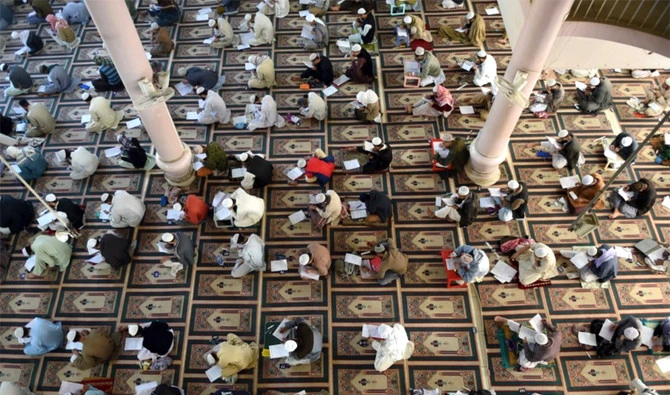
ISLAMABAD: Pakistan’s landmark move to mainstream madrassas (religious seminaries), meeting a highly pressing demand arising post 9/11 attacks, is being viewed as the “step in the right direction” by all sides.
Pakistan government announced last week to bring 30,000 religious schools under the ministry of education with modernized curriculums after reaching a formal agreement with the leaders of major madrassa systems.
The mainstreaming of thousands of madrassas (religious seminaries) has for years been a delicate subject in the Muslim majority country of 208 million people, where religious schools have often been blamed for the radicalization of youngsters. Repeated attempts to modernize seminaries in the past were stayed due to fears of a religious backlash.
“This agreement is just a step, but a step in the right direction,” said Arshad Mirza, federal secretary at the Ministry of Federal Education and Professional Training, who was closely involved in negotiating the agreement.
“We are introducing technical education for madrassa students including modern IT-based skills and other technology courses,” Mirza told Arab News.
Pakistan’s government has been facing increased global pressure to act against militant groups, with the Paris-based terror financing watchdog, the Financial Action Task Force, scrutinizing the country’s compliance with an internationally agreed action plan, and a timeline until October to improve its counter-terror financing operations or risk being sanctioned.
With some seminaries considered as breeding grounds for militancy, and as pretexts for militant financing, the government revealed in April this year that it planned to bring 30,000 seminaries under the Ministry of Information.
These reforms were on the cards for a long time. In the aftermath of the Al-Qaeda led Sept. 11, 2001 attacks in the US, where almost 3,000 people died in three American cities, the 9/11 Commission Report linked madrassas to militancy. Under US pressure, the then government of President Pervez Musharraf attempted to modernize seminaries but did not have much success against a strong religious lobby.
Now, Mirza said, the government would introduce a single curriculum that applied to seminary classrooms as well, the National Common Curriculum.
“We will introduce common curriculum for the students of class one to five in March 2020 and then take it to the highest level subsequently,” he said.
Eventually, the government wants madrassa students to study under the common curriculum up to class eight.
“These students will study the same syllabus as other children, whether he is a son of a bureaucrat, a businessman or a minister. It is a big challenge but it is a step toward the right direction to unify the nation,” he said.
Professor Sajid Mir, President Wafaq-ul-Madaris Salfia, who is also a signatory in the madrassa agreement with the government, told Arab News that he was optimistic about the move and happy to deal directly with the country’s education ministry.
“It was our long-standing demand that the ministry of education should deal with madrassas (seminaries) as previously, either they put us under Interior Ministry, or others, who had no direct link with us.”
Mir said seminaries had never opposed madrassa reforms and registration, but simply demanded a more convenient process to register themselves.
“We always asked for an easy process, as institutions (involved in registration) demanded a lot of documents and the process was very complicated. I hope now, things will move forward smoothly,” he said.