- Privatization DG says investors from Russia and China interested in buying shares of Pakistan Steel Mills
- The government hopes to complete financial closure of foreign investments by April next year
ISLAMABAD: A senior official at the Privatization Commission has said the government was expecting at least $1 billion in foreign investment by the end of the year to revive Pakistan’s largest steel manufacturing complex, Pakistan Steel Mills (PSM), with investors from Russia and China displaying interest in running the facility as part of a consortium.
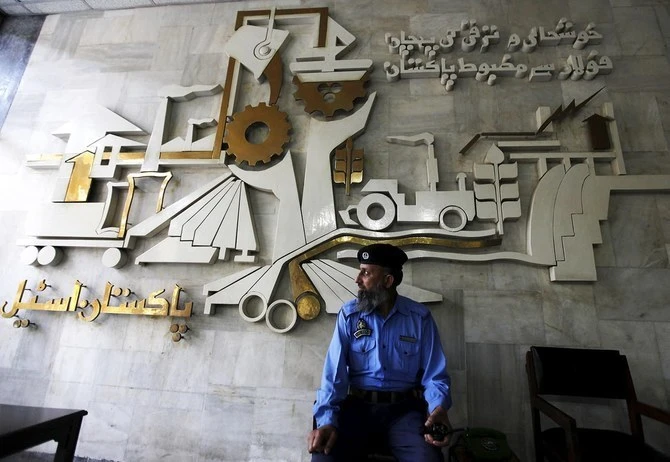
Once the producer of almost half the country’s steel needs, state-owned PSM, designed and funded by the Soviet Union in the 1970s, now has around Rs400 billion in losses and liabilities. The facility has been dormant since 2015 and contributes up to Rs20 billion in annual losses to the national exchequer.
Officials say the Mills have the capacity to expand to produce three million tonnes of cold and hot-rolled steel annually. But managers over the years have failed to upgrade machinery, losses have spiralled and production has tumbled 92 percent in the past decade as demand for steel tanked during the 2008 recession and customers turned to cheaper Chinese products.
But the government of Prime Minister Imran Khan says it is resolved to turn around the facility’s fortunes, calling for international companies to run the Mills in partnership with the government.
The plan includes creating a new subsidiary, Steel Corp Limited, on the premises of the Pakistan Steel Mills to offer the mammoth industrial unit to foreign investors. Instead of selling or privatizing the Mills, the government aims to revive the operation and production of the unit with the help of foreign investors to meet growing local demand for steel.
“We are planning to sell its shares to foreign investors through a competitive bidding process, which is expected to be completed by December or January,” Iftikhar Naqvi, director-general of the Privatization Commission in Islamabad, told Arab News.
“We are expecting at least one billion dollars in foreign investment for an annual production of one million tons in the first year. The investors may pour an additional $3 to $4 billion to enhance the annual production capacity of up to three million tons.”
Naqvi, who is the brain behind the government effort to revive the stalled Mills, hopes the country would be able to complete the financial closure of all foreign investments by April next year to revive and operate the steel mill and once more begin production.
The Privatization Commission has recently completed road shows in Islamabad to gauge the interest of local and foreign investors in the steel mill, he said.
“We have received a very encouraging response from numerous foreign investors especially from China and Russia,” Naqvi said.
Pakistan’s annual steel demand stands at about eight million tons whereas local production fluctuates in the range of three to four million tons. The country fills the gap by importing steel and iron from Japan and other countries.
“Once we revive our steel unit, it will not only fulfill our local demand but also help us export steel,” Naqvi said, adding that the government would retain up to 74 percent shares to continue having a decision-making role in the organization.
Pakistan Steel Mills is spread over an area of 19,000 acres while the government has carved out a piece of 1,229 acres to house machinery, equipment and plant for steel production to be handed over to investors on lease.
“This separate and clean entity of all losses and liabilities will be handed over to investors," Naqvi said, "wherein they can install new machinery and recruit technical hands of their choice."
Last year, six Russian firms including the METPROM Group, three Chinese companies including the Metallurgical Corporation of China (MCC), four Ukrainian entities including Ukrainian National Foreign Economic Corporation, one American firm and three Pakistani companies expressed interest in running the facility.