- Pakistan is expected to lay out ambitious fiscal targets for the fiscal year 2024-2025 budget on Wednesday
- The government aims to strengthen its case through the upcoming budget for a new bailout deal with the IMF
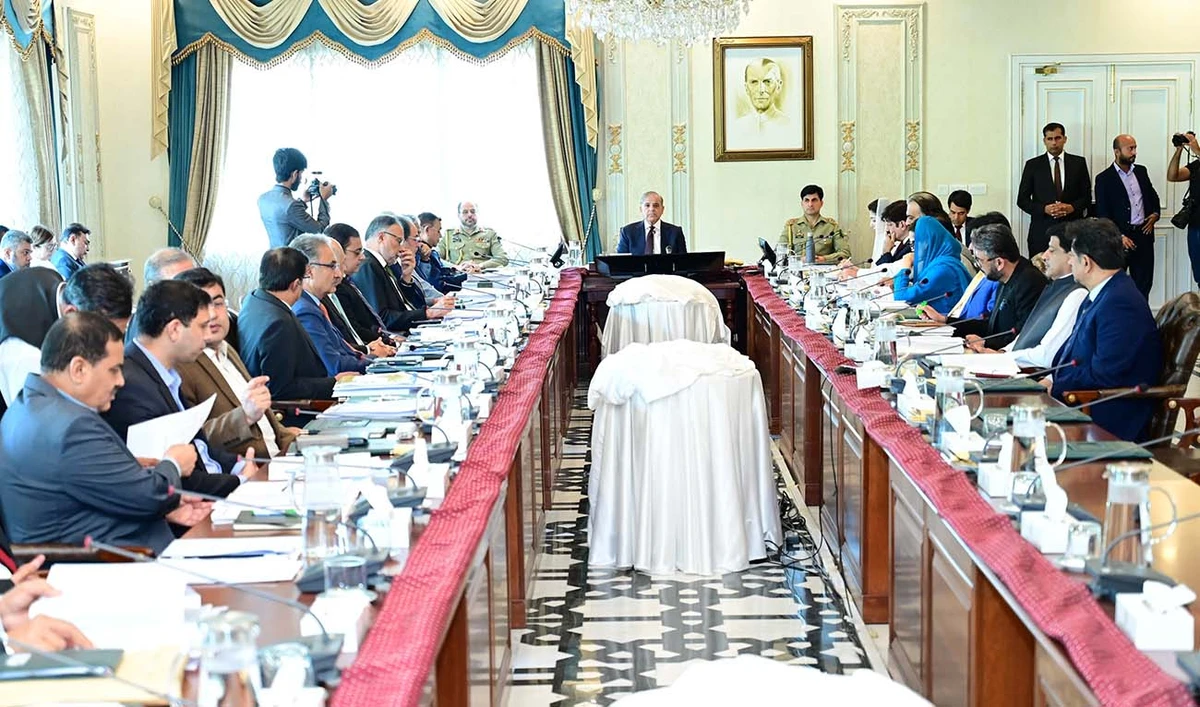
ISLAMABAD: Pakistan’s top economic body on Monday approved various proposals for the upcoming budget with regard to the inclusion of China-Pakistan Economic Corridor (CPEC) and foreign investment projects in the development plan, Pakistan Prime Minister’s Office said.
The statement came after a meeting of the National Economic Council (NEC) in Islamabad, which was presided over by Prime Minister Shehbaz Sharif. The forum reviewed development budget of fiscal year 2023-24 and was briefed on proposals for development plans in fiscal year 2024-25, starting July 1.
Pakistan’s coalition government is expected to lay out ambitious fiscal targets for the fiscal year 2024-2025 (July-June) budget on Wednesday that would help strengthen its case for a new bailout deal with the International Monetary Fund (IMF).
“The council was told that CPEC projects, international investment projects, and ongoing projects close to completion will be given priority in the upcoming development budget,” PM Sharif’s office said in a statement.
“Apart from this, sustainable development goals (SDGs) will be included in the development budget and backward areas will be prioritized in the development budget. The Council approved the said measures.”
Beijing is investing over $65 billion in energy and infrastructure projects in Pakistan as part of CPEC, a major segment of Beijing’s Belt and Road infrastructure initiative, which will connect China to the Arabian Sea and help Islamabad expand and modernize its economy through a network of roads, railways, pipelines and ports in Pakistan.
Along with talks with the IMF to support the dwindling $350 billion economy, Islamabad has also been making ambitious efforts to boost foreign direct investment in the country and has seen a flurry of high-level exchanges with Saudi Arabia, Japan, Azerbaijan, Qatar and other countries in recent months.
Speaking at the meeting, PM Sharif said his government would ensure best utilization of available resources for the economic revival, welfare of the masses and development of the country.
“The federation will ensure consultation with provinces and stakeholders so that decisions are made through collective wisdom and consensus for economic revival of the country,” he said.
The council was also given a detailed briefing on the 13th five-year development plan and informed that the scheme included development of all regions, especially backward areas, increase in exports, promotion of small and medium-scale industries, social security and poverty alleviation, increase in efficiency of workforce, progress in knowledge economy and a strategy to mitigate adverse effects of climate change.
Pakistan is in talks with the IMF for a loan estimated to be anything between $6 billion to $8 billion to avert a default for an economy that is growing at the slowest pace in the region.
While its fiscal and external deficits have been brought under control, it came at the expense of a sharp drop in growth and industrial activity as well as high inflation, which averaged close to 30 percent in the last financial year and 24.52 percent over the last 11 months.
The growth target for the upcoming year is expected to be higher at 3.6 percent compared to 2 percent this year and economic contraction last year.