ISLAMABAD: Pakistan and Afghanistan have agreed to take action against "irreconcilable elements" who pose security threats to either country.
Both countries, who have accused each other of sheltering their armed opponents, also committed to “deny use of their respective territories by any country, network, group or individuals for anti-state activities against either country” under the Afghanistan-Pakistan Action Plan for Peace and Solidarity, APAPPS.
The APAPPS is a joint plan for cooperation in key areas of counterterrorism and for reduction of violence and promotion of peace and reconciliation, involving the repatriation of refugees and joint economic development.
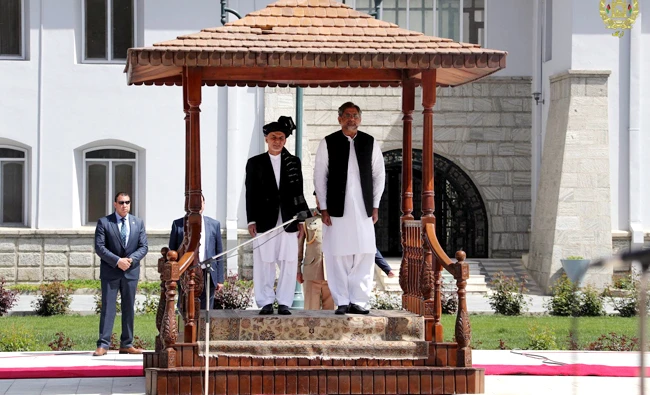
Pakistan Prime Minister Shahid Khaqan Abbasi and Afghan President Ashraf Ghani reached the understanding on Friday in their talks in Kabul which, Afghanistan said, marked the beginning of state-to-state comprehensive dialogue.
“The two countries will undertake effective actions against fugitives and the irreconcilable elements posing security threats to either of the two countries,” an Afghan Foreign Ministry statement said at the conclusion of Abbasi’s day-long visit.
Pakistan has been under pressure from the US and the Afghan government to take action against the Afghan Taliban leaders.
The prime minister’s office said Abbasi welcomed President Ghani’s peace and reconciliation offer to the group and both leaders called on the Taliban to respond positively to the peace offer and join the peace process without further delay.
Afghan Taliban spokesman Zabihullah Mujahid was evasive.
“We do not want to issue any response,” he told Arab News when a query was posted on his WhatsApp. The Taliban political office also did not respond to a question.
Pakistan and Afghanistan will “put in place a joint supervision, coordination and confirmation mechanism through Liaison Officers (LOs) for the realization of the agreed actions,” the Afghan Foreign Ministry’s statement said.
“The two countries commit to avoid territorial and aerial violations of each other’s territory and both will avoid public blame games and instead use APAPPS cooperation mechanisms to respond to mutual issues of contention and concerns,” it added.
Foreign affairs experts in Pakistan believe that the US and Afghanistan have used every option for the settlement and to manage dialogue with the Taliban but they did not succeed as they have not addressed the Taliban’s fundamental demand to end the foreign presence in Afghanistan.
“Americans are badly caught in their own game in Afghanistan. The US has misjudged the war and has committed mistakes,” Pakistan’s former ambassador to Afghanistan Qazi Hamayun told Arab News.
He said the US spends $45 billion annually on its own forces in Afghanistan and $5 on the Afghan forces.
“The money matters and war efforts are not easy,” Hamayun said. He added that the US has now increased the number of troops and will bear more spending.
The former diplomat was not expecting the Taliban to come to the table unless the issue of the presence of the US-led NATO forces is addressed.
“The Taliban want withdrawal of foreign troops. They have been fighting for 17 years. The Taliban cannot take a U-turn as their own commanders can act against their own leaders,” he argued.
Pakistan, Afghanistan to take action against ‘irreconcilable elements’