ISLAMABAD: Pakistan's Foreign Office spokesman has declared there are no plans for talks with India at the Kabul Process conference.
In an interview with Arab News, Dr. Mohammed Faisal dismissed the likelihood of a meeting of the foreign ministers Pakistan and India at the meeting in Afghanistan.
Earlier this week, the US State Department had urged the two South Asian nuclear rivals to hold talks, leading to widespread speculation that bilateral dialogue would take place.
The US has not signaled any intention to mediate between Islamabad and New Delhi as ongoing skirmishes at the disputed Kashmir border threaten regional peace and stability. However, US spokesperson Heather Nauret said: “We think that both sides would certainly have to sit down and have talks about (the cease-fire violations).”
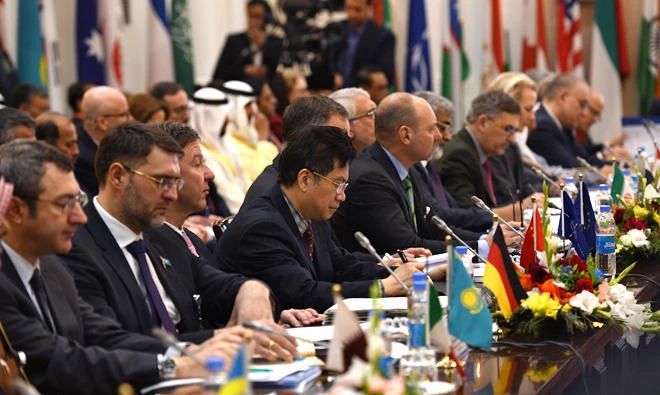
The Kabul process resumed on Wednesday. Twenty five countries as well as the UN and NATO are taking part in the conference. Issues concerning the broader region of South Asia will also be discussed.
Former Pakistani diplomat Salman Bashir welcomed Washington’s statement. “If (the US) is advocating talks, it is good,” he said.
“Talks are needed to bring down the temperature between Pakistan and India,” said Bashir who has served as Pakistan’s Foreign Secretary and High Commissioner to India.
He added that communication is vital first to restore cease-fire, then to establish contacts between the foreign secretaries to resume stalled dialogue.
The National Security Advisers (NSA) of Pakistan and India covertly met in Bangkok, Thailand’s capital city, last December.
The purpose was to chart out viable solutions to reduce tensions between the two countries and open doors to a formal dialogue between them. It is suggested that the two sides have maintained a back channel of communication in the midst of the ongoing row stemming from decades-old disputes.
Tensions between the two nuclear-armed neighbors have reached alarming levels, witnessing an escalation of border skirmishes which have resulted in dozens of deaths of civilians and soldiers along the de facto Kashmir border known as the Line of Control (LoC), and have suspended all official channels of dialogue, raising fears that matters could spiral out of control without negotiations.
“The US is well positioned to bring (India to talks) if they press ahead seriously (which) would be good for the region,” says Bashir.
In an interview with Arab News, Dr. Mohammed Faisal dismissed the likelihood of a meeting of the foreign ministers Pakistan and India at the meeting in Afghanistan.
Earlier this week, the US State Department had urged the two South Asian nuclear rivals to hold talks, leading to widespread speculation that bilateral dialogue would take place.
The US has not signaled any intention to mediate between Islamabad and New Delhi as ongoing skirmishes at the disputed Kashmir border threaten regional peace and stability. However, US spokesperson Heather Nauret said: “We think that both sides would certainly have to sit down and have talks about (the cease-fire violations).”
The Kabul process resumed on Wednesday. Twenty five countries as well as the UN and NATO are taking part in the conference. Issues concerning the broader region of South Asia will also be discussed.
Former Pakistani diplomat Salman Bashir welcomed Washington’s statement. “If (the US) is advocating talks, it is good,” he said.
“Talks are needed to bring down the temperature between Pakistan and India,” said Bashir who has served as Pakistan’s Foreign Secretary and High Commissioner to India.
He added that communication is vital first to restore cease-fire, then to establish contacts between the foreign secretaries to resume stalled dialogue.
The National Security Advisers (NSA) of Pakistan and India covertly met in Bangkok, Thailand’s capital city, last December.
The purpose was to chart out viable solutions to reduce tensions between the two countries and open doors to a formal dialogue between them. It is suggested that the two sides have maintained a back channel of communication in the midst of the ongoing row stemming from decades-old disputes.
Tensions between the two nuclear-armed neighbors have reached alarming levels, witnessing an escalation of border skirmishes which have resulted in dozens of deaths of civilians and soldiers along the de facto Kashmir border known as the Line of Control (LoC), and have suspended all official channels of dialogue, raising fears that matters could spiral out of control without negotiations.
“The US is well positioned to bring (India to talks) if they press ahead seriously (which) would be good for the region,” says Bashir.