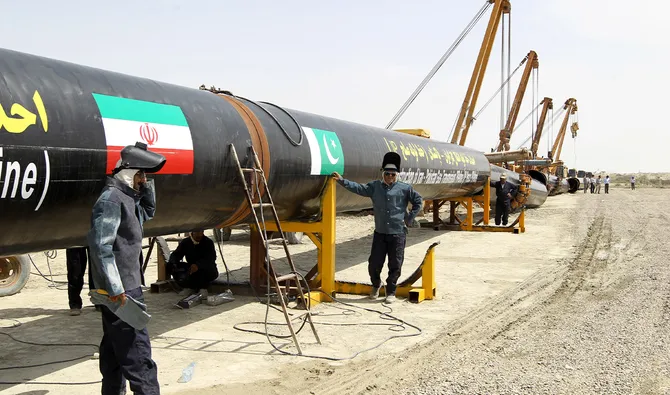
- The 1,900-kilometer pipeline was meant to supply Pakistan 750 million to one billion cubic feet per day of natural gas for 25 years
- Tehran, which says it has invested $2 billion to construct the pipeline, filed an international arbitration case in Paris in 2024
ISLAMABAD: Prime Minister Shehbaz Sharif has constituted a committee to work out a mutually acceptable resolution of the Pakistan-Iran gas pipeline issue to balance Pakistan’s potential financial liability arising from arbitration with its future energy requirements, Pakistani state media reported on Tuesday.
The 1,900-kilometer (1,180-mile) pipeline was meant to supply 750 million to one billion cubic feet per day of natural gas for 25 years to meet Pakistan’s rising energy needs. Tehran says it has invested $2 billion to construct the pipeline on its territory.
Pakistan, however, did not begin construction, citing international sanctions on Iran as the reason. In 2014, Islamabad asked for a 10-year extension to build the pipeline that expired in Sept. 2024, prompting Iran to file an international arbitration case in Paris over project delays.
Responding to a question in the Senate on Tuesday, Petroleum Minister Ali Pervaiz Malik said the committee is examining the legal, financial and energy dimensions of the stalled project with a view to finding a solution in Pakistan’s national interest.
“The leadership of the two countries remained fully engaged in efforts to reach an amicable settlement acceptable to both sides,” Malik was quoted as saying by the state-run APP news agency.
Pakistan, whose domestic and industrial users rely on natural gas for heating and energy needs, is in dire need for cheap gas, with its own reserves dwindling fast and disruptions in the Strait of Hormuz making supplies difficult and expensive.
Iran has one of the world’s largest gas reserves but sanctions by the West and political turmoil have slowed its development as an exporter.
Tehran has already made substantial physical progress on the pipeline on its side and brought gas from the South Pars field to a major city close to the Pakistan border, according to the Malik.
The matter had gone into arbitration in Paris that made it important for Pakistan to carefully handle the potential liability associated with the project. The government wanted to avoid further complications in litigation and is now working toward a negotiated resolution with Iran.
The committee is looking at the “potential liability facing Pakistan, the implications of litigation and the country’s future energy requirements to determine a way forward” on the project, Malik added.